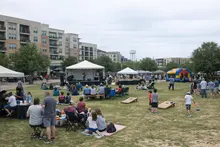
Mueller’s pocket parks are busy by day and its restaurants glow after dark — a planned neighborhood built for strolling, shopping and living close to it all. That mix also brings the everyday churn of public-safety calls. The city’s incident logs show the kinds of cases that ripple through dense, mixed-use districts like this one: car break-ins near garages, family disturbances at all hours, and the occasional serious violent offense that draws a heavier response.
What the data shows
APD’s public incident database on the City of Austin data portal is a running ledger of reports written by officers, updated weekly and spanning back to 2003. Only the most serious offense tied to an incident is shown, a standard that simplifies the view but means some secondary crimes aren’t listed in the same entry, according to the City of Austin Data Portal.
In recent days, the log reflects the kinds of incidents that routinely touch neighborhoods with Mueller’s mix of homes, garages and storefronts. Representative examples from APD’s dataset include:
- “BURGLARY OF VEHICLE” at 11/25/2025 19:24 in “PARKING /DROP LOT/ GARAGE” (Incident 20259031542).
- “AUTO THEFT” at 11/26/2025 06:53 in “PARKING /DROP LOT/ GARAGE” (Incident 20253300279).
- “BURGLARY OF VEHICLE” at 11/26/2025 07:47 in “PARKING /DROP LOT/ GARAGE” (Incident 20253300343).
- “THEFT BY SHOPLIFTING” at 11/25/2025 12:35 in “GROCERY / SUPERMARKET” (Incident 20253290639).
- “FAMILY DISTURBANCE” at 11/25/2025 04:28 in “RESIDENCE / HOME” (Incident 20253290184) and again at 11/26/2025 12:19 in “RESIDENCE / HOME” (Incident 20253300572).
- “ASSAULT W/INJURY-FAM/DATE VIOL” at 11/25/2025 16:01 in “RESIDENCE / HOME” (Incident 20253290930).
- “KIDNAPPING FAM VIO” at 11/25/2025 17:52 in “RESTAURANT” (Incident 20253291071).
The dataset also records evening and overnight patterns that residents often talk about: a string of auto thefts clustered around the dinner hour and late at night (for example, “AUTO THEFT” at 11/25/2025 18:24 in “PARKING /DROP LOT/ GARAGE,” Incident 20253291123; and “AUTO THEFT” at 11/29/2025 20:15 in “PARKING /DROP LOT/ GARAGE,” Incident 20253331108), and recurring property crimes in commercial settings, such as “THEFT” at 11/26/2025 12:19 in a “SHOPPING MALL” (Incident 20253290634) and “THEFT” at 11/29/2025 08:24 in a “GROCERY / SUPERMARKET” (Incident 20253330393).
Because APD lists only the top charge per incident, an entry such as “ASSAULT WITH INJURY” at 11/29/2025 18:23 in a “PARKING /DROP LOT/ GARAGE” (Incident 20253330959) may reflect a situation where other violations occurred but are not displayed. That reading is consistent with the portal’s methodology note that the most serious offense per incident is shown and that the database is refreshed weekly, as described by the City of Austin Data Portal.
Police and community responses
Citywide, violent crime trends have shown improvement this year. During the first half of 2024, Austin saw a 6% decline in violent crime and a 17% drop in homicides compared with the first half of 2023. The Austin Police Department credited 911 upgrades, community violence-prevention efforts, strengthened police support, and the graduation of new cadets for those gains, according to Axios.
On the investigative front, APD’s homicide unit reported an uncommon milestone last year: clearing every homicide case it handled. There were 75 homicides in 2023, and APD said it cleared 100% of them. “Each of those cases represent a person whose life was taken and a family left searching for justice. To solve every single one of those cases is not only rare, it is exceptional,” said Lisa Davis, Police Chief. Fox 7 Austin.
At the same time, the department continues to operate with fewer officers than its ideal staffing level. Reporting from Community Impact notes roughly 1,482 officers on duty versus an estimated ideal of about 1,800, with business owners linking staffing strain to concerns about property crime and delays for non-urgent responses, according to Community Impact. Those operational realities can shape how quickly lower-level offenses are addressed in busy districts as calls stack up.
How reporting has changed
Transparency advocates have pushed APD to restore the department’s regular publication of clearance rates and other yearly metrics. KUT reported that the department stopped routinely releasing annual crime and traffic reports after 2021, which left the public with fewer ways to assess case-solving numbers across categories, as noted by KUT. The Austin Monitor similarly highlighted concerns that gaps in published clearance-rate data can undercut public trust and the deterrent value of making clear how often crimes are solved.
Understanding the numbers also requires tracking how APD and other agencies report them. The FBI’s crime-collection system shifted in recent years from the Uniform Crime Reporting summary method to the National Incident-Based Reporting System (NIBRS). Under UCR, only the most serious offense in an incident was counted; NIBRS requires reporting of all offenses — changes that make direct comparisons tricky across eras. APD began complete NIBRS submissions in 2019, as explained by Patch.
Those methodological realities mirror the design of the city’s incident portal: it shows a single top charge per entry even when officers documented more. The portal’s metadata underscores that distinction and that the database is refreshed weekly, which means trend snapshots can shift as cases are updated on the City of Austin Data Portal.
What this means in Mueller
For Mueller residents, the city’s incident log is a practical pulse check. The recent pattern of vehicle crimes in garages and lots — from “BURGLARY OF VEHICLE” at 11/28/2025 22:27 in a “PARKING /DROP LOT/ GARAGE” (Incident 20253321243) to “AUTO THEFT” at 11/29/2025 20:46 in a “PARKING /DROP LOT/ GARAGE” (Incident 20253331108) — lines up with precautions neighbors often take around busy town-center garages and surface lots. Family-related calls show up morning, afternoon and late night across “RESIDENCE / HOME” entries — a reminder that domestic safety is a daylong effort.
The bigger picture is a study in contrasts: Austin’s progress on violent crime and strong homicide investigations, reported by Axios and Fox 7 Austin, alongside ongoing questions about clearance-rate transparency and the strain of fewer officers on the street, raised by KUT and the Austin Monitor and detailed by Community Impact.
As the city moves through the holidays and into a new year, Mueller’s daily rhythms — kids at the playscapes, couples headed to dinner, workers parking for late shifts — will continue to show up in the numbers: vehicle crimes clustered around garages and curbside parking, shoplifting and fraud in retail corridors, and a steady cadence of family-related calls behind closed doors. The tools to track those patterns are improving, the police force is rebuilding, and the public push for clearer reporting is unlikely to fade. For neighborhoods like Mueller, the goal is simple enough: keep enjoying the sidewalks — and keep an eye on the log.