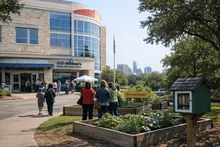
Austin has never needed much convincing to show up for its neighbors—especially when the cause is health, hope, and the kind of support that can carry families through their hardest seasons. On March 21, that spirit will be on full display as the city gathers for the Race to Cure Sarcoma (RTCS) Austin, a community run and walk designed to raise awareness of sarcoma, celebrate survivors, and honor those lost to a rare cancer that too often goes unseen.
The invitation is straightforward: come as you are, bring who you love, and move forward together.
The Race to Cure Sarcoma takes place March 21 from 7:00 AM to 11:30 AM at Lake Park Amphitheatre, 4550 Mueller Blvd, Austin, TX 78723. The event includes a 5K run and a 1-mile walk, welcoming runners chasing a personal best, families pushing strollers, friends walking in memory, and neighbors who simply want to stand beside those living with sarcoma.
At its heart, the mission is as personal as it is public: to celebrate survivors, honor those lost, support current patients, and build much-needed awareness for sarcoma. RTCS Austin, as listed by Life at Mueller, brings together hundreds of community members impacted by the disease—people who understand that showing up in a crowd can be its own kind of medicine.
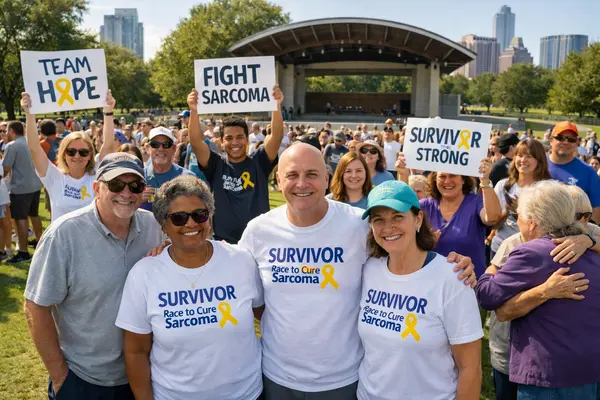
That sense of togetherness matters because sarcoma can be isolating. It’s rare, and that rarity can make it harder to recognize—sometimes even inside the exam room. “Our ‘Days to Diagnosis’ initiative reveals a stark reality – the path to a sarcoma diagnosis is often fraught with challenges. Many healthcare professionals are unfamiliar with sarcoma symptoms, and the referral process can be frustratingly complex and inconsistent across regions,” said Richard Davidson, Chief Executive of Sarcoma UK. https://sarcoma.org.uk/news/sarcoma-awareness-month-launches-with-dont-delay-campaign-to-spotlight-early-diagnosis/?utm_source=openai
For patients and caregivers, delays and detours on the road to diagnosis aren’t abstract problems—they shape treatment options, timelines, stress, and outcomes. An awareness event can’t fix every systemic barrier, but it can change the trajectory of a conversation: prompting someone to pay attention to a symptom that lingers, encouraging families to seek follow-up, and reminding communities that rare cancers still demand common purpose.
Austin is uniquely built for that kind of collective response. The city’s estimated population—about 993,588 as of 2024—creates the critical mass that helps community health efforts reach beyond a single circle of friends, according to the U.S. Census Bureau. Yet the city can still feel like a network of neighborhoods, where people recognize each other at the park, on the trail, or at a weekend market.
That combination—a big city with a small-community reflex—matters in a place with a median age of 34.5 and substantial diversity, where residents often show up for one another across backgrounds and generations. Data from Texas Demographics describes Austin as 47.6% White non-Hispanic, 32.2% Hispanic/Latino, 8.5% Asian, and 7.5% Black/African American, with a median household income of $91,461. Those numbers don’t just sketch a civic profile; they help explain why so many local causes find traction here. Austin is a city where a Saturday morning event can become a bridge—between fitness and advocacy, grief and action, personal story and public awareness.
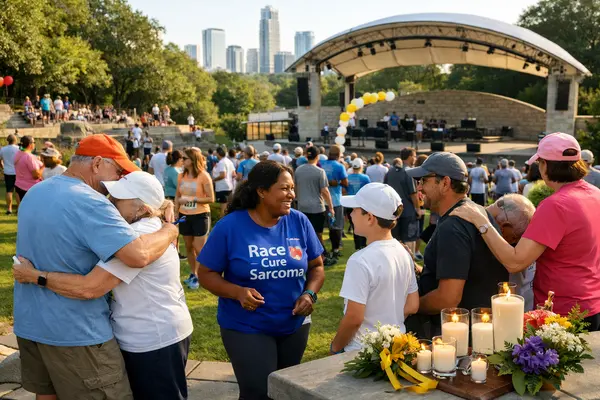
And in many ways, a run or walk is the perfect vehicle for that bridge. The American Cancer Society has long framed these gatherings as moments when “walkers, runners, and volunteers come together to honor cancer survivors, raise awareness about reducing cancer risk, and raise money to bring hope to cancer patients,” according to the American Cancer Society. RTCS Austin fits that tradition, offering a format that welcomes a wide range of abilities while creating a shared finish line.
For people touched by sarcoma, the day can hold multiple meanings at once. It can be celebratory—another scan behind you, another year of remission, another day strong enough to walk with your family. It can also be tender, with names spoken aloud and memories carried mile by mile. Events like this make room for both realities: the joy of surviving and the ache of loss, the strength of caregivers and the vulnerability of patients still in treatment.
The call for awareness is urgent, and not only because sarcoma is rare. Public figures who’ve amplified the cause often stress how much is still unknown outside the sarcoma community. “Everyone needs all the awareness of sarcoma they can get. Twelve thousand people get diagnosed a year. That's too many,” said Peri Gilpin, Actress. https://quotedark.com/quote/everyone-needs-all-the-awareness-of-sarcoma-they__peri-gilpin?utm_source=openai
In Austin, the power of that message lies in how quickly it can travel when people decide to carry it. In a city built around movement—morning runs along neighborhood paths, walks to coffee, bike rides under big skies—the Race to Cure Sarcoma turns everyday motion into a public statement: you are not alone, and your story matters here.
Mueller’s Lake Park Amphitheatre offers a fitting setting for that statement—an open, welcoming space in a part of town known for gathering. On March 21, the park won’t just be another place to pass through; it will be a place to pause, connect, and commit to learning more about a cancer that can be difficult to spot and hard to name.
Whether you arrive as a survivor, a caregiver, a friend who wants to do something concrete, or a neighbor who simply believes health advocacy belongs to the whole city, the morning promises a simple kind of solidarity. In a community as large—and as close-knit—as Austin can be, a few steps taken together can ripple outward: into conversations, into awareness, and into the steady reminder that when one family faces sarcoma, the whole city has room to help carry the load.