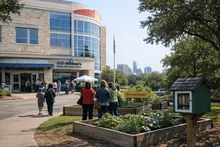
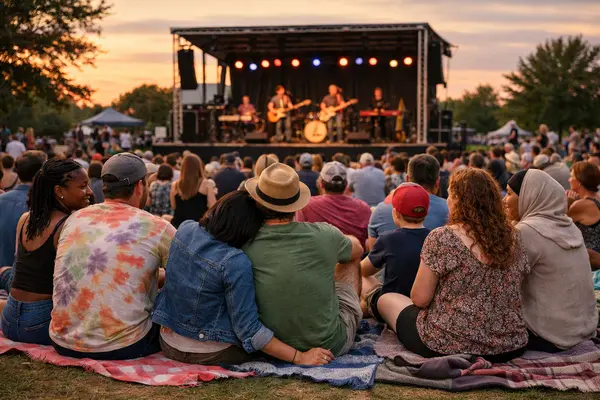
The sun starts to drop behind the trees at Mueller Lake Park, turning the water into a ribbon of copper. Parents tug wagons and tote diaper bags; couples arrive with dogs on leashes; kids do that pre-show thing—restless loops around the lawn, then a sudden stop to stare at the stage as the soundcheck blooms into something like a promise. By the time the first beat lands, blankets have stitched the amphitheater into a patchwork quilt of neighbors: longtime Austinites, newcomers, stroller brigades, music nerds, friends who only see each other outdoors when the weather turns forgiving.
This is the atmosphere KUTX 98.9’s Rock the Park has cultivated over 16 seasons—less “concert” in the traditional sense than a monthly, open-air gathering where the city’s love of live music shows up in comfortable shoes. It’s loud enough to feel in your chest and gentle enough to leave space for conversation, snacks, and the little rituals that make public life feel humane: saving a spot for late arrivals, sharing sunscreen, applauding not just the headliner but the whole idea of showing up.
This spring, Rock the Park returns for its 17th season at Mueller Lake Park Amphitheater, again offering free, family-friendly Friday-night shows that lean into what Austin does best—making local music feel like a civic resource. Presented by Dell Children’s Medical Center, part of Ascension Seton, the series keeps its focus on high-energy performances, sing-alongs, and dance-ready grooves from homegrown artists, staged in a setting that welcomes all ages.
That welcome is practical, not performative. Rock the Park encourages guests to bring blankets or stadium cushions, and well-behaved pets on leashes are part of the scene. The ground rules are designed to keep the park safe and comfortable—no chairs, no glass containers, no alcohol—so the lawn stays open and the night stays uncomplicated. And because a truly public event has to be accessible in more than name, Rock the Park also offers reserved seating for guests with limited mobility, including pregnancy, along with ASL interpretation. Additional accommodation requests can be arranged in advance.
It’s the kind of detail that shapes a night: when someone who doesn’t usually feel welcome in a crowd can settle in without fuss, the music lands differently. The park becomes what it’s supposed to be—shared.
A lineup that sounds like Austin—right now
Rock the Park has always worked best as a snapshot of the city’s creative present: not a museum of what Austin used to be, and not a hype reel chasing whatever trend is loudest, but a curated cross-section of scenes that overlap in backyards, clubs, and studio spaces across town. This season’s bill—anchored by Dorio, francene rouelle, and The Animeros, along with SaulPaul, Bananner Man, and DJ Jester the Filipino Fist—leans into that blend.
First up on March 27 is Dorio, an indie pop duo that makes dreamy, retro-tinged electronic pop with a playful, eclectic edge. Their songs feel like neon reflected in water—bright and a little nostalgic without getting stuck in the past. They’re the kind of act that turns a park into a dance floor without asking anyone to be cool about it: kids bounce, adults sway, and the chorus becomes a friendly group project.
On April 10, SaulPaul brings a different kind of electricity—built live, in real time. He’s known for producing catchy, layered beats on the fly while freestyling about everything from self-respect to the importance of family and friends. In a city that can sometimes mistake irony for personality, SaulPaul’s approach is refreshingly direct: music as encouragement, rhythm as a way to say what we mean.
That same night features francene rouelle, a rising voice crafting heartfelt dance pop paired with dynamic visuals. Signed to Austin’s Asian-American label mhart, she represents the way the city’s musical identity keeps widening—not just in sound, but in who gets centered onstage. Her songs are built to move bodies, but there’s tenderness underneath the pulse, the kind of emotional clarity that plays well under an open sky.
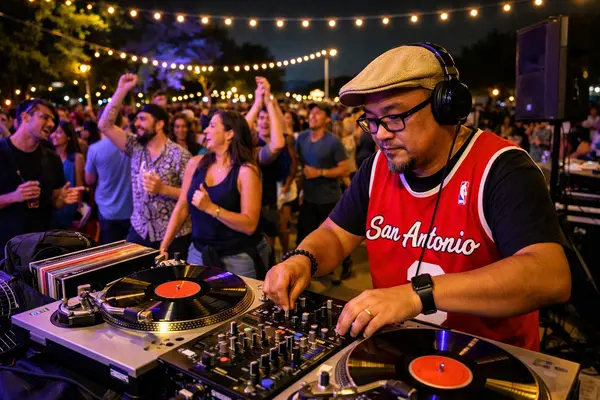
Then on May 15, the series leans into pure motion with DJ Jester the Filipino Fist, a Texas-based turntablist known for high-energy, genre-bending vinyl sets that stitch together hip-hop, funk, pop, and country. It’s the sound of an Austin night out condensed into a single set: borderless, unbothered by purists, powered by joy.
Headlining that final spring show are The Animeros, who blend cumbia-inflected psychedelic rock with driving rhythms and dance-ready songs—music that doesn’t just invite movement, it assumes it. With new music released via Dan Auerbach’s Easy Eye Sound, the band embodies a familiar Austin story: local roots meeting wider ears without losing the neighborhood heartbeat.
Behind the scenes, the season is curated by KUTX 98.9 Live Music Booker Deidre Gott and Bill Childs, host of KUTX’s Sunday-evening kids’ show Spare the Rock, Spoil the Child. Their programming approach is part of what makes Rock the Park feel less like a one-off event and more like a community anchor: it’s not simply about booking talent; it’s about building a tradition that teaches the next generation what live music can feel like when it’s close, affordable, and welcoming.
A joyful tradition, in a city where making music is getting harder
It’s tempting to treat a free concert series as an uncomplicated good—an easy win in a city that loves to brand itself with guitars and slogans. But Rock the Park’s importance lands differently when you look at what it costs, now, to make a life in Austin while making art.
The 2022 Greater Austin Area Music Census put hard numbers on what musicians have been saying in green rooms and group chats for years. Data highlighted on the Austin Music Census shows that nearly 38% of respondents reported difficulty paying for housing, and about one-third said they were considering leaving the area within three years. Reporting from the Austin Monitor underscored the same reality: rising costs aren’t just a lifestyle inconvenience—they’re a threat to whether artists can remain in the city that depends on them.
And it’s not only performers feeling the squeeze. “Musicians, venue owners, educators, technicians, and promoters are all part of our music ecosystem and are collectively the people that make us the live music capital. We need to support and protect these people in order to strategically sustain our music economy. The Greater Austin Area Music Census will do that by allowing us to see who and where they are.” — Steve Adler. https://www.austinmusiccensus.org/?utm_source=openai
If housing is the headline, wages are the quiet, grinding subhead. “I think we know, anecdotally, that there’s some stagnation of wages,” — Bobby Garza. https://www.kut.org/austin/2022-07-19/austin-music-census-2022?utm_source=openai
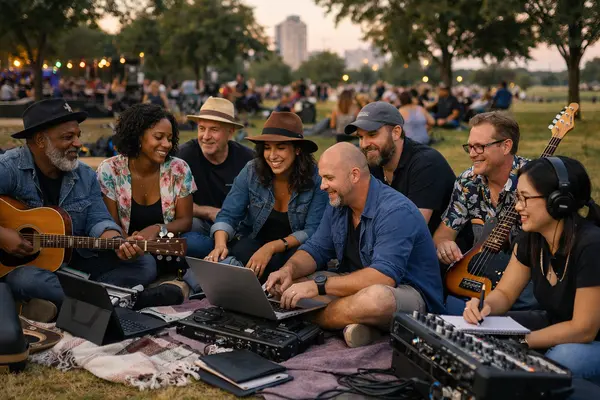
Those pressures hit hardest for the kinds of artists who animate lineups like Rock the Park’s: local acts building careers one show at a time, stitching together income from gigs, teaching, freelance work, and side jobs—often while trying to remain present for family and community. When a city becomes too expensive for its working creatives, it doesn’t just lose bands; it loses the everyday cultural infrastructure that makes music a shared language.
The boom in live music—and the fight to keep it local
The strain on Austin’s music ecosystem is unfolding at a moment when demand for live music has roared back globally. After pandemic shutdowns, audiences didn’t just return—they surged. As reported by the Press Herald, a Live Nation report found that “Attendance jumped 20% to a staggering 145 million in 2023, compared with the previous year.” — Live Nation report. In that same reporting, Live Nation CEO Michael Rapino captured the industry’s optimism in a single line: “This is going to be a great year,” — Michael Rapino. https://www.pressherald.com/2024/02/23/a-swift-rebound-and-unprecedented-tickets-sales-for-live-music-after-pandemic-shut-venues-down/?utm_source=openai
That boom has a local shadow side. When demand spikes, ticket prices often follow, and the live-music economy can tilt further toward the biggest tours and the deepest pockets. Outdoor, free community series like Rock the Park offer a counterbalance—a reminder that live music isn’t only an elite experience behind a service fee; it’s a public good, a shared night in the park, a chance for a kid to see a band up close and decide, privately and powerfully, I want to do that.
Austin’s reputation as the “Live Music Capital of the World” is tied to its density of venues and breadth of genres, as noted in an overview of the city’s cultural identity on Wikipedia. But a slogan can’t play a set. People do—musicians and the workers who support them, the audiences that keep showing up, and the institutions that make room.
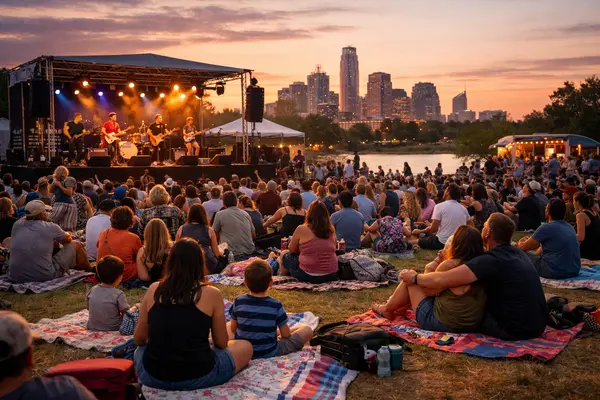
It’s why a simple night at Mueller Lake Park can feel like more than entertainment. It’s civic life with a backbeat, a way of insisting that the city’s music culture is still something you can participate in without buying your way in.
That culture has long been a magnet. “The Austin music scene is the reason why so many of them moved here.” — Bob Livingston. https://fixquotes.com/quotes/the-austin-music-scene-is-the-reason-why-so-many-41319/?utm_source=openai
Rock the Park makes that sentence tangible: people don’t just move to Austin for the idea of music; they stay out late on a Friday with their neighbors and their kids and their dogs, and they build a memory around a chorus they didn’t know they needed.
A small act of resistance, wrapped in a tradition
There’s a particular kind of hope embedded in free, all-ages events—especially ones that have lasted long enough to become generational. Seventeen seasons is long enough for a toddler on a blanket to become a teenager at the rail, long enough for a young band to grow into a scene staple, long enough for a neighborhood to measure time by what song was playing the first time someone danced in the grass.
This spring’s Rock the Park lineup is built for that continuity: indie pop that feels like a daydream, dance pop with a beating heart, freestyle that speaks directly to how we treat ourselves and each other, turntablism that refuses genre boundaries, psychedelic cumbia-rock that turns the park into a moving crowd. It’s Austin in miniature—diverse, inventive, open-armed.
And in an era when the city’s creative class is being priced and pressured, the series’ simple premise reads as a quiet kind of advocacy: keep the gates open, keep the music local, keep the gathering accessible. If Austin’s live-music identity is going to endure, it won’t be sustained only by headlines or marquee festivals. It will be sustained by nights like these—when the sky stays wide, the lawn stays full, and the soundtrack belongs to everyone.