
How did Texas gun law loopholes enable the recent West Sixth Street mass shooting in Austin by a suspect with a documented history of domestic violence?
That question hangs over downtown like the echo of gunfire that turned a packed nightlife corridor into a triage zone—three people dead, including the suspect, and 14 injured—and it demands a harder answer than condolences.
Court records show the man suspected of opening fire near West Sixth Street had a documented history of family violence. Yet under Texas law, that history did not automatically translate into a durable, enforceable barrier to gun possession. Not because the danger was unknowable—but because the legal system, in critical and predictable ways, is built to treat domestic violence as a private problem until it becomes public bloodshed.
The chain of failure starts with what Texas does prohibit, then widens into what Texas doesn’t—and what it often can’t or won’t enforce.
The five-year ban that sounds stronger than it is
Texas does have a firearm prohibition tied to certain domestic violence convictions. But its reach is narrow and its timeline finite.
Under Texas law, a conviction for certain domestic violence misdemeanors—specifically, Class A misdemeanor assault involving bodily injury against a family or household member—triggers a prohibition on possessing a firearm for five years after the person is released from confinement or community supervision, according to the Giffords Law Center.
On paper, that looks like a safeguard. In practice, it’s an obstacle course of conditions—Class A, bodily injury, family or household member, and a five-year clock that eventually runs out.
Each of those qualifiers can become a hole.
Domestic violence cases are frequently charged, negotiated, or pled down in ways that matter enormously later. If the conviction is not the specific Texas offense that activates the five-year prohibition described by Giffords—or if the case ends in a way that does not count as that qualifying conviction—Texas law may never trigger the ban. Even where it does, the law’s own expiration date can function like a countdown to rearm.
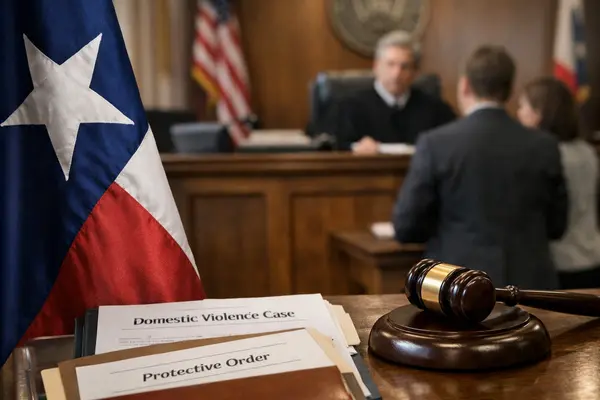
And even when a person is prohibited, the state still has to connect the dots: courts, clerks, prosecutors, and law enforcement must ensure the outcome is correctly recorded and enforceable, and that firearm access is actually interrupted—not just discouraged.
Where the law falls short: relationship gaps and the “boyfriend loophole”
A central failure point is the scope of who is protected.
Texas restrictions, as summarized by Giffords, focus on family or household relationships—language that can leave dangerous gaps for people harmed by dating partners who do not fit neatly into statutory definitions, and for those targeted by coercion and violence that never results in the “right” conviction.
This is why advocates and some in law enforcement have long warned about the real-world effect of the so-called “boyfriend loophole”—a shorthand for policies that fail to disarm abusive dating partners.
Houston Police Chief Art Acevedo put that political and moral divide bluntly years before Austin’s West Sixth Street shooting forced the issue back into the open.
“You’re either here for women and children … or you’re here for the NRA,” said Art Acevedo, then Houston police chief, in remarks reported by The Texas Tribune.
Acevedo’s critique wasn’t rhetorical flourish. It was an indictment of a policy environment where lawmakers repeatedly decline to close predictable gaps—and where those gaps are most lethal inside intimate relationships.
Federal law, Supreme Court scrutiny, and Texas enforcement reality
Federal law contains its own prohibitions related to domestic violence—often stronger in duration than Texas’ five-year state restriction for certain misdemeanors. But federal protections are only as effective as the state-level systems that identify qualifying cases, notify the right databases, and remove guns in time.
That is the friction point survivors live with: the difference between a legal theory and an abuser’s immediate access to a weapon.

The U.S. Supreme Court’s modern Second Amendment era has also pulled domestic-violence firearm restrictions into a broader constitutional fight, forcing states and local jurisdictions to defend gun removal laws against aggressive challenges. Those cases can create uncertainty, delays, and uneven enforcement—conditions that compound an already fragile protective-order system.
For Emilee Whitehurst, president and CEO of the Houston Area Women’s Center, that uncertainty isn’t academic.
“It is outrageous survivors in Texas lost this critical life-saving strategy for any period of time, especially knowing guns are the leading cause of domestic violence homicides,” said Emilee Whitehurst, President and CEO of the Houston Area Women’s Center, in a statement published by HAWC.
Her point is not just that firearm surrender works. It’s that time—days, weeks, months of litigation or inconsistent practice—is itself a risk factor. A system that restores weapons, stalls surrender, or fails to act on a protective order is a system that gambles with a survivor’s life.
The numbers Texas lives with, year after year
West Sixth Street was a mass shooting. But the engine behind it—domestic violence and gun access—feeds a wider toll that rarely receives the same sustained attention.
Data from the Johns Hopkins University Center for Gun Violence Solutions shows that in 2022 Texas recorded at least 186 domestic violence-related homicides, and 66% involved a firearm.
That statistic should end any lingering pretense that guns are incidental in domestic violence. In Texas, they are a primary method.
The policy implication is as uncomfortable as it is direct: any legal structure that allows known abusers to retain or regain firearms isn’t a niche failure. It is a statewide, measurable driver of death.
Austin’s local protocol tries to do what state law often doesn’t: take the gun now
In Travis County, local officials have pushed a more immediate intervention model—one that treats firearm removal as a practical public-safety task, not a symbolic legal clause.
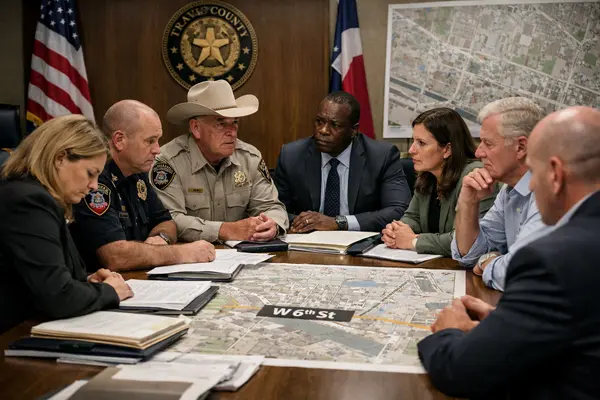
The City of Austin has highlighted a firearm surrender protocol connected to protective orders. “Protective Orders can require an abuser to temporarily surrender any firearms, reducing the danger to everyone involved,” the city says on its public safety resources page. City of Austin
The significance isn’t merely procedural. Protective orders are often the brief window when the system recognizes danger while the victim is still alive to ask for help. A surrender protocol tries to make that window actionable.
But a local protocol cannot fully patch a state framework that is both limited in who it disarms and inconsistent in how it ensures guns are actually surrendered. Even when judges order relinquishment, compliance can hinge on whether someone verifies surrender, whether law enforcement has capacity to retrieve weapons, and whether the court has teeth to act quickly when an abuser doesn’t cooperate.
Political pressure rises—then hits the familiar wall
In the aftermath of the West Sixth Street shooting, elected officials faced a question the community has asked after every high-profile attack: what now, and who will be held responsible for preventing the next one?
“We must end America’s gun violence epidemic,” said U.S. Rep. Greg Casar, who represents parts of Austin, in a public statement reported in the entry on the shooting by Wikipedia.
Casar’s framing—epidemic, not anomaly—matters. It shifts responsibility from individual pathology to public policy: laws, enforcement systems, and the officials who choose what risks are acceptable.
That shift is precisely what gun-law debates in Texas often resist. The state’s political gravity has long favored expanded carry rights, reduced permitting barriers, and narrow prohibitions—an approach that assumes the cost of access is manageable until a mass shooting, or an intimate-partner homicide, makes the cost visible.
In Austin after the attack, that visibility has been amplified by grief and by fear, but also by demands for accountability. Vigils and community meetings have become pressure valves; protests and public forums have become a chorus. Survivors’ advocates have argued that the state’s refusal to fully close domestic-violence loopholes isn’t a legislative oversight—it’s a choice that reverberates in emergency rooms, funerals, and courtrooms.
The mechanics of preventable violence
The most damning part of the West Sixth Street case is not that it exposes a gap in the law. It’s that the gap is familiar.
A documented history of violence should be the clearest warning label a justice system can generate. Yet Texas’ principal state-law response to certain domestic-violence misdemeanors—a five-year prohibition, tightly tied to a specific conviction category described by Giffords—can leave people armed when prosecutors plead cases down, when relationships fall outside statutory definitions, or when the surrender process is weak.
Those are not abstract loopholes. They are operational failures—points where the system declines to convert known risk into physical safety.
West Sixth Street will be remembered for the chaos of one night: the sudden sprint for cover, the frantic calls, the desperate pressure on wounds. But the longer story—the one lawmakers and courts will be forced to answer for—is how a state that knows domestic violence is a leading precursor to homicide continues to tolerate firearm access for people with histories that should have stopped them long before the first shot was fired.