On a recent afternoon in Austin’s Mueller neighborhood, the latest entrant in the last‑mile race wasn’t a van or a bike—it was a knee‑high, sensor‑rimmed cart rolling toward a front door. H‑E‑B quietly launched a pilot in May to send autonomous robots trundling short distances from its Mueller store, a hyperlocal experiment with the potential to change how a dense, walkable community gets milk, snacks and missing dinner ingredients, according to Austin American-Statesman.
How the robots work
Built by Austin‑based Avride, the compact vehicles are designed for small, quick orders rather than a week’s worth of groceries. The pilot serves addresses within roughly a one‑mile radius of the store and runs daytime hours—reported between about 11 a.m. and 7 p.m.—with each robot carrying up to 10 small items per trip, according to Austin American-Statesman. Inside, insulated compartments can be partitioned to keep hot, fresh, cold and frozen goods separate, with capacity described as the equivalent of six pizzas and five large bottles of soda, the outlet reported, citing H‑E‑B and Avride details provided for the trial (Austin American-Statesman).
Navigation is handled by a layered suite of sensors. Avride’s bots use LiDAR, cameras and ultrasonic sensors to map the sidewalk, detect pedestrians and avoid obstacles at modest speeds—about 3 to 5 miles per hour. They’re built to operate in varied weather conditions, which matters in a city where blazing sun and pop‑up thunderstorms often share the day, according to Austin American-Statesman.
The upshot is a service tuned to the rhythms of a neighborhood errand: the missing cilantro, the last‑minute dessert, the snacks for a spur‑of‑the‑moment movie night. It’s not trying to replace a full grocery run; it’s meant to tuck into the gaps where speed, affordability and a short hop are the value proposition, according to Austin American-Statesman.
Why Mueller, why now
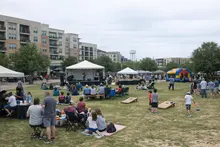
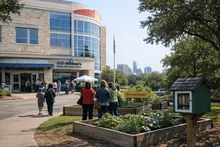
Mueller’s demographics make it a natural laboratory. The 700‑acre, master‑planned district east of downtown is dense with townhomes, apartments and street‑front retail, and it skews young, educated and professional. The neighborhood has about 7,901 residents with a median age of 37 across roughly 3,898 households; individual incomes average around $75,424, and educational attainment is unusually high, with about 78.6% holding at least a bachelor’s degree and 38.7% an advanced degree, according to RealtyTips. Those patterns typically align with early adoption of convenience tech and willingness to try new services that shave minutes from busy days.
For H‑E‑B, the pilot fits a century‑long habit of operational tinkering. Founded in 1905 by Florence Butt, the company grew under Howard Edward Butt by rethinking the basics—streamlining distribution, pivoting from credit‑and‑delivery to self‑service, and introducing air conditioning and frozen foods by 1942. Today it spans more than 440 stores across Texas and Mexico, with recent revenues reported around $46.5 billion—scale that lets it test ideas like sidewalk robots without betting the whole chain, according to MySanAntonio.
The grocery robot push lands amid a broader experimentation in autonomous delivery. In Phoenix, Waymo and DoorDash have teamed up to dispatch full‑size self‑driving cars for grocery drop‑offs, with customers retrieving orders from an autonomous vehicle’s trunk—an altogether different approach from small sidewalk bots, as reported by Business Insider. DoorDash is also rolling out its “Dot” robot in select markets, a higher‑capacity unit that can carry up to 30 pounds and travel at speeds up to 20 mph, signaling a race to cover more distance and payload than most neighborhood robots are designed to handle, according to AP News.
If the national players are pushing range and capacity, H‑E‑B’s Mueller test is staking out the opposite: ultra‑short trips and small orders through compact devices that thread sidewalks and crosswalks. The question is less “Will this replace delivery drivers?” and more “Where does this fit?”—as a complement to curbside pickup, traditional delivery and the in‑store experience.
Early signals suggest many Texans are acclimating to automation without the sky falling. Nearly 40% of firms in the state already use AI, and another 16% plan to adopt it, with more companies reporting productivity gains than job losses so far, according to research from the Federal Reserve Bank of Dallas. That context frames the neighborhood bots as a labor‑light augmentation—an efficiency play aimed at tight radiuses and off‑peak runs—rather than a wholesale shift in staffing overnight.
On Mueller’s sidewalks, the social calculus is still unfolding. Residents have shown a mix of curiosity and pragmatism—welcoming a way to grab a few items without loading kids into a car or stepping out during triple‑digit heat—while watching how the devices behave around strollers, dogs and scooters, according to Austin American-Statesman. That street‑level reception, plus the data H‑E‑B gathers on reliability and cost, will determine whether the little carts become a neighborhood fixture or just a summer experiment. Either way, a one‑mile loop in East Austin is now a proving ground for what last‑mile delivery might look like next.