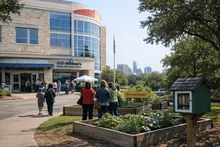
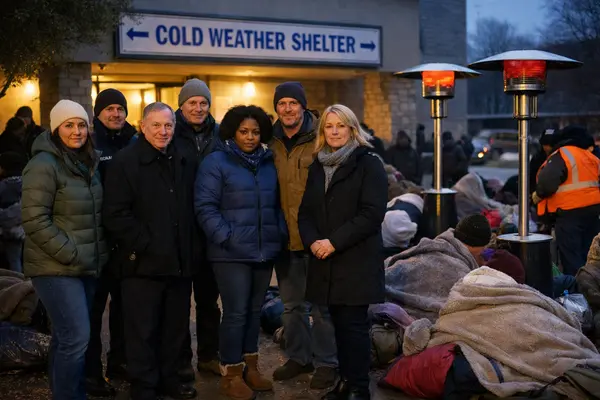
More than 650 people sought overnight refuge in Austin’s emergency cold weather shelters as sleet and ice moved across the city, a level of demand the City of Austin confirmed after Saturday night’s storm response. The city reported that shelters were extended to six facilities and welcomed 652 guests overnight—a rapid scale-up aimed at keeping residents out of dangerous conditions as roads iced over and temperatures dropped.
The city’s message has been clear and urgent: the cold weather shelters remain open for subsequent nights, and the service is not limited to people experiencing homelessness. While the network is often used by unhoused residents, anyone who needs a warm place to sleep during hazardous weather can access it—an important distinction during ice events that can trap people without heat, power, or safe transportation.
Access begins with the city’s embarkation process. Embarkation to cold weather shelters is scheduled from 2 to 8 p.m. at the One Texas Center, 505 Barton Springs Road. Because activation and capacity can change as weather conditions evolve, residents are urged to call the Cold Weather Shelter Hotline at 512-972-5055 for the latest information on availability and access.
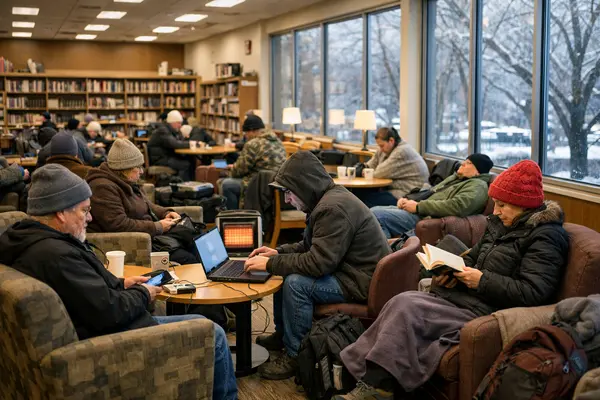
Meanwhile, Austin expanded daytime options for people needing warmth, charging, and a safe indoor space by opening public library warming centers. The Austin Public Library is operating warming centers from 8 a.m. to 5 p.m. at three locations: the Central Library (710 W. Cesar Chavez St.), the Terrazas Branch (1105 E. Cesar Chavez St.), and the Little Walnut Creek Branch (835 W. Rundberg Ln.). In a storm, these sites can serve multiple needs at once—especially for residents who may be avoiding travel at night but still need a stable place to warm up, recover, and plan for the next 24 hours.
The surge in shelter use during this ice storm also lands amid a broader reality: thousands of Austinites are living without stable housing, and emergency cold-weather operations can quickly become a life-safety backstop. Overnight between Jan. 25–26, 2025, Austin’s annual Point-in-Time Count recorded 3,238 people experiencing homelessness, with 1,577 unsheltered and 1,661 in shelters, as reported by FOX7 Austin. The numbers underline why cold weather activations can fill quickly—especially when the same storm that creates exposure risk can also make it harder to reach services.
ECHO, the region’s homeless response system lead, has emphasized the value of that snapshot for emergency planning, even as the community debates how best to measure and respond to need. “There are real limitations, but it is a really good data point for us to understand our unsheltered population in the community,” said Matt Mollica, executive director of ECHO, in remarks reported by FOX7 Austin.
That planning lens matters in storms because cold weather sheltering is both an immediate intervention and a stress test—one that reveals how much capacity the system can surge to create, and how fast. Austin officials have pointed to recent growth in the local homelessness response system as a reason the city can expand more effectively during emergencies than it could just a few years ago. According to the 2025 State of the System Report, beds and housing units rose 108% overall since 2019, emergency shelter beds increased 70% since 2022, and more than 3,000 people moved into housing in 2024, according to the City of Austin and ECHO.
City leaders describe those numbers not as abstractions, but as the infrastructure that determines whether people have a safe place to go when the forecast turns dangerous. “This report is an important tool for understanding how our community is responding to the realities of homelessness,” said David Gray, director of Austin Homeless Strategies and Operations, in a statement from the City of Austin and ECHO. Mayor Kirk Watson, in the same release, framed the progress as the product of deliberate choices and coordinated work: “Progress like this doesn’t happen by chance,” Watson said. City of Austin and ECHO
The city’s storm posture also reflects a longer-running policy argument about what actually reduces harm—especially when residents are displaced by enforcement actions or extreme weather. In a 2023 interview, Watson argued that homelessness response has to be built across a range of services rather than reduced to a single lever. “Addressing the needs of those that are living homeless in Austin is not as simple as a lot of people think, which is as simple as saying, 'Let’s enforce the camping ban.'” said Kirk Watson, Mayor of Austin, in an interview with Community Impact. He added, “What we’ve attempted to do as part of fixing the system is focused on the whole continuum. More on prevention. More on emergency shelter beds. More on rapid rehousing. And ultimately, some additional permanent supportive housing.” Community Impact
That emphasis on coordinated, step-by-step capacity building has also shaped how Austin leaders talk about state-led encampment enforcement—debates that intensify in winter when clearing an area can be immediately life-threatening if people have nowhere to go. Watson has criticized state-ordered sweeps as dramatic but incomplete. “They go in with a show of force, and they may clean it up, but we don’t know where they’re sending anybody,” said Kirk Watson, Mayor of Austin, in remarks reported by KUT News. He warned that, “What you're getting at the state level is short-term action for a long-term issue.” KUT News
In the immediate aftermath of an ice storm, those policy disagreements can feel distant from the urgent choices residents face—whether to drive on slick roads, whether an older home will hold heat overnight, whether a neighbor has power, or whether someone sleeping outside will survive the next cold snap. But the city’s response this weekend—expanding emergency shelter space, keeping it open additional nights, and adding warming options through libraries—shows how a community’s long-term investments in capacity become real, practical protection when conditions turn hazardous.
For residents who need help now, the pathway is straightforward: embarkation runs 2–8 p.m. at One Texas Center (505 Barton Springs Road), updates are available through the Cold Weather Shelter Hotline (512-972-5055), and three library warming centers—Central, Terrazas, and Little Walnut Creek—are open 8 a.m. to 5 p.m. As the city keeps shelters operating beyond the storm’s first night, the larger lesson is equally direct: emergencies reward preparation, and protecting vulnerable residents depends on both immediate, accessible refuge and the steady work of building a system that can meet surging need when the weather turns dangerous.