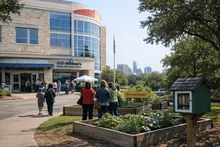
MUELLER, TX — Thinkery is urging Mueller families to lean on play, steady routines and calm reassurance to help children feel safe and grounded when upsetting news or sudden disruptions make the world feel uncertain.
The basic idea is simple: kids use play the way adults use conversation. Thinkery’s local guidance emphasizes that after frightening or confusing moments, children often need time to process before they are ready to “play like normal,” because emotions can be too big to organize all at once. In those moments, play is less about distraction and more like a child’s “working language” — a way to test what feels scary, practice control and rebuild confidence in small, manageable pieces.
In practical terms, that processing often starts before any big talk. Children pick up cues from adults — a changed routine, a tense phone call, a TV left on in the background — even when they do not fully understand what happened. That is why Thinkery’s approach begins with caregivers dialing down the volume of the world: turning off graphic news when kids are nearby, keeping adult conversations about frightening events out of earshot when possible and creating predictable “anchors” in the day (meals, bedtime, school drop-offs, the same park loop) so children’s bodies learn, again, what to expect.
The mechanics of how play helps can look surprisingly ordinary. A child builds a block tower just to knock it down; in emotional terms, that can be practicing the idea that something falls apart and gets rebuilt. A child acts out a story with stuffed animals; that can be trying on worry, rescue, separation and reunion — all from a safe distance. Local therapists in Austin describe play therapy similarly: it gives kids a way to communicate feelings without needing the perfect words. Kids can also benefit when adults follow their lead rather than directing every step, because child-led play lets them set the pace — speeding up when they feel brave and slowing down when they do not.
Caregivers in Mueller often ask the same question: How do I know if my child is stressed if they are not saying it? Austin mental health professionals say many children “show” feelings through behavior — sleep changes, clinginess, irritability, stomachaches, new fears, more meltdowns, or acting younger than their age. “Children aren’t miniature adults; their mental health struggles manifest uniquely. What may seem like misbehavior or defiance is often a signal of emotional distress and reflects their difficulty in communicating their needs.” said Austin Guida, licensed associate counselor and assistant professor. Another Austin-based practice offers a similar shorthand for what families might see after a loss or major life change: “When a child experiences a big life change or loss, you often see the impacts in their behavior: acting out, regressing, panicking, or isolating.” said Blue Note Psychotherapy.
When a child seems unsettled, experts generally recommend starting with connection and reassurance before explanations. For Central Texas families, that guidance was especially clear after severe weather events, when many children saw alarming images and heard anxious adult conversations. “We want to hug our children tightly, and we should, but we also have to be a voice of reassurance.” said Karin Price, Texas Children’s Hospital chief psychologist. “They need to know that they are safe.” said Karin Price, Texas Children’s Hospital chief psychologist. In Thinkery’s day-to-day framing, those messages can be short and repetitive — “You are safe right now,” “We are together,” “Grown-ups are helping” — because children tend to need steadiness more than details.
The key players in this conversation, locally, are the people and places children touch every week: caregivers; schools and classrooms across Austin Independent School District; pediatric and mental health providers; and “third places” where families decompress together. That includes Thinkery, which often serves as a familiar, low-stakes environment for hands-on exploration, and the parks and trails network that wraps through Mueller. City research has linked proximity to green space and frequent park visits with lower stress, and it has found higher odds of stress among people who live farther from green space — evidence that everyday outdoor time can be more than recreation. For a neighborhood built around shared outdoor spaces, that can translate into a practical mental-health tool: a walk around the lake, a stop at a playscape, a few minutes of movement that helps a child’s body settle.
That is also where the debates and tensions tend to land for families. Many adults worry that “talking about it” will make fear worse, while others worry that saying too little will feel like secrecy. The middle path Thinkery and clinicians describe is to keep answers honest and age-appropriate — enough to reduce a child’s uncertainty, not so much that it overwhelms them — and to remember that a child may “ask” through play long before they ask with words. Families also wrestle with screens: limiting exposure can feel unrealistic, but even small changes matter, like not watching breaking news in shared spaces or choosing a child-friendly explanation over a looping clip. Another tension is adult pace versus child pace; grown-ups often want a quick return to normal, while kids may circle the same theme in pretend play for days.
What comes next, for Mueller families, is less about a single perfect response and more about building a small “toolbox” that can be used anytime the world feels shaky: connection first, routine as a stabilizer and play as a pressure valve. For younger children, that might mean low-pressure activities — drawing, simple games, movement, sensory play — that strengthen the caregiver-child bond without requiring big conversations. When families gather in shared spaces, children also see community in action, whether it is a neighbor saying hello at the playground or a multi-family picnic that turns a regular afternoon into something more secure. And when the city faces frightening events, Austin’s response systems — including the victim-support network previously described in Austin opens Victim Assistance Center after West Sixth Street mass shooting; counseling, spiritual care and help recovering belongings available — can remind caregivers that emotional support is part of public health, not an afterthought.
In that same spirit, parks remain one of the most accessible “reset buttons” Mueller has, and city leaders have increasingly described them as core infrastructure for well-being. “parks are essential to the health, well-being, and vitality of every Austin resident.” said Jesús Aguirre, Director of Austin Parks and Recreation. For parents wondering what to do tomorrow, that can be permission to keep it simple: turn down the scary inputs, keep the next routine step predictable, and make room for play — not as a way to skip hard feelings, but as a child’s way of moving through them.