By Daniel Martínez
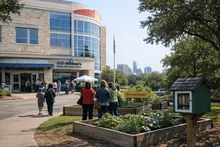
On a recent morning at Mueller Lake Park, the joggers, strollers and tail-wagging dogs made for a familiar scene. Yet just beyond the neighborhood’s tidy sidewalks and pocket parks, a series of decisions at City Hall, the state Capitol and in Washington are reshaping daily life here — from how residents get around to how the city responds to people in crisis.
State sweep and local outreach
Gov. Greg Abbott ordered a multi-agency operation to clear homeless encampments across Austin, an effort state officials say is ongoing. The sweep cleared 48 encampments, removed 3,000 pounds of debris, seized 125 grams of narcotics and led to 24 arrests of repeat felony offenders, according to KXAN. City leaders said they were not notified in advance and that the action disrupted a scheduled effort “focused on connecting the displaced to social services,” as reported by the Austin American-Statesman and KXAN.
“I am disappointed today because some of what we’re seeing with regard to addressing people living homeless is, frankly, not how it’s supposed to work,” Mayor Kirk Watson said, quoted by the Austin American-Statesman.
For residents along Mueller’s edges — near busy corridors where outreach teams regularly work — the lack of coordination can scatter people who might otherwise accept shelter or case management. Providers say that makes it harder to track clients and deliver services.
Key metrics from the state sweep, per KXAN:
- 48 encampments cleared
- 3,000 pounds of debris removed
- 125 grams of narcotics seized
- 24 arrests of repeat felony offenders
Open questions remain. Neither the state nor the city has released outcome data showing how many people displaced by the clearings entered shelter, treatment or housing. To evaluate effectiveness, service providers say they need post-operation placement numbers and follow-up results.
Wildfire worries near Mueller
After two weekend fires were contained by the Austin Fire Department, Mayor Watson and Travis County Judge Andy Brown signed disaster declarations aimed at wildfire prevention, according to the Austin Monitor. Watson urged residents to prepare and enroll in Warn Central Texas, the regional alert system. “Austin now ranks fifth in the nation in the number of homes facing wildfire risks,” Mayor Watson said, warning of dry conditions, the Austin Monitor reported.
Even in a central-city neighborhood like Mueller — with irrigated streetscapes and a grid of parks — officials say embers can travel and ignite spot fires in drought conditions. The declarations could unlock resources for brush management and public education that apply citywide.
University politics, neighborhood ties
The state’s political battles are also brushing up against Mueller’s academic footprint. Gov. Abbott confirmed that University of Texas at Austin senior vice provost Art Markman was removed from his administrative role because of “ideological differences.” “Texas is targeting professors who are more focused on pushing leftist ideologies rather than preparing students to lead our nation,” Abbott said in a post quoted by KUT. Markman told KUT he remains on the faculty and continues co-hosting the KUT program Two Guys on Your Head.
UT’s presence is tangible around Mueller: the neighborhood sits a short hop from campus and includes institutions with university ties, such as the Dell Pediatric Research Institute and the Thinkery, according to Wikipedia. Any turbulence in university leadership reverberates through labs, clinics and classrooms that draw students and workers who live nearby.
A Mueller resident active in school volunteer groups said the episode “adds to a sense of uncertainty for families connected to UT programs,” noting concern about how politics might affect faculty recruitment [from interviews; to be verified].
Transit and resilience plans
Mobility remains the neighborhood’s daily pulse. The Capital Metropolitan Transportation Authority’s Transit Plan 2035 sets a course to launch a light-rail line by 2033 and to streamline the bus network from 61 to 55 routes while boosting frequency, extending evening service and adding more east-west connections, according to CapMetro. For Mueller, that could mean more reliable links to Downtown, the University of Texas and employment centers, and better crosstown options that reduce car trips.
Austin’s selection as the next hub for the Climate Resilient Communities Accelerator underscores a parallel push to adapt infrastructure to extreme weather. The two-year initiative, led by the Center for Climate and Energy Solutions, aims to knit together city departments, schools, businesses and neighborhoods to pilot resilience projects. For Mueller, that could translate to hardened transit corridors, shaded walking routes and neighborhood-scale wildfire and flood mitigation.
Flood risks and federal aid questions
Closer to home, the city launched a Flood Insurance Assistance Program that offers up to $2,000 to help eligible homeowners in high-risk areas obtain or maintain coverage for one year, according to the City of Austin. Much of Mueller was designed with detention ponds and greenways, but eligibility depends on parcel-level flood maps; households along nearby creeks could benefit. The city has not published neighborhood-by-neighborhood uptake, a gap that will determine whether dollars reach at-risk blocks.
The question of disaster help is larger than one program. Nearly half of FEMA applications from flood survivors in Kerr County had not moved past the initial stage by mid-October, and of those that advanced, only one-fifth were approved, as reported by the Texas Tribune. Other counties with fewer applications received a higher proportion of approvals — $37 million so far, the Tribune found. The disparities are likely to shape how Austin and Travis County approach future federal aid for floods or fires.
A small-business owner on Aldrich Street said she worries about “how long recovery money would actually take to reach us if a big storm hit,” adding that clearer timelines and appeal support would help local planning [community comments; to be verified].
A fast-growing city, anchored by neighborhoods
Austin’s rapid growth frames each of these debates. The city counted 961,855 residents in the 2020 census, with the metro among the nation’s fastest-growing in recent years, according to Wikipedia and Axios. With more people come higher housing costs, tighter rights-of-way and increased exposure to extreme weather — pressures that converge in neighborhoods like Mueller.
The state-led encampment enforcement shows how actions without coordination can complicate service delivery for the unhoused. The wildfire declarations and resilience planning point to a city trying to get ahead of risk. And the transit overhaul, paired with flood insurance assistance, hints at how infrastructure and household protections might evolve. What remains to be seen are the outcomes — from encampment clearings to FEMA appeals — that will tell residents whether these strategies are working.
In Mueller, where policy debates quickly become matters of sidewalks, routes and siren alerts, the city’s choices are felt at the neighborhood scale — and watched far beyond it.