Roger Lavon Taylor Sr. Plaza opened to the public in Austin’s Mueller neighborhood following a March 29 ceremony, marking the final named park in the district’s long-running airport redevelopment and signaling the project’s home stretch, according to Austin Culture Map and the City of Austin.
Tower and plaza
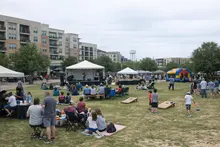
The new public space surrounds Mueller’s preserved, blue-striped control tower—one of the last visible links to the site’s aviation era—with a design focused on flexible use and durability. The layout features paved circulation areas, a pedestrian bridge that frames the tower, and a central hill terraced with low retaining walls that double as stepped seating. New landscaping includes native grasses and young trees intended to mature into shade and habitat over time, according to Austin Culture Map.
Performers from Blue Lapis Light highlighted the tower with aerial arts during the opening, animating the landmark and underscoring the plaza’s potential for cultural events, as noted by the City of Austin and Austin Culture Map. The plaza is located at 3925 Berkman Dr., according to Austin Culture Map.
A two-decade project
Mueller’s transformation from the Robert Mueller Municipal Airport into a mixed-use urban village has unfolded over roughly 20 years, weaving new housing, parks, offices, and retail into a former airfield. The airport operated from 1930 until its closure in 1999, when commercial flights moved to Austin-Bergstrom International Airport. The neighborhood intentionally preserves elements of that history—most visibly the control tower—to ground a new district in its past, according to the City of Austin.
The plaza’s debut is a milestone for the buildout: it is the final named park in the master plan and arrives as planners project broader completion around 2027, according to Austin Culture Map and the City of Austin. While construction continues on remaining sites, much of the district’s streetscape, homes, and commercial core now function as a cohesive neighborhood.
The namesake: preservation and advocacy
The plaza honors Roger Lavon Taylor Sr., a neighborhood advocate who pushed to relocate the airport while working to preserve the control tower as a civic landmark. Taylor was active in Citizens for Airport Re-Location (CARE), a community group that helped shape the redevelopment vision decades before the first homes opened. He died in November 2012. The naming recognizes both his role in moving Austin’s aviation infrastructure and his insistence on maintaining a tangible reminder of Mueller’s history, according to the City of Austin and Austin Culture Map.
Who the plaza will serve
Mueller today is a varied community where students and faculty, young professionals, families, and retirees live in close proximity. Recent neighborhood profiles estimate about 5,964 residents with a median age around 36, reflecting a mix of life stages clustered around parks, schools, and retail, according to RentCafe.
Educational attainment and household income are relatively high. Data compiled by Rastegar Capital show roughly 59.89% of residents aged 25 and older hold a bachelor’s degree and 22.76% have advanced degrees; about 53% of households earn $75,000 or more, and 29% earn $150,000 or more. Safety and affordability remain central to the neighborhood’s appeal: Mueller is recognized for comparatively lower violent and property crime rates than the city overall, and its housing stock ranges from entry-level condos and apartments to single-family homes topping $1 million, according to Taco Street Locating. About a quarter of planned homes participate in the Mueller Affordable Program, broadening access for households below the area median, the same source notes.
Against that backdrop, a plaza that blends heritage with everyday usefulness is likely to draw a wide cross-section of neighbors. The terraced hill is built for casual seating during festivals or movie nights; paved loops can host small markets, fitness classes, or stroller-friendly walks; and the control tower offers a ready-made focal point for arts programming. Those possibilities were on display at the opening, when Blue Lapis Light used the tower itself as a stage, according to the City of Austin.
What comes next
As the district approaches its projected 2027 finish, the plaza’s low-maintenance landscape and simple hardscape suggest a site that can be active without heavy infrastructure. With native grasses and young trees still filling in, regular care will help the space reach its intended shade and habitat. The design’s flexibility, coupled with the neighborhood’s mix of families, students, and professionals, points to routine community use—everything from weekend gatherings to cultural activations—supported by the area’s safety profile and pedestrian-friendly layout, according to Taco Street Locating and RentCafe.
The Roger Lavon Taylor Sr. Plaza is ultimately a physical summary of Mueller’s promise: a place where a repurposed airfield reads as a neighborhood, and where preservation and growth share the same ground. By anchoring public life around the last major remnant of the old airport, Mueller closes a chapter of its redevelopment while giving residents a new daily commons—one that makes the site’s history visible and usable at the same time.
Read the press release on austin.culturemap.com.