MUELLER, TX — On a recent spring weekend in Mueller, residents gathered in parks, talked schools and swapped stories about the Austin that still feels close at hand — from longtime institutions like ThunderCloud Subs to public memorials in East Austin — in a continuing effort to keep neighborhood identity rooted in place as the city grows.
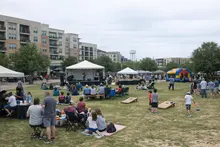
The lake at Girard Kinney Park held the late light like a shallow bowl, the surface stippled by wind and the slap of a coot’s feet. Parents pushed strollers along the loop trail. A cluster of kids negotiated the playscape like it was a small republic. Near the amphitheater, a couple on a blanket ate from a paper-wrapped sandwich, the kind of unplanned dinner that happens when you can walk somewhere and let the neighborhood decide the rest.
In Mueller, public space is not just scenery; it is where the city’s personality gets rehearsed, tested and passed along. It happens in ordinary moments — on a shaded bench, at a food counter, in the drift of a conversation that begins with the weather and ends, somehow, in a question about who belongs to what part of Austin.
That question has a practical edge here. Mueller sits close to East Austin’s civic and cultural spine, and the connection shows up most clearly in schools — in where families enroll, who represents them on the Austin Independent School District board, and how district lines can either reinforce or fracture relationships. Years ago, as Austin ISD weighed redrawing trustee boundaries, Mueller-area advocates argued those lines were not abstract.
“There is a misperception that Mueller advocates, such as myself, and Mueller residents don’t want to be a part of East Austin schools. That’s not true,” said Jim Walker, a Cherrywood resident and a member of the city’s Mueller Commission.
Walker’s point landed as both rebuttal and invitation: Mueller’s newer streets and East Austin’s older campuses are tied by daily routines — a drop-off line, a PTA meeting, a middle-school feeder pattern — and by the belief that representation should follow those lived connections. The debate reached beyond one map cycle, because it described a lasting tension in fast-growing Austin: as neighborhoods change, the civic structures meant to hold them together can feel as if they lag behind the reality on the ground.
“It makes a lot of sense to keep those folks in District 1,” said Jim Walker.
Other residents framed the same issue less as a technical dispute than as a statement of belonging — not only to a set of schools but to the cultural and civic fabric of East Austin itself. It is the kind of claim that can sound lofty until you notice how often it gets made on playgrounds and sidewalks: people wanting their daily geography to be recognized as real.
“What we want is to be a seamless part of the fabric of East Austin,” said Kevin Foster.
“However, we feel we are being denied that opportunity by the district,” said Kevin Foster.
The push and pull of those hearings still echoes in Mueller’s everyday life because it points to something larger than trustee seats: the way Austin decides which communities are expected to share responsibility for each other. AISD’s process, as described in KUT’s reporting, had to balance equal-population requirements and Voting Rights Act concerns — but the feelings in the room were about continuity, trust and whether growth would be allowed to sever relationships that residents were actively trying to build.
“Regardless of whether you are District 1, you are part of the community and that does not change,” said Cheryl Bradley, who represented District 1 at the time.
Trust, in Austin’s school conversations, is never only about boundaries. It is also about how institutions speak to families — whether they show up, explain, listen, and make it feel as if the public in public education still means something. That theme has been a throughline in local civil-rights advocacy, including criticism of how AISD communicates with parents.
“You have to go to the families and show them why they should choose Austin ISD and really be transparent and they don’t do that,” said Nelson Linder, president of the Austin NAACP.
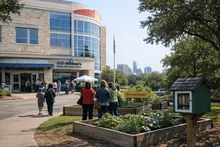
On weekends, those governance debates can feel far away from the pleasant arithmetic of a Mueller afternoon — the joggers, the lemonade, the casual hello — but the neighborhood’s public life is one reason the stakes stay visible. People in Mueller gather because the neighborhood makes it easy: parks, trails and shared spaces that invite you to linger without buying your way into belonging. The Austin Parks Foundation has described its own role in that civic ecosystem in straightforward terms.
“We create programs to encourage positive use of public spaces in neighborhoods across Austin,” said Austin Parks Foundation.
That ethos — keep it public, keep it low-barrier, keep it neighborhood-scaled — is why Mueller’s calendar often feels like a steady drumbeat rather than a big splash: a series of shared moments that, over time, become identity. As previously reported in Https://muellertoday.com/articles/honktx Brings Free Street Band Festival To Mueller Leaning Into Public Space And Local Scale, Mueller’s embrace of the small and the public has made it a natural stage for events that resist turning into something bigger than the neighborhood can hold.
That instinct shows up in the way people talk about what they miss — and what they keep. In Austin, institutions often become shorthand for continuity, especially as familiar blocks change quickly. ThunderCloud Subs, now past the half-century mark in Austin, is one of those cultural anchors people mention the way they mention a song they grew up with: not because it is rare, but because it is still there.
“For 50 years, ThunderCloud has been part of the rhythm of Austin, serving up scratch-made subs with a side of local love,” said Mike Haggerty, co-owner of ThunderCloud Subs.
The company’s longevity — and the way it has grown without losing its neighborhood feel — is often explained not as branding, but as culture: staff who stay, store managers with long tenure, and an internal emphasis on food quality and employee loyalty, as the company has described in its leadership materials. In public memory, though, the story lands as something simpler: an old Austin place that survived into new Austin.
“I don't like to look too far down the road, but when you get to 50 years, you kind of look back and go, 'how? Wow. How did we get here?'” said Mike Haggerty, president and co-owner, ThunderCloud Subs.
Part of the answer, current and former employees have said, is that ThunderCloud tries to stay specific — not smoothing every location into the same box. That matters in a city where neighborhood identity is often the point, and where a chain can still feel local if it behaves like a set of small rooms rather than one big machine.
“We’ve really strived hard to keep that individual feeling, for each shop to have their own individual personality as much as possible,” said Patty Sughrue, co-owner, ThunderCloud Subs.
“It’s a very Austin restaurant. The tip jars are always decorated, the music is always cool, the sandwiches are always easy and affordable,” said Sadie Wolfe, former ThunderCloud employee.
“They work with you as a person,” said Ben Webster, former ThunderCloud employee and musician.
If ThunderCloud is one kind of public memory — lived, casual, edible — East Austin holds another kind, one that asks for a different kind of attention. A memorial marker at Wesley United Methodist Church honors three unnamed Black men lynched in Travis County 130 years ago, an act of violence that for decades lived mostly in fragments and foreign newspaper accounts. The marker works the way public history often does: it stands there, unignorable, waiting for a passerby to stop.
“Every day when I see people stop to read it, I say, ‘Thank God that marker is here,’” said Rev. Sylvester Chase Jr., retired pastor.
The ethics of remembrance can feel abstract until you stand in front of a sign that names the violence but not the victims — until you realize that anonymity is part of the harm, and that being unknown is not the same as being unworthy. For Linder, the argument for memorialization is moral as much as historical.
“It feels like a basic human dignity to have your memory preserved, to at least get the simplest honors we offer the dead: an obituary, a headstone with your name on it,” said Nelson Linder, president of the Austin NAACP.
Mueller residents who spend their weeks navigating school calendars and park nights can miss how close that kind of public history sits — a short drive south and west, a quick turn into streets where churches still function as anchors and where markers insist that the city’s story includes what it would rather forget. Chase, in KUT’s reporting, described the marker’s reach with the frank humor of someone who has watched people approach it without knowing what they are about to feel.
“They might not want to know about Jesus Christ, but they’re going to stop and read that sign,” said Rev. Sylvester Chase Jr..
Long before Mueller was built as a model of walkability and planned public space, Central Texas had other communities shaped by work that was physical, isolating and often looked down upon. The cedar choppers — families who cut Ashe juniper for posts and fuel — are part of that regional labor history, a story that still clings to the Hill Country’s edges and to Austin’s older social boundaries.
“They were barefoot, their pants were too short, their shirts ragged. These were not kids you would see in Austin,” said Ken Roberts.
The point of those recollections is not nostalgia; it is texture. They show how class difference was once visible on a child’s body, and how the city drew lines — sometimes literal, sometimes social — between who counted as “Austin” and who lived just outside its respectable frame.
“They were very independent and very proud people—and aggressive, very aggressive,” said Frank Wilson.
The work paid, sometimes better than other local labor, which is part of why it mattered. Cedar chopping was not a quirky sidebar; it was an economic strategy in a place where options were limited, and it helped shape how Central Texas built itself — posts in the ground, fences on the horizon, the quiet infrastructure of ranching and settlement.
“A man could make as much money in two days cutting cedar as a week working in one of the local quarries,” said Ken Roberts.
Even the fragments of oral history carry a kind of grit you can feel in your hands: axes before chainsaws, the sound of metal into wood, the long hours that make a landscape look natural only after people have bled into it. Migration threaded through those families, too — Southern roots carried into the Hill Country and then into the region’s mythologies.
“My great-great-grandfather was a Stubblefield. He came from Mississippi. … and like them folks,” said Kerry Russell.
“They’s using ‘em choppin’ axes till they come in,” said Dick Turner.
Back in Mueller, the evening light eventually thins and the park empties by degrees — first the toddlers, then the dogs, then the last clusters of neighbors lingering as if leaving would break the spell. The conversations that begin in parks and school meetings and sandwich lines keep circling the same quiet question: how to live in a city changing fast without letting it become a place you only pass through.
A child’s scooter rattled over the bridge by the lake, the sound briefly louder than the birds. On a nearby bench, someone shook out a picnic blanket and folded it into a square, careful and practiced. The neighborhood returned to its ordinary rhythm — which, in Mueller, is also the point. Public life here is made of small, repeatable moments, the kind that teach you where you are by asking you to pay attention.