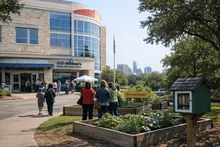
AUSTIN, TX — Thinkery, the children’s museum in the heart of Mueller, is urging local caregivers to use simple, child-led play, limited media exposure and steady reassurance to help kids feel safe and grounded when the world feels uncertain.
1) Start by dialing down what kids see and hear. Kids pick up far more than adults expect — not just headlines, but shifts in routine, tense conversations and the emotional tone at home — and that can fuel worry or confusion even when they can’t explain it. Begin with one concrete change today: turn off TV news when children are in the room, silence news alerts on your phone during family time, and move adult conversations about frightening topics to a separate space. This aligns with Thinkery’s message that children do not need every answer; they need consistency and connection, plus room to make sense of what they notice. In practice, that means repeating simple, present-tense reassurance rather than details. “We want to hug our children tightly, and we should, but we also have to be a voice of reassurance.” said Karin Price, Texas Children’s Hospital chief psychologist.
2) Watch for stress that looks like “behavior,” then make space for feelings without rushing to fix them. Many children show distress through changes that can look like defiance, clinginess, sudden anger, sleep trouble, regressing (accidents, baby talk) or withdrawing. “Children aren’t miniature adults; their mental health struggles manifest uniquely. What may seem like misbehavior or defiance is often a signal of emotional distress and reflects their difficulty in communicating their needs.” said Austin Guida, licensed associate counselor and assistant professor. When those signals show up, set a low-pressure routine for check-ins: offer a choice (“Do you want to talk or draw?”), name what you see (“Your body looks worried”), and validate feelings (“It’s OK to feel scared”) before you problem-solve. “When a child experiences a big life change or loss, you often see the impacts in their behavior: acting out, regressing, panicking, or isolating.” said Blue Note Psychotherapy.
3) Use Thinkery-style play as the “language” for processing — and let your child lead. Thinkery’s central idea is that kids often need time to process hard moments before play feels freeing again; play becomes most helpful when it follows emotional space, not when it replaces it. Start with open-ended options that match your child’s age and temperament: building with blocks (control and mastery), drawing (externalizing worries), movement games (releasing body tension), pretend play (testing “what if” safely) or quiet exploration (sensory soothing). If your child doesn’t want you to join, stay nearby; if they invite you in, follow their rules and narration. Local clinicians describe why this works: play can communicate what children can’t yet put into words. “allowing children to express themselves in a non-verbal way, helping them process trauma or anxiety in a supportive environment.” said Deep Eddy Psychotherapy. If you want an age-specific default for preschool and early elementary kids, keep it simple and low-stakes. “For younger children, this often means play-based activities, drawing, games, or movement - low-pressure ways to build connection and help the child feel safe.” said Austin Anxiety & OCD Specialists. For children ages 5 to 12 who seem “stuck,” Austin therapists also emphasize non-directive, child-led play as a path toward resolution. “In play therapy, I help children, ages five to twelve, to express themselves in ways that support resolution of difficult experiences, emotions, and behavior patterns through the therapeutic use of non-directive play.” said Shannon Huggins, Psychotherapy Group.
Prerequisites and eligibility: These steps are designed for caregivers of children roughly ages 2 to 12, including families connected to Austin ISD campuses serving Mueller and nearby neighborhoods. You do not need a diagnosis, membership or appointment to use them at home. Consider professional support if your child’s distress is intense, lasts more than a few weeks, or includes self-harm talk, persistent panic, refusing school for multiple days, or major sleep disruption. For families navigating medical stress, Dell Children’s Medical Center of Central Texas is a nearby anchor institution; ask your pediatrician or care team for a behavioral-health referral pathway if worry is affecting daily functioning.
Key timeframes and neighborhood routines: For most families, the most realistic “deadline” is the next 24 to 72 hours — the window when upsetting news and adult stress can spill into children’s bodies and behavior. Aim to (a) reduce news exposure immediately, (b) add one predictable daily ritual by the next day (bedtime story, after-dinner walk, Saturday morning park time), and (c) offer play-based processing opportunities multiple times per week. Parks matter here not as a luxury but as part of Mueller’s everyday mental-health infrastructure: City research links proximity to green space and frequent park visits with lower stress, and notes higher odds of stress among people who live farther from green space, with regular park contact supporting stress and anxiety levels especially for children and low-income families. That local evidence matches what many Mueller parents have experienced firsthand at Girard Kinney Park and the broader Mueller trail-and-playscape network; as previously reported once, the neighborhood’s Movie in the Park nights created low-pressure, outdoor family routines that can help kids feel connected in community spaces. “parks are essential to the health, well-being, and vitality of every Austin resident.” said Jesús Aguirre, Director of Austin Parks and Recreation.
Contact information, forms and links, and common mistakes to avoid: For Thinkery program and visitor questions, contact Thinkery at 512-469-5580 or info@thinkeryaustin.org, 1830 Simond Ave., Austin, TX 78723; hours are posted at https://thinkeryaustin.org/visit/. If you need immediate guidance about child safety or crisis mental-health support, call 988 (Suicide & Crisis Lifeline), available 24/7; for non-emergency police support in Mueller, the Austin Police Department Northeast Substation is at 12425 Lamplight Village Ave., with public contact at 311 for city services. Avoid the most common caregiver missteps: replaying frightening footage where children can see it; over-explaining adult fears; asking rapid-fire questions (“Are you OK? Are you sure?”) that can increase pressure; forcing structured “talk time” before a child is ready; and treating stress behaviors as “bad” rather than signals. When you do reassure, keep it short, concrete and repeated; “They need to know that they are safe.” said Karin Price, Texas Children’s Hospital chief psychologist. Over time, those repeated messages — paired with play at home, walks around Mueller Lake Park, or a calm family outing that fits your child’s tolerance — can help kids regain the felt sense that their neighborhood, their adults and their routines are steady, even when the outside world is not.