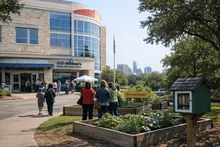
In Mueller, a quiet omakase goes dark
On a late-September Sunday in 2020, the white-walled, music-free dining room on Mueller Boulevard served its last pieces of nigiri. Kyoten Sushiko, the neighborhood’s intimate omakase counter at 4600 Mueller Blvd., closed permanently after service on September 27, according to Austin Eater. The restaurant’s arc was ambitious: launched as a food truck in 2014, it moved to a brick-and-mortar in 2016, with a chef-led tasting that ran about $150 per person and a daytime bento service, Austin Eater reported.
A neighborhood loss
Kyoten Sushiko’s Austin story mirrored the city’s appetite for inventive dining. The food truck quickly earned a reputation for pristine fish and precise technique before settling into Mueller’s evolving commercial district in 2016, as noted by Austin Eater. The room drew mixed reactions—spartan, all-white, and deliberately quiet—while the sushi itself won steady praise, Austin Eater wrote.
By 2019, after founder Otto Phan decamped to Chicago the prior year to open a restaurant under the same name, the Austin location reopened under chef Sarah Cook—an alum of Lenoir and Sway—who ran the counter with a slightly refreshed menu, according to Austin Eater. When the pandemic upended dining in March 2020, Kyoten pivoted to omakase and bento boxes to-go, a survival play common among chef’s-counter concepts at the time, Austin Eater reported.
Leadership, timing, and a hard year
In announcing the closure, Phan took public responsibility. “Any failures here were simply because of me and my failed leadership,” he wrote on Instagram, as reported by Austin Eater. He also cited the approaching end of the restaurant’s lease and said it was better to accept that he couldn’t keep things going in the moment rather than later, per Austin Eater. Phan’s Chicago restaurant, he noted at the time, would continue operating.
What the numbers show
The environment around Kyoten Sushiko’s final months was unforgiving. City-level data compiled by Wikipedia shows Austin’s unemployment spiked to 12.2% in April 2020—the highest since 1990—with roughly half of job losses tied to bars, restaurants, and hotels. The cancellation of South by Southwest, which generated an estimated $355.9 million in 2019, erased a crucial infusion of spring business. By July 2020, Yelp figures cited by Wikipedia indicated 1,449 businesses in the Austin metro had closed, including at least 155 restaurants that shut permanently between March 1 and July 10.
Those macro forces mattered especially for small, high-touch restaurants. Revenue vanished, fixed costs persisted, and safety restrictions limited the very intimacy that defines chef’s-counter dining.
Why omakase is uniquely vulnerable
Omakase depends on proximity—the chef’s cadence, the immediate handoff of rice and fish, and a limited number of premium seats to cover labor and ingredient costs. Research summarized by the University of Houston notes that the format relies on in-person, chef-to-diner interaction and per-seat economics that are hard to replicate through takeout. Many operators improvised with bento boxes and “omakase-at-home” kits, but those pivots typically reduce check averages and compress margins, the University of Houston explains. Kyoten’s March 2020 takeout shift fit that pattern, according to Austin Eater, but it couldn’t recreate the tactile theater—or the revenue mix—of a full counter.
What we know—and don’t
Available evidence suggests Kyoten Sushiko’s closure stemmed from both external shock and internal strain: an unprecedented collapse in hospitality demand layered over leadership and operational challenges that Phan acknowledged, per Austin Eater and Wikipedia. There are limits to how finely those factors can be weighed. No public financial statements for the Austin restaurant are available, and the selected materials do not include detailed customer-review trends or service metrics. Without that, the precise balance of cause and effect remains uncertain.
Building resilience for the next shock
Industry best practices that emerged from the pandemic point to pragmatic steps for small, high-touch restaurants to cushion future blows. Drawing on sector analyses and observed adaptations, including those summarized by the University of Houston and the citywide impacts documented by Wikipedia:
- Diversify revenue: retail sauces and pantry items, bento subscriptions, and private dining to reduce reliance on a full counter.
- Design modular tastings: shorter sequences that travel better while preserving brand identity.
- Plan for leadership continuity: documented recipes and cross-training to withstand chef transitions.
- Improve health-forward service: outdoor seating, ventilation upgrades, and small-format private bookings to sustain intimacy safely.
- Seek financial flexibility: rent relief clauses, emergency reserves, and targeted local grants when available.
Local governments and neighborhood stakeholders can also help preserve independent dining during crises, as seen in 2020’s upheaval:
- Streamline outdoor-dining permits and parklets to add safer capacity.
- Provide targeted grants and mediation resources to help tenants and landlords adjust leases.
- Support hospitality workforce retraining and job bridges when closures spike.
What might come next
Mueller has changed since Kyoten Sushiko switched off its sushi case, but the restaurant’s rise and fall still reads like a parable of this era: a chef-driven concept born of ambition, honed in an exacting room, and ultimately outmatched by a year that punished intimacy and rewarded scale. Phan’s Chicago counter continues, according to Austin Eater. In Austin, the space and the neighborhood have moved on, as they tend to do. What remains is a sharper understanding of how fragile—and how valuable—small, meticulous restaurants can be, and a blueprint for how the next one might endure when the room goes quiet again.