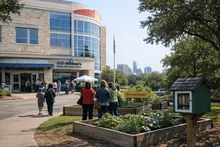
AUSTIN — On a recent Sunday at the Texas Farmers’ Market in Mueller, the line for early peaches and leafy greens snaked past strollers and bikes. Some shoppers compared prices on eggs and tortillas, stretching budgets made tighter by rising rent and the cost of care. The scene felt familiar — and, to many here, newly fragile — after a Texas legislative session that public-health advocates say did little to address the basics of staying healthy.
According to Public Health Watch, the 2025 Legislature declined again to expand Medicaid to low-wage adults, cut billions from mental health services, missed chances to stabilize maternal health, and took limited steps on food insecurity and environmental health. Those choices land locally in ways that are visible in Mueller’s clinics, schools and weekly market.
Access to care in Mueller
At community health centers near Mueller, clinicians say more patients are arriving uninsured or delaying visits until problems get worse — a pattern consistent with statewide data showing Texas again leads the nation in uninsured residents. As of 2023, 21.6% of working-age adults in Texas lacked coverage, the highest share in the country, data from Axios shows.
Lawmakers left that gap in place by refusing Medicaid expansion, a move that keeps nearly 5 million Texans without insurance, according to Public Health Watch. Research indicates expansion would have mattered on the ground: A large literature review by Kaiser Family Foundation links Medicaid expansion to improved access to preventive care and reductions in mortality, while the Robert Wood Johnson Foundation has documented benefits for state economies and household financial stability.
Closer to home, families in the Mueller area juggling retail, hospitality and gig work often earn too much for traditional Medicaid but not enough for private plans. Bills to streamline children’s enrollment in Medicaid and CHIP through “express-lane eligibility” (HB 321 and SB 238) advanced but ultimately failed, despite bipartisan interest and evidence of hundreds of thousands of eligible Texas children stuck in an application backlog, Public Health Watch reported. “Every child in Texas deserves a chance to grow up healthy … and the truth is we can give that chance to thousands of kids with one, simple notification,” Rep. John Bucy III said on social media, according to Public Health Watch.
One measure that did pass, HB 3940, requires state officials to provide clearer information about newborn Medicaid eligibility — a small administrative change that local clinic staff say will help some new parents leaving the hospital.
Mental health and schools
The neighborhood’s school counselors are already contending with more students reporting anxiety, depression and family stress. Those challenges are rising even as the Legislature cut mental and behavioral health funding by $2.3 billion — roughly 20% — and reduced support for jail-diversion programs by another $115 million, according to Public Health Watch. Advocates warned that bills to bolster the workforce and expand out-of-state telehealth did not make it to a vote, and a proposal to extend Medicaid coverage for children in crisis stalled.
At the same time, lawmakers advanced measures to restrict local gun-safety interventions. An “anti-red-flag” bill (SB 1362) bars judges from temporarily removing firearms unless someone has a criminal conviction, limiting a tool other states use when people are deemed a danger to themselves or others. Another bill (HB 3053) bans local governments from participating in gun buyback programs, and a separate measure allows marshals to carry handguns in public schools, Public Health Watch reported.
Pregnancy and postpartum care
In Northeast Austin, obstetric appointments can still require a cross-town drive and a day off work. That’s a common story in many parts of Texas, where vast swaths of the state qualify as maternity care deserts that lack full-service labor and delivery options or consistent prenatal care, background summarized by Wikipedia shows. The Legislature did not adopt proposals to add doula coverage in Medicaid or to strengthen the state’s maternal mortality review process, even as maternal deaths in Texas increased 56% in the year after the 2021 abortion ban took effect, Public Health Watch reported.
Abbott signed SB 31, clarifying that physicians can act when a pregnancy poses a life-threatening condition even if risk isn’t imminent. But SB 33 forbids using public dollars to help Texans travel for abortion care, a policy that curtails city-backed support in places like Austin, Public Health Watch noted.
Food and air quality
The Mueller market is a bright spot for fresh produce, but hunger remains a daily reality for many families across Travis County. A May analysis cited by Public Health Watch estimated that Texas had the nation’s highest number of people — nearly 5.4 million — experiencing food insecurity in 2023. Lawmakers rejected bills aimed at addressing food deserts and instead passed SB 379, which restricts what SNAP recipients can buy, including sweetened drinks and certain snacks. Local pantry volunteers say nutrition matters — but so does access, especially when the closest option is a convenience store.
On environmental health, neighborhood conversations often turn to traffic exhaust from I-35, construction dust, and concrete batch plant emissions that affect East Austin. “It was a session of many missed opportunities by our representatives,” Air Alliance Houston said in a statement, according to Public Health Watch. “Even widely supported, data-driven bills often fail to advance due to procedural bottlenecks and lack of political will.” One small win: SB 763 requires the state to review concrete batch-plant permits every six years. Broader oversight efforts stalled amid industry influence; in the past two years, legislators received nearly $3 million from oil, gas and petrochemical interests, Public Health Watch reported, citing campaign-finance tracking.
Public Health Watch’s review also drew on CDC PLACES to visualize county-level health needs; those are model-based estimates from surveys and census data, not raw counts — a limitation the outlet noted in its coverage.
What leaders said — and didn’t
In Austin, groups like Every Texan have warned that policy choices are worsening outcomes for families who already struggle to navigate housing costs, child care and health care. Lynn Cowles, the group’s health and food justice director, didn’t mince words about the political calculus at the Capitol. “Some Republican lawmakers who dependably vote against programs like Medicaid expansion ‘are willing to accept the political risks of selling out their constituents … to achieve the goal of wealth accumulation among the richest households in the world. Others genuinely believe that poor people are out to game the system, which is categorically untrue. No one wants to sit in an office and argue for their child’s Medicaid coverage,’” she said, according to Public Health Watch.
Cowles added: “Instead of surrounding themselves with experts who can improve conditions and outcomes for people in the state, they surround themselves with fawning ‘yes’ people who deeply share their ideological perspectives rather than a commitment to public health. Some lawmakers understand that public health experts are right but make decisions contrary to their expertise because they choose party objectives over people. Others believe the scientists are wrong. In either case, they’re actively supporting measles outbreaks in our state, and children will die. The awareness is so short, so acutely focused on the political moment,” according to Public Health Watch.
Governor Greg Abbott’s office did not provide examples of new laws it believes will improve health outcomes when asked by reporters, Public Health Watch reported.
The road ahead for Mueller
The November vote on $3 billion in dementia research funding may offer one statewide investment with local echoes in Austin’s growing senior population. But for many Mueller residents, the immediate picture will be shaped by county and city stopgaps — school-based mental health partnerships, mobile food distributions, and community health workers — that try to backfill gaps left by state policy.
What would move the needle? Evidence points to coverage and prevention. Expansion states have seen measurable gains in access and mortality, according to Kaiser Family Foundation and the Robert Wood Johnson Foundation. Until Texas changes course, the burden lands on neighborhoods like Mueller — where the lines at the clinic and the farmers’ market are reminders that public health is local.
Read the press release on austinfreepress.org.