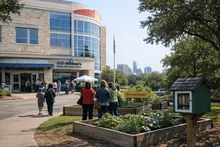
Peach season is in full swing in Mueller, where neighborhood shoppers are leaning on local markets and nearby orchards to bring Hill Country fruit into the city, even as yields fluctuate across Central Texas.
What to know in Mueller
Peaches are showing up across Austin outlets that serve the Mueller area, with weekly markets and grocers stocking regional fruit and related goods.
- Mueller Farmers' Market, 2006 Philomena St.: Every Sunday from 10 am to 2 pm, the Texas Farmers' Market at Mueller runs year-round and often includes vendors selling Fredericksburg peaches, according to CultureMap Austin.
- Barton Creek Farmers Market, 2901 S. Capital of Texas Hwy.: Every Saturday from 9 am to 1 pm, shoppers can find seasonal fruit; one of its current vendors is Jenschke Orchard, a Fredericksburg grower, according to CultureMap Austin.
- Central Market, 4001 N. Lamar Blvd. and 4477 S. Lamar Blvd.: The grocer is carrying more than 10 varieties of peaches along with peach pies in the bakery, according to CultureMap Austin.
These outlets reflect the region’s growing appetite for fresh produce. Central Texas added more than 13% in population between 2012 and 2022 and has a median age of 33.8, younger than the statewide median of 35, according to the Texas Comptroller. Those trends support steady demand for local fruit and agritourism.
Where to find peaches — and pick them
Pick-your-own orchards in Fredericksburg remain a draw for Austin residents willing to make the drive. Jenschke Orchards, 8309 US-290, allows guests to pick peaches on a 200-acre property with online reservations ($5) between 9 am and noon and fruit priced at $2.50 per pound, according to CultureMap Austin. CultureMap also notes that roadside peach stands appear seasonally along major Austin roads.
Regional production underpins what shows up at city markets. Texas harvests about 23 million pounds of peaches each year across 4,000 to 6,000 acres statewide, and roughly 72% of the crop is freestone varieties that dominate retail offerings, according to Texas A&M Aggie Horticulture. In Central Texas, peaches remain the top fruit by acreage even as overall farmland shrank 6.6% from 2012 to 2022; during that span, fruit-producing farms rose 76% and fruit acreage climbed 98%, data from the Central Texas Food System shows.
Regulatory and market context
Vendors bringing peaches to urban markets operate under statewide direct-to-consumer rules. Texas Health and Safety Code § 437.0065 requires that farmers’ market permits for eligible vendors last at least one year, cost no more than $100 annually, and cover sales at all permitted locations, according to Justia’s posting of the statute. The Legislature also clarified who qualifies as a “farmer” or “food producer” and the scope of these permits in Senate Bill 617, according to the Texas Legislature.
Producers selling jams, butters and other value-added peach products also face evolving rules. Beginning Sept. 1, 2025, Texas’ cottage food law expands to allow most direct-to-consumer sales while continuing to exclude meat, seafood, low-acid canned goods, frozen desserts, products with CBD/THC, and raw milk; some time- and temperature-controlled foods will require added labeling and registration, according to the Farm & Ranch Freedom Alliance.
Supply, swings and what that means for Mueller
While the statewide industry has grown, crop consistency remains a challenge in the Hill Country. In seasons with low winter chill, yields can fall sharply. “We’re looking at 30% of a typical season at best,” said Jim Kamas, an AgriLife Extension fruit specialist, in reporting by Axios. That kind of variability affects how many peaches reach Austin markets, including the Mueller Farmers' Market, and can influence whether Fredericksburg orchards offer robust pick-your-own windows.
Even with seasonal swings, agriculture’s overall footprint helps keep supply chains moving. Texas farms sold $32.2 billion in agricultural products in 2022, up from $24.9 billion in 2017, according to the Texas Department of Agriculture. That scale supports distributors and farmers’ market vendors who move fruit to urban neighborhoods, though week-to-week availability often depends on weather and harvest timing.
For shoppers in Mueller, the playbook is straightforward: use neighborhood markets to catch peak harvests, watch for Fredericksburg vendors, and plan any orchard trips around picking schedules. The region’s expanding consumer base, steady farm economy and maturing fruit sector point to continued access — even if the bounty arrives in spurts rather than a flood.
Read the press release on austin.culturemap.com.