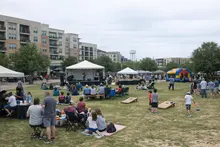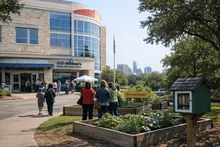
A neighborhood at the center of Austin’s changes
Mueller’s rapid build-out and steady foot traffic reflect Austin’s broader surge in housing demand and costs, even as the city continues to debate who benefits from that growth. The city’s Black population share fell from more than 13% in 2000 to 8% in 2010 and is about 7.5% in 2025, according to reporting by Austin Free Press. A 2018 study from the University of Texas School of Architecture found multiple East Austin tracts in active gentrification, with low-income Black and Hispanic renters most at risk of displacement.
Analyses of neighborhood change describe a shift toward higher-income residents and replacement of legacy businesses, which can weaken cultural networks that anchored communities, research from Mount Bonnell notes. As a master-planned district built on the former municipal airport site, Mueller sits along those fault lines, with new housing, retail and public spaces drawing citywide visitors while nearby neighborhoods manage rising costs and demographic churn.
Housing and displacement
The UT School of Architecture report identified 16 Austin neighborhoods as actively gentrifying and another 23 susceptible, with East Austin a focal point of displacement pressure, according to the University of Texas School of Architecture. Those patterns help explain the citywide decline in Black population share. Local histories also show a much different past: Black residents comprised 17% of Austin’s population at its founding in 1840, rising to 29% by 1860 and peaking near 37% after the Civil War, according to Austin Free Press.
As neighborhoods turned over, long-time residents reported feeling pushed to the margins. “Gentrification and the rising cost of expenses are definitely at the core,” said Brandon Boone, co-founder of Where Y’all At Though. “People think Black people don’t exist here. And it can be tough to find community if you’re not intentional. So we make it easy,” Boone told Austin Free Press.
Local cultural response
Where Y’all At Though (WYAT), founded in 2023 by Boone, Erinn Knight and Lauren Light, began as an online calendar and now curates monthly gatherings and seasonal collaborations across the city, according to Austin Free Press. The group’s “Auntie’s House” series is designed as a family-style meet-up. “We wanted to recreate that memory of hanging out with your cousins at your Auntie’s house,” Boone said. “It’s a safe place to be yourself.”
WYAT partnered with the Black Auteur Film Festival on Juneteenth weekend and drew more than 1,000 attendees, according to Austin Free Press. The group is also planning Vibe Weekends with the Black-led Downtown Austin Alliance on Old Sixth Street, the notes state. “I’m definitely seeing a lot of more collaboration amongst curators,” Boone said. “Together we are laying down a great foundation for Black Austin to grow.”
Art Is Cool, founded by Austin native Funmi Ogunro, documents Black history through film and hosts public programs that combine music, food and oral history, according to Austin Free Press. In March, the group produced the Rise! Freedom Communities Festival at Pease Park, previewing a feature film on post–Civil War Freedom Colonies and featuring readings by Austin Poet Laureate Zell Miller III. Ogunro said her free events are about “sharing information, taking up space, and reclaiming the spaces that used to be ours.” She added that collaboration “just makes us stronger.”
Water Your Plants (WYP), launched by Jazmine and Tamuka Simango, focuses on networking for Black professionals with roots in the tech sector. “There’s been a lot of layoffs in the tech industry,” Jazmine said. Tamuka added: “For the past four years prior to 2025, (diversity, equity and inclusion) DEI was championed. Now companies seem to be penalized for celebrating diversity of thought and diverse hiring,” according to Austin Free Press.
WYP’s “If You Know You Know” happy hours function as third spaces for career and social connection. Its Black in Business showcase featured Black-owned small businesses; its Y’all Hiring event brought recruiters from Google, Nvidia and Meta to share advice. WYP also co-hosted The Function: A Juneteenth Soiree with WYAT. “The highest compliment I ever got was from someone who came to one of our happy hours and said she forgot that she came by herself,” Jazmine said. Inside the venture, roles are clear. “Let’s not minimize this,” Tamuka said of his co-founder. “She is the co-founder, CTO, operations, HR — she does all the things and I just be talking.”
What organizers say
Boone, Ogunro and the Simangos describe similar operational hurdles. Time, cash flow, marketing and filings are persistent needs, according to Austin Free Press. “There is no overnight success,” Boone said, noting 30 collective years of curation experience. He credits outcomes to “an enormous amount of energy and consistency.” Tamuka’s advice to new organizers: “It takes time to build. You have to be a little delusional in your belief around an idea when you’re starting off … But I think the biggest thing you can tell someone is just start.”
Those constraints mirror broader community resource gaps described in local analyses of gentrification and neighborhood change, including the strain on legacy cultural institutions, according to Mount Bonnell.
Policy and program context
Research and local reporting point to steps that could affect how cultural life takes root in districts like Mueller:
- Expand tenant protections, increase affordable housing production and support community land trusts to reduce displacement pressure, according to the University of Texas School of Architecture and analyses summarized by Mount Bonnell.
- Create microgrants or multi-year operating support for Black-led cultural organizers to stabilize programming and cover production costs, a need reflected in organizer accounts reported by Austin Free Press.
- Leverage public-space programming and art commissions so that curators can operate in parks, plazas and corridors accessible to residents. The City’s cultural centers and festivals provide a template for community-facing events, according to the City of Austin. The Art in Public Places program’s open call offers commission budgets ranging from $100,000 to $625,000 for installations at city sites, which could increase visibility for underrepresented histories if access is equitable, according to Axios.
What comes next
As Mueller matures, it functions as a gathering point for residents from across Austin. The district’s parks and streets are part of a larger question about how public space supports cultural life as neighborhoods change. The organizing described by Boone, Ogunro and the Simangos shows one path: build consistent, open events; document history; and align with partners who can provide venues and resources, according to Austin Free Press.
If the city’s housing tools and cultural programs move in tandem, neighborhood nodes like Mueller could host more public storytelling and intergenerational gatherings while nearby communities address displacement pressures identified by the University of Texas School of Architecture. The work underway by local curators suggests a model that can travel across districts without losing its roots.
Read the press release on austinfreepress.org.