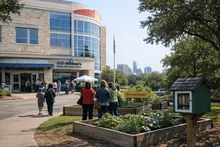
On a weekday morning in Mueller, the big windows at Halcyon no longer glow with laptop light and cappuccino foam. The neighborhood coffeehouse — a de facto living room for stroller brigades, remote workers, and late-night open-mic fans — has shuttered its Mueller location, a jolt in a community built on walkable routines. The downtown outpost remains open, but the Mueller closure followed a quiet pullback on events in July “due to business demands,” according to CultureMap/Austin.
A neighborhood loses a living room
Halcyon’s exit lands differently in Mueller, where density, parks, and steady foot traffic have long supported coffee and casual dining. The shop’s airy daytime vibe and nightlife programming helped bridge those dayparts. Its absence will ripple to adjacent businesses that benefited from shared traffic — a reminder that in master-planned neighborhoods, third places do more than caffeinate.
The past year has offered plenty of evidence that no pocket of the city is immune to churn. The highly regarded Aviary Wine & Kitchen on South Lamar “seems to have closed,” amid an eviction notice and staff departures, as first noted by Eater and relayed by CultureMap/Austin. On the north side, Japanese hot pot favorite DipDipDip Tatsu-Ya closed its Burnet Road restaurant after six years, with owners planning a new concept in the space, according to Houston Chronicle reporting.
City headwinds, local habits
Austin’s restaurant math has been rewritten by growth and affluence as much as by costs. The city’s population is nearing the million mark, and median household income topped roughly $91,000 in 2023, with poverty still hovering around 11–12%, data from the U.S. Census shows. That mix of new customers with higher spending power and long-time residents watching budgets creates both opportunity and volatility.
Meanwhile, wealth is concentrating and housing costs remain elevated. Households earning $200,000 or more grew by about 284% from 2010 to 2023, while every tier under $75,000 shrank, and median home prices jumped from roughly $229,000 in 2010 to nearly $595,000 by April 2024, according to an analysis from CultureMap/Austin. Rising rents and buildout costs follow those curves, making neighborhood concepts like Halcyon uniquely vulnerable when a few slow months coincide with lease pressures.
Operators also face evolving diner expectations. Sustainability and sourcing — once niche talking points — are mainstream. “quality/actually good restaurants in Austin are inherently farm-to-table, and that farm-to-table sourcing is an essential foundational building block of what makes for a true Austin restaurant,” said Phillip Frankland Lee, chef, in reporting by the Austin Chronicle. Those ideals carry costs and logistical challenges, even as they confer cultural cachet and, increasingly, critical rewards.
Openings point to what’s working
Newcomers around town hint at strategies that could translate back to Mueller: flexible footprints, daytime focus, and built-in audiences.
- Pizza aligns with beer crowds at St. Elmo: Good Vibrations, a wood-fired pizza trailer, has taken up residence at Vacancy Brewing, serving mostly traditional pies with creative twists and late-night hours; its opening weekend features specials and giveaways, according to CultureMap/Austin.
- Daytime comfort on West Sixth: SusieCakes, known for retro-style confections, is opening a second Austin location with a grand opening September 6 from 3–6 pm, including giveaways and a burnt-orange “Hook ’Em Cupcake” perk, per CultureMap/Austin.
- Irish fare for early hours downtown: Neighbourhood Café, sister to a new 6th Street pub, is now serving baked goods and breakfast-and-lunch plates daily from 8 am to 3 pm, reported by CultureMap/Austin.
- Pairing food with existing bar traffic: Downtown’s Fareground is threading the needle by combining the former South Texan pop-up Y Comida with the onsite cocktail bar Ellis, an incubation-style mashup noted by CultureMap/Austin. And up at the Hopsquad building, Kramer's Cocktails is leaning into agave spirits and, crucially for Texas summer, air conditioning, according to CultureMap/Austin.
Small menu pivots matter, too. Home Slice spent nearly a decade auditioning dairy-free options and now offers a coconut- and chickpea-based vegan cheese from Selfish Cow by the slice, a tweak flagged by CultureMap/Austin. Family-friendly gestures keep foot traffic rolling: Lick Honest Ice Creams built a National Dog Day promo around “pup cups,” bandanas, and freebies on August 25 and 26, also noted by CultureMap/Austin.
Signals from the wider food scene
Even as mid-market neighborhood venues shuffle, top-tier restaurants hold their ground. Austin retained seven one-star restaurants in the 2025 Michelin Guide for Texas, while Nixta Taqueria earned a Green Star for sustainability and two local spots — Mercado Sin Nombre and Parish Barbecue — joined the Bib Gourmand list, emphasizing value, according to Eater Austin. The juxtaposition is telling: sustainability and affordability both command attention at the extremes of the market.
At the same time, the pipeline of new concepts remains robust — from fast-casual to socially conscious imports — even as beloved storefronts bow out for lease or lifestyle reasons. Recent coverage catalogued openings like Twin Isle, Café Crème, La La Land Kind Cafe, and Siti, alongside closures including JewBoy Sub Shop and Jim Jim’s Water-Ice, illustrating the push-pull of growth and attrition, as reported by Austin Post.
For Mueller, Halcyon’s departure is a prompt, not a verdict. The neighborhood’s café culture was never about a single sign on a single corner; it’s the sum of morning rituals, stroller-friendly sidewalks, and a community willing to back the places it loves. As operators citywide experiment with shared spaces, daytime business models, and sustainability-minded sourcing, Mueller’s next living room is likely to be shaped by those same forces — and by the neighbors who decide where to linger next.