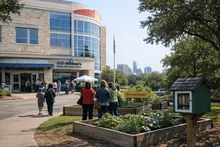
As summer crests and neighbors lean into slow mornings, Mueller’s Sunday market is set to feel more like a block party than a weekly errand. Texas Farmers’ Market will cap National Farmers Market Week with a two-day festival across its two sites, Lakeline and Mueller, on August 12 and 13. Attendance is free with a suggested donation of $5 per person or family, according to Texas Farmers’ Market.
A weekend at the market
Saturday’s festivities begin at Lakeline with live music from New Orleans-influenced band the Mighty Pelicans, a kids’ scavenger hunt and face painting, plus chef demonstrations featuring fresh-sample tastings, according to Texas Farmers’ Market. Sunday’s program shifts to the Mueller market, where the soundtrack turns to “Pan-American Soul” from Frederico7. The headliner for home cooks is a chef demo by Philip Speer — a four-time James Beard Award nominee and owner of downtown’s Comedor — designed to showcase seasonal Texas produce in approachable ways, the market says via Texas Farmers’ Market.
The weekend’s format reflects how the organization treats its markets as community gathering spaces as much as retail hubs. “Every week, our small but mighty team set up and break down our markets — rain or shine, record-breaking heat or snow — and work tirelessly to provide vibrant community gathering spaces for all to participate in our local food economy,” said Executive Director Laura McDonald in a statement from Texas Farmers’ Market.
Access and inclusion
Texas Farmers’ Market is based in Austin and runs two markets every week, year-round: Saturdays at Lakeline and Sundays at Mueller. The markets are produced by F2M Texas, a nonprofit focused on educating producers and consumers about sustainable food systems, according to Texas Farmers’ Market.
Importantly for a city grappling with affordability, both markets accept SNAP and WIC and last year distributed more than $75,000 in benefits, the organization reports via Texas Farmers’ Market. The suggested $5 donation for the festival helps support that access work and the operational lift of free family programming without creating a paywall to entry.
Local business impact
Beyond weekend entertainment, the markets function as small-business incubators. Entire restaurants have found their footing through vendor stalls — Mum Foods and its cult-favorite pastrami is a frequently cited example — and vendors often graduate into brick-and-mortar spaces. In 2022, the markets generated a reported economic impact of $7.5 million, according to Texas Farmers’ Market.
Industry analysis suggests how that figure reverberates through the neighborhood. Research from FarmstandApp shows that money spent at farmers markets tends to stay close to home; for every $100 spent, roughly $62 recirculates into adjacent businesses and services. That multiplier effect helps explain why a crowded morning at Mueller can translate into fuller coffee shops, busier lunch counters and steady foot traffic for nearby retailers.
Why Mueller’s Sunday matters
Mueller’s market has evolved into a weekly civic ritual: dogs stretched out by the shade, strollers navigating a maze of tomatoes and tortillas, neighbors comparing notes on recipes and school start dates. In a city that’s both fast-growing and diverse, the programming lands broadly. U.S. Census data compiled by CensusDots indicates Austin’s population tops 960,000 and reflects a mix of racial and ethnic communities, including sizable Hispanic/Latino and Asian populations alongside white and Black residents. Family-friendly elements like a kids’ scavenger hunt — paired with chef demos that pull in seasoned cooks and curious beginners — give the market a wide on-ramp for participation.
For Mueller residents, the Sunday festival’s draw is as practical as it is celebratory. The neighborhood’s walkability makes stocking up on eggs, greens and salsas part of a morning loop around the park; adding live music by Frederico7 and a teaching moment from Speer turns routine shopping into a shared experience. That’s central to the market’s mission to keep local food visible and viable, according to Texas Farmers’ Market.
The bigger picture
Texas Farmers’ Market’s dual role — groceries and gathering place — has outsized resonance in Austin’s current moment. With cost pressures on both households and small producers, the acceptance of SNAP and WIC and the continuation of free programming are not mere add-ons; they are core to the markets’ value proposition, as reflected in the more than $75,000 in benefits distributed last year via Texas Farmers’ Market. The organization’s reported $7.5 million economic impact and the documented multiplier effect from FarmstandApp suggest those Sunday mornings ripple well beyond the tents.
This weekend’s festival underscores what regulars already know: Mueller’s market is where the city’s food economy meets its sense of place. As vendors set up and the band tunes, the familiar circuit from stall to stall becomes a reminder that community infrastructure can be as simple as a shaded table, a ripe peach and a reason to linger.