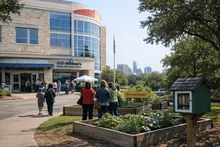
In Mueller, L’Oca d’Oro shifts from dining room to production line
The dining room at L’Oca d’Oro sits quiet on Simond Avenue, but the kitchen hasn’t gone still. In the pandemic’s early months, the Mueller Italian restaurant retooled to cook at scale for neighbors in need and to keep staff on payroll. “L’Oca d’Oro is not really a restaurant right now so much as a food production facility,” co-owner and general manager Adam Orman said, describing the pivot as a deliberate move to protect workers and stabilize revenue, as reported by Eater Austin.
From Dining Room to Production Line
Orman said the team chose not to reopen the dining room while virus spread remained high. “We were not going to open our dining room and risk the health of our employees until numbers were much lower for much longer than they’ve been,” he said, according to Eater Austin. In place of nightly table service, the restaurant focused on batch cooking and packaging meals that could be distributed quickly.
The restaurant’s chef and co-owner, Fiore Tedesco, helped design menus that travel well and oversaw the streamlined kitchen workflow. The operation produced food for community distribution, a shift that turned a neighborhood date-night spot into a production kitchen.
Feeding the Community, Keeping Staff Employed
The scale of the change was significant. “We aggressively sought contracts from the city to prepare meals for food-insecure populations that would allow restaurants to hire back staff, feed people, and generate predictable, consistent revenue,” Orman said. “In the last six months, L’Oca and other Good Work Austin restaurants have produced over 300,000 meals funded by the city, grants, and donations,” according to Eater Austin.
The need was—and remains—broad. Data from the City of Austin shows that approximately 16.2% of Travis County residents, or about 158,270 people, experience food insecurity. That local context helps explain the demand for large-scale meal programs originating from kitchens like L’Oca d’Oro, especially as Austin’s hospitality sector absorbed a severe shock after the cancellation of major events such as SXSW and the Austin City Limits Music Festival during the pandemic, according to Wikipedia.
Safety First in a High-Risk Industry
Inside the Mueller kitchen, management leaned on strict protocols. “No guests. Our staff are temped every day. They have masks on while in the building at all times,” Orman said in the interview with Eater Austin. He described limits on kitchen occupancy—no more than 12 people at once—along with team-wide PCR and antibody testing and signed health declarations to reduce risk in and outside of work.
Those measures mirror broader foodservice recommendations for reducing COVID-19 transmission—mask use, temperature checks, distancing in work areas, and testing strategies—outlined by StateFoodSafety. The guidance emphasizes structured monitoring, PPE, and staggered staffing to keep production lines moving while limiting exposure.
Reaching Customers at Home
Alongside its contract cooking, L’Oca d’Oro maintained ties with regulars through a paid subscription program. “In addition to this food-access work, we launched a subscription service with weekly and monthly options and curated wine pairings,” Orman said. “We send subscribers an email on the week of pickup with instructions on preparing their meal at home. Chef Fiore Tedesco and his little friend Chef Luigi [a puppet] shoot a video for each meal to help guide people through the finishing steps. Support has been tremendous,” as reported by Eater Austin.
The videos, which feature Tedesco in the role usually played from across the pass, translate restaurant techniques to home kitchens. Tedesco said the goal was to preserve a sense of hospitality while ensuring dishes could be finished safely and consistently at home.
The Uncertain Road Ahead
The business case for the pivot is complicated. “This model works, but we’re basically making five times the amount of food at 12 percent the cost,” Orman said, according to Eater Austin. The scale has allowed the restaurant to rehire staff and shield them from whiplash between closures and reopenings. But the model depends on public contracts and philanthropic support. As emergency dollars ebb, operators face questions about sustainability.
Industry guidance suggests documenting outcomes—meals produced, recipients reached, and satisfaction—as well as diversifying revenue streams to hedge against funding volatility, according to StateFoodSafety. Those steps can help demonstrate impact to funders and build a bridge back to a more balanced operation.
For now, the work continues. Orman said the team would keep pushing for resources and maintain stringent safety rules within the four walls on Simond Avenue, as reported by Eater Austin. In Mueller, the restaurant has found a way to serve its neighborhood—both literally and figuratively—by turning a dining room into a distribution point and a kitchen into a community asset. The need in Travis County remains high, the economic aftershocks are still felt in hospitality, and the questions about what comes next are not all resolved. But the framework forged in this period has revealed how a neighborhood restaurant can function as part of the city’s response.
Read the press release on austin.eater.com.