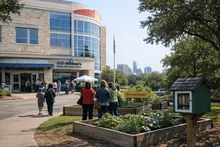
On a weeknight in Mueller, families drift around Lake Park as red‑winged blackbirds work the reeds and bikes roll along the Southwest Greenway. The same mix of daily routine and living habitat sits at the center of Our Texas, Our Future, a five‑part documentary short series from H‑E‑B that uses Texas parks and wildlife stories to frame simple steps residents can take at home. The films were produced with Fin & Fur Films and narrated by Austin musician Shane Smith, with a steady focus on the work that keeps nature intact, according to the H‑E‑B newsroom.
"H‑E‑B has a deep commitment to support all Texans, and that includes helping to protect, conserve, and beautify our great state for people to enjoy now and for generations to come," said Leslie Sweet, H‑E‑B's Managing Director of Sustainability and Environmental Affairs. "We’re excited to support these passionate filmmakers and their mission to tell important stories that we hope will inspire people to celebrate and protect the diverse habitats, unique wildlife, and beautiful landscapes across Texas." That statement came in an announcement of the series and H‑E‑B’s partnership with Texas Parks & Wildlife Foundation, reported by the H‑E‑B newsroom.
At Mueller, a local lens
For neighbors who use Mueller’s trail system or bring school groups to the Thinkery, the series offers ready links to the spaces just outside the front door. Venues such as Alamo Drafthouse Mueller, Branch Park Pavilion, and the Browning Hangar give community groups options to host discussions or educator meetups built around the films’ themes. The neighborhood’s lake edge plantings and prairie pockets along the Greenway also give families a spot to turn a film night into a Saturday morning bird or insect count.
The films cover topics that resonate with Austin life. One short spotlights Bracken Cave, which hosts a very large colony of Mexican free‑tailed bats and anchors a conversation about nightly flights, pest control, and agriculture, according to the H‑E‑B newsroom. Another follows ocelot conservation on private ranch land; ocelots are critically endangered in the U.S., a reality the filmmakers press into clear view, noted by the H‑E‑B newsroom.
What the films cover
The five shorts move from coast to desert. Redfish Revival revisits the push that rebuilt a fishery. Second Chance documents the slow return of black bears in West Texas. A Century Celebration: Texas State Parks looks at a system that spans 1.5 million acres and draws about 10 million visitors each year, a scale that shows how many Texans rely on public land for time outside, according to the H‑E‑B newsroom.
For Mueller residents, the sweep of those subjects mirrors what makes Austin’s own green pockets work. Data from the Texas Parks & Wildlife Department counts nearly 800 fish species, 443 butterflies, 639 birds and about 5,000 native plants across twelve ecoregions in Texas. That diversity cuts through parks, creeks, grasslands, and backyards. It also sets a baseline for school projects and neighborhood stewardship.
How the series connects to local work
The films give teachers at Mueller‑area campuses and educators at the Thinkery material for modules on pollinators, springs, and night skies. Families can match scenes from the bat and ocelot films with basic steps at home—securing trash, keeping pets on leash on trails, planting native species in patios and courtyards, and pointing porch lights downward to reduce glare during migration.
Conservation also moves through state and regional projects. The Texas Parks & Wildlife Foundation reports more than 215,000 acres permanently protected since 1996 and over 110,000 acres restored. Those numbers sit behind the healthy edges of rivers and prairies that feed urban biodiversity. In East Texas, the Texas Parks & Wildlife Department has designated the Trinity River Wildlife Management Area on 6,900 acres with 11.3 miles of river frontage, the first new WMA in that region in nearly two decades, according to mySanAntonio. While that work happens far from Mueller, it supports migratory birds and river systems that cross the state and reach Central Texas.
H‑E‑B’s role, beyond the screen
Our Texas, Our Future is part of a broader push that ties retail to conservation goals. H‑E‑B describes a Field & Future by H‑E‑B product line that channels support to statewide projects in partnership with the Texas Parks & Wildlife Foundation, including coastal conservation, black bear restoration, and the establishment of Palo Pinto Mountains State Park, according to the H‑E‑B newsroom. The model gives households a way to align routine purchases with habitat work as they plan dinners, school lunches, and weekend outings around the Mueller H‑E‑B and nearby markets.
That partnership sits within a wider conservation ecosystem. Land protection and restoration totals from the Texas Parks & Wildlife Foundation illustrate how private philanthropy and corporate support backstop public investment. And biodiversity counts from the Texas Parks & Wildlife Department show why urban neighborhoods benefit when statewide programs hold.
Ways neighbors can plug in
The films aim to inspire action that fits daily life. In Mueller, that can look like:
- Joining a weekend litter pickup around Mueller Lake Park or the Southwest Greenway, or organizing a block‑by‑block cleanup on side streets that drain to the lake and bog.
- Planting native grasses and perennials in courtyards and patios to support butterflies and birds, then sharing plant lists with neighbors.
- Coordinating a film night and discussion at a local venue such as Alamo Drafthouse Mueller, the Thinkery, or a community room, with a follow‑up walk to look and listen for birds and bats at dusk.
- Bringing short clips into classrooms and after‑school clubs to build lessons around migration, water cycles, and urban ecology.
The series’ subjects—bats, redfish, black bears, ocelots, and the state park system—cover different corners of the map, but they point home. In Mueller, the loop around the lake, the open turf at Branch Park, and the prairie pockets along the Greenway give residents a test bed for small, steady work. The films give a blueprint for that work and a reminder that neighborhood habits connect to state‑level land, water, and wildlife.
Read the press release on austin.culturemap.com.