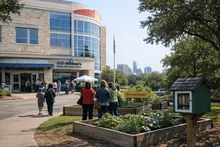
Mueller families, seniors, students and unhoused neighbors felt the SNAP interruption immediately because it hits the exact line items—groceries and basic meals—that keep a household stable. “Missed paychecks and not being able to afford your weekly groceries don’t just hurt a few people,” said Kirk Watson, Austin Mayor. “These losses hurt kids, families and communities. It also places additional pressure on local governments and nonprofits already struggling from losing federal funds earlier this year.” said Andy Brown, Travis County Judge. In Mueller, that pressure shows up at school drop-off lines, in the service-worker apartments near Aldrich Street, and among hospital staff and patient families moving in and out of Dell Children’s Medical Center of Central Texas, where food costs can compound medical stress.
1) Start with the fastest “today” options, then work outward. If you need food the same day, prioritize no-registration access: ATX Free Fridge Project community fridges (open 24/7; no sign-up), then free-meal sites like the Sunrise Homeless Navigation Center weekday meal service at the Sunrise Hub day center (especially helpful for unhoused neighbors), and then pantry partners that can move quickly through a line like El Buen Samaritano (drive-up/walk-up, no reservation). If you can plan a day ahead, use appointment-based partners such as Harvest Blessings (registration for a pickup slot required) or check-in systems like Food For All in Pflugerville (check-in required; generally once per day). For students, Riverbat Bites food pantries at Austin Community College campuses are available to currently enrolled students during posted hours; for seniors who are homebound, Meals on Wheels Central Texas requires an application, but it’s the most practical route when shopping and cooking aren’t feasible.
2) Use the Central Texas Food Bank as your map and backbone. The Central Texas Food Bank (CTFB) is still the region’s main hub for finding pantries and hot-meal sites across Travis County, including mobile pantry outreach (expanded with Feeding America). The scale matters: after the shutdown-driven spike, the food bank said it was serving about 610,000 food-insecure people across its 21-county service area, with demand up nearly 50%. “We are now serving 610,000 food-insecure individuals in the 21 counties we serve just as a result of the government shutdown and a loss of SNAP benefits.” said Sari Vatske, President, Central Texas Food Bank. If you’re in Mueller and can travel, start by searching CTFB’s pantry finder for the closest partner sites; if you can’t, use their listings to find a mobile distribution that’s easier to reach than a fixed pantry.
3) Know the eligibility rules before you show up (so you don’t waste a trip). SNAP itself paused starting Nov. 1, 2025, and the interruption has been especially destabilizing because Texas has a high baseline reliance on SNAP: about 10% of Texas households receive benefits, and in Travis County, nearly 6% of households received SNAP in the past 12 months. Many pantry and meal programs do not require SNAP enrollment—most serve anyone who needs food—but access rules vary sharply. Travis County Food Pantry operates six locations and requires an application to access services; Meals on Wheels also requires an application. By contrast, ATX Free Fridge Project requires no registration at all, and several restaurant-based meal initiatives that ran during the disruption explicitly did not require proof.
4) Track the key timeframes—and treat them as “check before you go.” The SNAP pause began Nov. 1, 2025, and resumption timing was clouded by court orders and appeals; statewide, delays could impact more than 3.4 million Texans, including 1.7 million children, even when benefits eventually restart because backlogs and payment timing can still trigger a food gap. On the restaurant side, some help was date-limited: Aci offered a free cup of granita on Nov. 1, 2025 for anyone affected, while Gopuff offered $50 in credits for SNAP recipients through two promo-code windows (Nov. 1–15 and Nov. 16–30, 2025) by linking SNAP/EBT to an account and purchasing SNAP-eligible groceries. Other offers were recurring (for a period): Fitzhugh Brewing in Dripping Springs offered a free “SNAP Meal” (two sandwiches with sides) Thursday–Sunday with no verification required, and Korea House Restaurant offered free meals on the first Wednesday of each month.
5) If you can pay, restaurants can still be part of the emergency food network—without replacing pantries. During the SNAP delays, Austin restaurants like Wu Chow and Swift’s Attic served free meals to people affected, according to local reporting, showing how hospitality can fill short-term gaps when benefits or paychecks stall. That matters in Mueller because neighborhood destinations—like Alamo Drafthouse Cinema, a hometown standard-bearer we’ve previously profiled in our dinner-and-a-movie guide—also function as community gathering points; when restaurants step into relief, they’re meeting neighbors where they already are. If you’re using a restaurant initiative, ask staff exactly what hours they’re running the program and whether it’s still active; if you’re dining and want to help, ask how to sponsor or support “family meal” tabs so the program can keep going.
Avoid the most common mistakes that slow people down: (a) showing up to an application-based pantry without completing the intake first (especially at Travis County Food Pantry and Meals on Wheels); (b) assuming every CTFB partner has the same rules—some require reservations, some don’t; (c) bringing donations a pantry can’t store or distribute (glass containers, oversized bulk items, or foods that require special cooking access); and (d) overthinking donations until you give nothing. Austin’s public-health system has been strained even before a shutdown: Austin Public Health reported more than 101,800 residents used neighborhood center food pantries and other basic-needs services in FY2025, and the 2025 Austin-Travis County Community Health Assessment flagged food insecurity alongside housing, childcare costs and health access as linked pressures. “These assessments are essential to identifying needs in our community and how best to address them,” said TC Broadnax, Austin City Manager. “The needs of our community continue to evolve as we see rising issues with opioids, stress and just finding healthy food to eat,” said Dr. Desmar Walkes, Austin-Travis County Health Authority.
If you want to donate in a way that stretches farthest, prioritize cash to Central Texas Food Bank (bulk purchasing and retailer relationships typically multiply impact), then targeted food items pantries repeatedly need: peanut butter; canned chicken or tuna; low-sodium canned vegetables; canned fruit in its own juice; dry beans; brown rice; dry pasta; nonfat dry milk; whole-grain cereal; tomato sauce; canned tomatoes; and canned entrees. For food-waste prevention, restaurants and businesses can coordinate pickups through Keep Austin Fed; for drop-off simplicity, the Pflugerville Library accepts shelf-stable food during operating hours and also runs a care-kit program seeking hygiene items like toothpaste, toilet paper and soap. For mutual-aid, Austin Mutual Aid can connect donors directly to neighbors’ needs. And for the no-questions-asked, immediate-access layer that helps people who can’t navigate paperwork, community fridges remain critical—especially because, as Travis County estimates put local food insecurity at roughly 187,000 to 208,000 residents (including one in five children), need doesn’t stay confined to any single ZIP code. “People would be shocked to know just how many people are using these fridges to feed themselves,” said Kellie Stiewert, organizer. “We rely on the community to keep these seven fridges running.” said Kellie Stiewert, organizer.
Contact and access info (call before you go): Central Texas Food Bank, 6500 Metropolis Dr., Austin, TX 78744, (512) 282-2111, Mon–Fri 8 a.m.–5 p.m.; Travis County Health & Human Services (for county-run pantry locations and intake guidance), 5501 Airport Blvd., Austin, TX 78751, (512) 854-4100, Mon–Fri 8 a.m.–5 p.m.; Meals on Wheels Central Texas, 3227 E 5th St., Austin, TX 78702, (512) 476-6325, Mon–Fri 8 a.m.–5 p.m.; Sunrise Homeless Navigation Center (Sunrise Hub), 4430 Manchaca Rd., Austin, TX 78745, (512) 522-1097, weekdays for navigation services; meal service is typically weekday daytime—confirm by phone.
Forms and portals to use right now: Travis County Food Pantry intake application (county HHS intake), Meals on Wheels Central Texas client application, Austin Community College Riverbat Bites pantry access page for enrolled-student hours, and findhelp.org for ZIP-code-based filtering when you don’t know which program fits your situation. For businesses coordinating surplus-food donation logistics, use the Keep Austin Fed partner network signup; for mutual-aid requests and direct giving, use Austin Mutual Aid’s request and coordination channels. As programs and hours can change quickly, verify same-day details by phone before leaving Mueller—especially if you’re walking, biking, or relying on CapMetro connections.