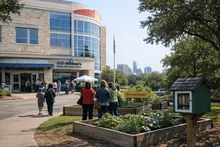
A familiar Austin food-truck success story is planting roots in Mueller. Korean-Mexican fast-casual operator Chi’lantro will open its sixth brick-and-mortar at 1201 Barbara Jordan Boulevard in December, keeping daily hours from 10:30 a.m. to 10 p.m., according to reporting from Eater Austin. The new storefront takes over the former PhoNatic space, extending the brand’s eastward footprint into one of the city’s most deliberately walkable neighborhoods.
Why Mueller
Built on the former municipal airport, Mueller spans 711 acres as a planned, mixed-use district designed for pedestrians, with nearly 7,000 residences and four retail and entertainment hubs that include Aldrich Street (home to the Thinkery and Alamo Drafthouse), the Market District anchored by an eco-minded H‑E‑B, a Regional Retail corridor, and a zone around Dell Children’s Medical Center. Those layers of homes, offices, parks, and destination venues translate into steady foot traffic throughout the day, a profile that often benefits quick, flexible concepts such as Chi’lantro, according to a neighborhood overview from Homes.
That context helps explain the timing and site choice. Families spilling out of the Thinkery on weekends, office workers hunting fast lunches, and moviegoers seeking post-show snacks are the kinds of demand spikes a fast-casual kitchen can handle if ordering is efficient. Operators across the segment are leaning on digital ordering, mobile apps, and kiosks to smooth those peaks, a pattern industry analysts have flagged as a defining trend for 2025, according to research published by Fast Casual.
What’s on the menu
Chi’lantro began as a food truck in 2010 and quickly built a following for its kimchi fries, a mash-up that helped define the city’s appetite for bold, cross-cultural flavors, as the company’s own site and local coverage note (Chi’lantro and Eater Austin). The menu at Mueller will mirror other units, with rice and noodle bowls, tacos, and salads augmented by proteins like beef ribeye, spicy chicken, marinated tofu, and grilled vegetables, plus the fries that started it all and Korean fried chicken wings, according to Eater Austin.
That lineup aligns neatly with the broader fast-casual shift toward customization—build-your-own formats and international flavors that diners can tailor to taste—which is fueling category growth, according to market analysis summarized by PR Newswire and trend spotters at Fast Casual. In practice, that means a menu built for swift assembly and personal tweaks—useful in a neighborhood where lunch rushes and pre-show dinners can swell suddenly.
Growth and risks
Founder Jae Kim secured a $600,000 investment on ABC’s Shark Tank, a national spotlight that provided capital for build-outs and a credibility boost as the brand eyed new markets. The company has discussed plans to take the concept to Houston and Dallas, though no addresses have been set, according to Eater Austin. For Austin, that capital also underwrote steady local expansion from a single truck to multiple stores, catering, and even a dedicated kimchi production facility that can support consistency as volumes grow, as described by Eater Austin.
The growth playbook reflects where the wider industry is headed. Analysts tracking the fast-casual segment point to sustained expansion driven by menu innovation and personalization, as well as technology that boosts throughput and accuracy—table stakes for maintaining margins in high-traffic nodes like Mueller, according to Fast Casual and market data compiled by PR Newswire.
There are caution signs, too. National peers show how momentum can be sustained—and where it can stall. Mediterranean chain Cava has posted standout revenue growth on the strength of new protein offerings and careful market selection, illustrating how disciplined expansion and R&D can translate to the top line, according to Reuters. On the casual-dining side, Chili’s recent same-store sales rebound highlights the impact of pricing strategy and targeted marketing on younger diners, lessons that can resonate even in fast-casual settings, as summarized by The Week.
For Chi’lantro, the execution risks are familiar across the category: holding quality steady on signature items, scaling supply chains for specialty ingredients, and staffing consistently in a tight labor market. Industry observers warn that these pressures intensify as brands add units quickly, especially without the training systems and tech backbone to keep operations humming, according to Fast Casual. The company’s kimchi facility and catering arm offer one built-in buffer on the supply side, as detailed by Eater Austin, while Mueller’s concentration of family attractions and a Sunday farmers market create clear avenues for neighborhood-level partnerships that can introduce the brand to new households, based on the district map from Homes.
What to watch next
When doors open on Barbara Jordan Boulevard, the bet is straightforward: a proven Austin brand meeting a master-planned neighborhood built for constant circulation. The hours and menu are designed for volume; the district’s anchors can feed reliable traffic; and the company’s growth capital and production infrastructure aim to keep quality consistent. The fast-casual tailwinds favor concepts that let diners personalize meals and order with minimal friction, trends that Chi’lantro’s bowls, tacos, and app-friendly format naturally fit, according to analysis from Fast Casual and market research cited by PR Newswire.
The next few months will show whether that alignment translates into lines out the door in Mueller—and how the brand applies any lessons to its Houston and Dallas ambitions. If Cava’s experience underscores the value of steady menu evolution and Chili’s highlights the power of calibrated pricing and audience targeting, the takeaway for Chi’lantro is to grow deliberately while protecting what made the kimchi fries a phenomenon in the first place, a balancing act the company appears poised to test in its newest neighborhood hub, as reported by Eater Austin and detailed in the Mueller profile by Homes.