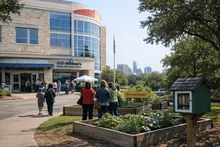
An Evening at Mueller Lake Park
On October 26, as dusk falls over the water and families fan out across the sloped lawn with blankets and lawn chairs, Mueller Lake Park will turn into an open-air theater for Hocus Pocus. The free screening is part of the Austin Parks Foundation’s long-running Movies in the Park series, which spreads family-friendly film nights across neighborhoods from spring into fall. For Mueller, with its dense mix of homes, apartments, and restaurants clustered around the park’s trails and lake, an easy, no-ticket night out is more than a seasonal diversion—it’s a reminder of how public spaces knit the neighborhood together.
“Movies in the Park” is designed to be low-barrier and local. Organizers bring the screen and sound; the community brings the crowd. The model is simple, but the impact is not. After several disrupted years for public life, the Foundation has framed these gatherings as part of a broader effort to welcome people back to their neighborhood green spaces. "It’s time for all Austinites to get back outside to enjoy their local park while enjoying a good movie. We want to welcome everyone back to Movies in the Park and all of our community events," said Collin Wallis, Austin Parks Foundation CEO, in a statement from the Austin Parks Foundation.
A Neighborhood Stage, Citywide Goals
The Mueller screening sits within a larger slate of outdoor activations that bring programming to parks across the city. Alongside movie nights, the Foundation has expanded free, family-centered events through Playdates in the Park—developed with Creative Action, an arts-based youth nonprofit, with story time, music, creative movement and hands-on activities for young children—aimed at reaching families where they already spend time, according to the Austin Parks Foundation.
Placing events in neighborhood parks matters in Austin, where access is uneven. Roughly 69% of residents live within a 10-minute walk of a park, but communities with higher shares of nonwhite residents have nearly 50% less parkland per person than whiter areas, and low-income neighborhoods have about 64% less park space than wealthier ones, reporting from Community Impact shows. By rotating free events through parks in different corners of the city—including Mueller’s centrally located lakefront lawn—programming can help close some of those experience gaps even as the system works on long-term land and investment needs.
What the Numbers Show
Austin’s park system compares favorably to national peers in several respects. The city maintains more than 500 parks covering about 11% of the land area, spends roughly $198 per resident each year on parks, and boasts a median park size of 6.7 acres—larger than the U.S. median—according to ATX Today. Those inputs have helped produce signature destinations like the hike-and-bike paths and lakefront gathering areas at Mueller.
But the city’s broader demographics underscore the stakes for equitable activation. Austin is home to an estimated 935,755 residents with a median household income of about $67,462. About 61.3% of households are considered rent-burdened and 9.6% of residents live below the federal poverty level, and the city’s racial and ethnic composition is diverse—roughly 48.3% White, 33.9% Latino, 8.5% Black and 7.5% Asian, according to GIE Equity. In a city growing more expensive, free cultural programming close to where people live can be a small but meaningful tool for inclusion.
Post-Pandemic Public Life, Rebuilt on the Lawn
Researchers tracking mobility and social contact patterns during COVID-19 have documented a lasting shift in how people use cities, including fewer and less diverse everyday encounters in public places. One analysis found the diversity of urban encounters dropped by an estimated 15–30% during the pandemic and had not fully rebounded by late 2021, with behavioral changes dampening cross-group mixing in shared spaces, according to arXiv. That makes geographically distributed, low-cost events like Movies in the Park—where neighbors of different ages and backgrounds share a lawn and a story—especially relevant to restoring the casual connections that define city life.
At Mueller, those connections play out in familiar, local ways. Residents walk over from nearby blocks with strollers and picnic baskets. Cyclists roll up along the park’s loop trail. Food from the surrounding mixed-use district appears across blankets—tacos, popcorn, and kid-friendly snacks—while the screen flickers to life. The setting is intimate enough that first-timers easily find a spot, and expansive enough to feel like a collective night out.
Why It Matters in Mueller
Hocus Pocus on Oct. 26 is one date on a citywide calendar, but it carries particular resonance for a neighborhood that was planned around its public realm. Mueller’s central lake and greenways are daily backdrops for dog walks, kids on scooters, and evening jogs. Turning that everyday stage into a communal theater for a night sends a simple signal: this space is for everyone, together.
As Austin weighs how to expand and maintain its park system equitably—and as residents continue to recalibrate routines—small, shared rituals can help build momentum. A free film on a Thursday night will not solve the city’s park disparities, but it can draw new faces onto the grass, nudge people to linger a little longer, and remind families that their neighborhood park is a place to gather, not just pass through. If public life is rebuilt encounter by encounter, Mueller’s lakefront lawn is a good place to start.
Read the press release on CultureMap.