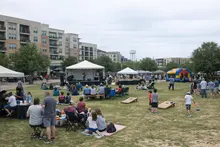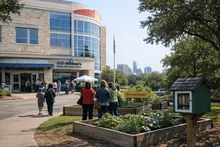
AUSTIN — On the former runways of the Robert Mueller Municipal Airport, the namesake neighborhood has become a full-fledged district of homes, parks and storefronts that draw thousands every week. As the master-planned community moves closer to build-out, residents and city officials are focused on a familiar set of questions for fast-growing Austin: how to keep housing accessible, streets safe, and public spaces open to all.
Housing pressure meets a long-term plan
Mueller was conceived as a mixed-use, mixed-income redevelopment guided by a long-term agreement between the City of Austin and master developer Catellus. The plan set aside a significant share of homes as income-restricted, with about a quarter of the overall housing stock intended to be affordable. Demand has remained high for those units, even as market-rate prices across the city rose over the last several years.
Neighbors and housing advocates say the resale restrictions on affordable for-sale homes have helped keep prices within reach for qualifying households. At the same time, renters point to tight vacancy in newer apartment buildings and the need to preserve affordable rents as the district matures. Small builders working within Mueller’s townhome blocks say materials and labor costs continue to complicate delivery timelines, even as interest rates stabilize.
Public space, everyday use
Parks and plazas are a hallmark of the plan. Mueller Lake Park, the Browning Hangar and the Southwest Greenway host daily foot traffic and regular events, with informal games and picnics sharing space with programmed activities. As the area grows, families have pressed for more shade, drinking fountains and public restrooms, and for slower vehicle speeds on connectors like Berkman Drive and Aldrich Street.
Business owners in the Aldrich district say steady foot traffic and neighborhood-based customers help sustain storefronts, but they are watching lease costs and parking policy closely. Cyclists and pedestrians continue to call for stronger protected connections to key corridors and transit stops beyond Mueller’s boundaries.
What residents say
Residents who participate in neighborhood and city advisory discussions have raised three recurring items:
- Keeping the affordable-housing pipeline on track as the final blocks come online.
- Managing cut-through traffic and parking spillover during events.
- Maintaining parks and trails with a focus on safety lighting, shade and access.
Parents and seniors alike emphasize street design around schools, medical facilities and busy intersections, asking for better crossings and clearer wayfinding. Others urge the city to ensure that storefront rents do not push out local operators as leases turn.
City response
City staff and the development team have pointed to the original Mueller framework—which ties housing, retail and parks to infrastructure phasing—as the guide for decisions on the remaining tracts. While specific timelines vary by tract and market conditions, officials say the project’s affordability goals and open-space commitments remain in force. Ongoing transportation work includes traffic calming on neighborhood streets, signal timing on major corridors, and incremental additions to the all-ages bike network connecting Mueller to surrounding neighborhoods.
Statewide context: parole hearing, public safety conversations
According to KVUE, Elmer Wayne Henley, one of the last surviving accomplices in the Dean Corll killings, has a parole hearing scheduled this week. KVUE reports that law enforcement recovered the remains of 28 teenage boys and young men killed between 1970 and 1973. The station’s reporting notes that Henley and David Owen Brooks were convicted in 1974 for their roles in some of the murders, and that Brooks died in prison in 2020, also according to KVUE. Pasadena demographics, as reported by Wikipedia, show a large and diverse community today, underscoring how high-profile parole cases can resonate beyond the immediate families involved.
Criminal-justice experts say parole reviews for long-incarcerated violent offenders in Texas typically weigh several factors, including the severity of the offense, institutional conduct, rehabilitation and treatment, psychological evaluations, victim-impact statements and concrete release plans. As outlined in coverage by KVUE, boards generally consider:
- Nature and severity of the original offenses
- Disciplinary record and rehabilitation programming in prison
- Psychological risk assessments
- Victim and survivor input
- Specific supervision and housing plans if released
Why this matters in Mueller: Public-safety concerns—from lighting in parks to event security and traffic—often surface in local planning meetings. Statewide debates about parole and accountability can influence how communities think about safety and prevention close to home, even as Mueller’s day-to-day concerns remain focused on design, maintenance and local policing.
Institutions anchoring a district
Major employers and institutions have transformed the area’s profile. A pediatric hospital campus, a regional children’s museum, and offices for public- and private-sector employers help sustain daytime activity and support nearby restaurants and services. Grocers and neighborhood-scale retail add daily needs within walking distance, a goal that early planning documents identified as essential to lowering car trips and keeping local dollars in the community.
Transit access and street safety continue to shape how people use the district. Bus connections and multiuse trails stitch Mueller to the east side and central city, while advocates push for safer crossings at the edges where faster arterials meet neighborhood streets. As Austin revises citywide land-use and mobility policies, residents here are watching how broader changes might interact with a built-from-scratch plan that tried to pre-wire walkability.
Next steps
With only a limited number of sites left to fill, attention is shifting to long-term stewardship: how the homeowners’ associations, public-improvement districts and city departments will fund shade, tree care and facilities as assets age; how affordability commitments are monitored; and how small businesses can stay rooted as rent cycles reset. The city’s implementation meetings for the Mueller plan remain a key venue for updates on infrastructure, housing allocations and open-space maintenance.
The decisions made in the coming months will be less about what Mueller becomes and more about how it endures. That is the work of a maturing neighborhood: to keep a promise—homes for a range of incomes, active parks, local shops—even as market forces and population growth test the blueprint.
Read the press release on muelleraustin.com.