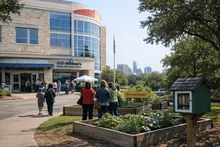
A national scare, a local check-in
After a week of sobering national headlines about a thwarted Halloween-weekend plot in Michigan, the Mueller neighborhood is doing what Austin neighborhoods tend to do in uncertain moments: taking stock, comparing notes, and asking what vigilance should look like close to home.
Federal officials said they disrupted an alleged plan in Michigan and made multiple arrests, a reminder that threats sometimes surface far from where families gather for Friday-night dinners near Aldrich Street or joggers loop around Mueller Lake. In a public statement, the bureau said, “This morning the FBI thwarted a potential terrorist attack and arrested multiple subjects in Michigan who were allegedly plotting a violent attack over Halloween weekend,” according to the FBI. The agency did not release operational specifics, and investigators often withhold details to protect ongoing cases and prosecutions, also noted by the FBI.
What police say
Local law enforcement typically coordinates with federal partners when national cases capture public attention, and Austin officials emphasized the value of early reporting and routine situational awareness rather than dramatic changes to daily life. While no detailed threat information has been released publicly regarding Austin, the pattern in recent disruptions offers a guide: agents build cases quietly and move when they believe a plot is actionable. Earlier this year, for example, federal agents arrested 19-year-old Ammar Abdulmajid-Mohamed Said in Michigan after an undercover operation infiltrated his circle; investigators alleged he had scoped out a U.S. Army facility and even launched a drone before he was taken into custody on the planned day of attack, according to the FBI.
That kind of proactive approach—surveillance, undercover work, and fast arrests—has become a hallmark of domestic counterterrorism. It echoes lessons from the 2020 kidnapping conspiracy against Michigan Gov. Gretchen Whitmer, a case often cited in risk briefings and historical context, according to Wikipedia. In that case, federal agents embedded with the conspirators; 13 people were arrested and most were later convicted. “They had no real plan for what to do with the governor if they actually seized her. Paradoxically, this made them more dangerous, not less,” Assistant U.S. Attorney Nils Kessler argued in a court filing at the time.
Neighbors and officials respond
In Mueller, where weekend foot traffic swells around the parks and market district, neighborhood leaders and property managers have been reminding residents of simple habits that matter: keep porch lights working, lock ground-floor windows, and don’t prop open shared doors in multifamily buildings. Parents tracking Halloween events are also comparing routes and meet-up points, and several buildings have reiterated protocols for reporting suspicious activity to emergency dispatch.
Citywide, Austin Police Department community officers often encourage residents to:
- Call 9-1-1 to report immediate threats; use nonemergency channels for after-the-fact concerns.
- Share clear descriptions (location, clothing, direction of travel) when reporting suspicious activity.
- Coordinate with building managers or homeowners associations on cameras, lighting, and access control.
- Walk in pairs after dark on less-traveled blocks and use well-lit routes around Mueller Lake and the town center.
Those steps are ordinary, not alarmist. They reflect a community that hosts festivals, farmers’ markets, and daily commerce—spaces that depend on attentiveness as much as on law enforcement. Neighbors said the tone this week is measured: alert, but determined to keep routines intact.
What national trends show
The Michigan disruption is not an isolated case, and the broader backdrop helps explain why some Austinites are thinking twice about safety, even without a specific local threat. Analysts and civil rights monitors have documented a rise in politically motivated incidents in the U.S. since late 2023, including a spike in antisemitic harassment and violence that has altered behavior for many families, according to Time. Those patterns intersect with heightened risks to public officials nationwide. Recent prosecutions underscore the point: courts have been handling a stream of high-profile cases, and roughly 150 politically motivated attacks were recorded in the first half of 2025, according to Reuters.
Law enforcement leaders also point to a string of prevented attacks as evidence that coordination works. Recent disruptions in other states—including the alleged Halloween-weekend plot in Michigan—were brought to a halt before violence unfolded, according to the FBI. The bureau’s use of undercover operatives and confidential sources, illustrated again in the Said case, remains central to those outcomes, the FBI says.
The view from Mueller
Mueller has grown into a dense, mixed-use district where families, students, and seniors share trails, transit, and townhomes—making security a collective enterprise as much as a policing function. Residents here tend to traffic in pragmatism: keep an eye out, check in with neighbors, and let officers know when something feels off. That approach aligns with what investigators say they need most: timely tips and patience as cases develop behind the scenes. Officials said they would provide more details later in the Michigan matter, and federal agencies declined to release tactical specifics to avoid compromising the investigation, according to the FBI.
The national climate is undeniably tense, but the lesson in Mueller is steadiness. Public spaces are busiest when people feel they belong in them. The way to keep it that way, residents and officials agree, is to stay visible, stay informed, and avoid letting distant threats hollow out local life. As the fall calendar fills and holiday events draw crowds to the parks and plazas, neighbors here are opting for calm vigilance—eyes up, lights on, and community first.
Read the press release on kvue.com.