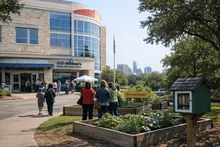
A downtown scare hits close to home in Mueller
The Austin Central Library is 3 miles from Mueller, a short ride many residents make for weekend programs, study space and views of the river. That familiar commute is why last weekend’s downtown shooting ripples east: investigators say the suspect moved by city bus before and after the attack, the same system thousands in Mueller rely on daily.
How it unfolded
Court documents and the Austin Police Department say the suspect, identified as 55-year-old Harold Newton Keene, is tied to two shootings on Saturday. Around 1:30 a.m., officers responded to a CapMetro bus in the 3200 block of Guadalupe Street after a passenger reported that Keene made erratic comments, appeared to take drugs and threatened riders with a gun. As the passenger stepped off at a stop, Keene allegedly fired and grazed his hip before fleeing on a scooter, the documents say.
Later that day, police were called to the Austin Central Library. Surveillance showed a man matching Keene’s description leaving the sixth-floor area shortly after a victim ran from a bathroom with a gunshot wound, according to the documents. Investigators said the suspect again boarded a CapMetro bus. CapMetro staff reviewed video and spotted him getting off at the Brodie Oaks shopping center near South Lamar and State Highway 71. Patrol officers found Keene near a Starbucks and recovered a bag carrying a stolen pistol and drugs, APD said in its report; he was arrested and booked into the Travis County Jail.
Police said both victims are expected to recover. The sequence was contained quickly. The incident involved one suspect and one victim and was not treated as an active-shooter event, and the suspect was apprehended roughly an hour after the downtown shooting, according to Associated Press.
What officials say about charges and penalties
Travis County jail records and court filings list 10 charges against Keene tied to the two scenes, including aggravated assault with a deadly weapon, deadly conduct, tampering with evidence and an application to revoke probation. A bond order requires him to stay away from the Austin Central Library and all CapMetro buses, according to the court documents.
For context, Texas law generally classifies aggravated assault as a second-degree felony punishable by two to 20 years in prison and up to a $10,000 fine; when a deadly weapon is involved or serious injury results, it can be charged as a first-degree felony with possible penalties ranging from five to 99 years or life, with the same fine cap, according to LegalClarity.
Transit’s double role: mobility and evidence
In this case, buses appear to have provided both an escape route and a trail of evidence. CapMetro’s onboard footage and timestamps helped investigators trace the suspect’s movement from downtown to South Austin, the police documents show. The dynamic fits a broader pattern in urban systems: large commuter flows can shape where and when crime occurs, even if most riders and trips are uneventful. Academic research cited by arXiv links increases in inbound commuters to measurable upticks in certain offenses such as theft and burglary, highlighting how mobility influences opportunity and policing needs. At the same time, transit networks generate surveillance video and rider reports that can accelerate identification and arrest, as this investigation suggests.
Local concerns in Mueller
Mueller is closely tied to downtown by CapMetro routes, with many residents riding for work, medical appointments and library visits. While this weekend’s violence occurred elsewhere, the method of travel resonates. Parents heading to story times, students using study rooms and workers commuting along Airport Boulevard corridors share the same public spaces and expectations of safety.
It is also important to place the fear in context. Austin’s violent crime rate has run higher than the national average in recent years, yet the city recorded declines in key categories through early 2024. Violent crime fell about 6% and homicides dropped more than 17% in the first half of 2024 compared with the same period in 2023, according to Axios. One alarming incident does not rewrite those trends, but it does test confidence in shared civic spaces.
What changes might follow
Library and transit-safety specialists point to steps that are practical and consistent with how this case was solved. Public libraries commonly rely on cameras, staff training and emergency plans; the downtown investigation underscores how those pieces connect with transit operations. Based on investigative takeaways from police documents and standard public-library guidance, local institutions in and around Mueller could:
- Formalize rapid-sharing protocols for transit and building surveillance footage with APD to speed suspect identification.
- Rehearse joint drills so library staff, security and officers know roles, exit routes and communication channels.
- Expand de-escalation and suspicious-behavior recognition training for front-line staff and contractors.
- Audit camera coverage for blind spots in stairwells, restrooms-adjacent corridors and entries, and ensure secure, expedited access for investigators.
- Maintain a visible but low-friction security presence that reassures patrons without creating barriers to access.
- During booking, integrate behavioral-health screening when reports indicate possible intoxication or erratic behavior, a step many agencies already take.
None of these measures eliminate risk, but together they can shorten response times, improve evidence collection and keep community spaces welcoming.
Outstanding questions
Several details remain unclear. Authorities have not released a motive. Beyond the “expected to recover” updates, the extent of the victims’ injuries is not public. Court filings outline current charges and bond restrictions, but additional records may clarify the suspect’s background and probation status. APD’s full timeline, along with CapMetro’s exact video markers, would further document the hour-by-hour response described by the Associated Press.
For Mueller, the lesson is less about geography than about systems. The same buses that connect the neighborhood to downtown made it possible to locate a suspect quickly. Libraries remain central, open institutions; the challenge is keeping them that way through steady, visible safety work and cooperation across agencies. Residents will keep riding, reading and gathering. The task now is to ensure the systems they rely on remain both accessible and resilient.
Read the press release on kuve.com.