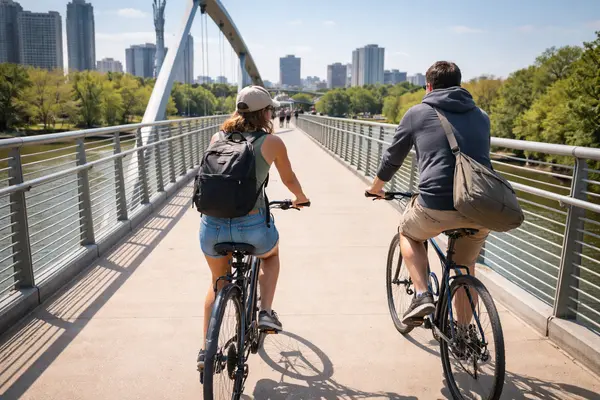
Nearly 175,000 people walked or biked across Austin’s newly opened Wishbone Bridge in its first three weeks, making it the most-used segment among the city’s monitored trails in February.
The bicycle-and-pedestrian bridge spans Lady Bird Lake on the Colorado River just upstream of Longhorn Dam, linking the Ann and Roy Butler Hike-and-Bike Trail and adding a direct, off-street river crossing for east-side and Riverside-area trail users. The City of Austin’s Eco Counter dashboard, which tracks counts on 42 city-maintained trail locations, shows the Wishbone Bridge ranked first in February and accounted for about 16% of all traffic recorded across those monitored trails.
The bridge’s early adoption comes as cyclists and pedestrians report it provides an alternative to the nearby Pleasant Valley vehicle bridge, where trail users previously mixed with cars and faced constrained space. “It’s like, ‘Oh, now I have to get up on the road, it’s windy, it’s by traffic, a lot of times it’s narrow and crowded.’ This will be much more pleasant, for sure.” said Jim Newsome, local resident. Several people who attended the Feb. 7 opening festivities also cited safety concerns about crossing the Pleasant Valley bridge in a corridor the city identified in 2020 as a “High-Injury Roadway.”
For commuters and students using the trail network, the new crossing adds both east–west continuity around the lake and a north–south connection between neighborhoods and destinations on either side of the river. Lydia Carroll, who bikes with her partner Paul Ceseski from the Holly neighborhood to classes at Austin Community College’s Riverside Campus, said she expects to rely on the bridge daily. “It’s gonna change our lives,” said Lydia Carroll, local resident. “We’re gonna be biking across this two times a day, if not more, forever.” said Lydia Carroll, local resident.
Elected officials and advocacy groups tied the project to broader city goals around travel options and safety, while emphasizing delivery and funding. In his Watson Wire newsletter, Austin Mayor Kirk Watson said he was “very proud” of the city’s work on the bridge, which he noted had been completed on budget and ahead of schedule, said Kirk Watson, mayor of Austin. The city’s completion timeline and budget picture included more than $4 million in federal grant funding secured for the project after earlier cost overruns, with U.S. Rep. Greg Casar’s office describing the money as filling a funding gap as part of the Longhorn Dam Multimodal Improvements project. “I’m incredibly excited to see this new wishbone bridge come to life for East Austin. It’s going to be an amazing place that reminds us of why we love our city,” said Congressman Greg Casar, U.S. Representative (D-Texas).
Cycling organizers said the bridge reduces planning constraints for group rides at the river crossing, particularly in the Pleasant Valley corridor. “You would have to make sure you had a very solid plan,” said Tawny Villain, Coordinator, Ghisallo Cycling Initiative. “Now, that doesn’t have to be a consideration anymore.” said Tawny Villain, Coordinator, Ghisallo Cycling Initiative. At the ribbon cutting, residents also described the new crossing as changing how they move between lakefront destinations. “I’m proud of the city … before we had to cross the street in order to come to this side of Austin, that was always a bit treacherous.” said Jackie Lain, local resident. “Now we have a safe and beautiful pass through to get to the other side. It will help the community enjoy the leisure aspects of this bridge a whole lot more.” said Jackie Lain, local resident.
The bridge’s debut also comes amid other waterfront mobility projects and negotiations along Lady Bird Lake. As previously reported in Sign—or Lose It: Inside TxDOT’s Boardwalk Ultimatum and Austin’s Fraying Mitigation Bargain, the city and state have been in a separate dispute over a proposed boardwalk segment tied to I-35 mitigation.
City trail-use data will continue to be updated on the Eco Counter dashboard as spring weather and commuting patterns shift, offering a month-to-month measure of whether the bridge’s early volume holds. As previously reported in From Compass-Point Corridors to Street-Level Rail: How Austin’s Urban Rail Arguments Hardened—and Evolved—Over a Decade, Austin transportation debates have often centered on building public trust through projects that can be delivered and used at visible scale.