A proposal to widen the MoPac Expressway’s 8.7-mile “MoPac South” corridor through the Edwards Aquifer recharge zone has triggered a dispute over whether the Central Texas Regional Mobility Authority’s draft environmental assessment is sufficient or whether federal reviewers should require a full environmental impact statement.
The project, led by the Central Texas Regional Mobility Authority, would add express lanes, auxiliary lanes and new crossings from Slaughter Lane to Enfield Road, a stretch that runs past and over parts of the Barton Creek Greenbelt and toward the Barton Springs segment of the aquifer system. The draft environmental assessment was released in early March, and public comment remains open through early May; after that window closes, transportation officials will decide whether the assessment supports a finding of no significant impact or whether a more detailed environmental impact statement is needed. The question turns on the level of analysis required under the National Environmental Policy Act for a widening inside an established corridor that also crosses sensitive groundwater recharge features.
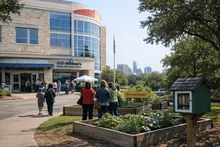
Public attention sharpened at an open house and comment event at James Bowie High School, 4103 W. Slaughter Lane, where more than 150 residents and public officials reviewed displays and spoke with agency staff about design, funding and environmental protections. Travis County Precinct 2 Commissioner Brigid Shea said the draft review does not meet the threshold for a project that could affect Barton Springs-dependent habitat and species. "If you’ve done even a preliminary review and it shows likely environmental harm, you shouldn’t be proceeding," said Brigid Shea, Travis County commissioner for Precinct 2. "You should stop and go back and do a full environmental impact statement," said Brigid Shea, Travis County commissioner for Precinct 2.
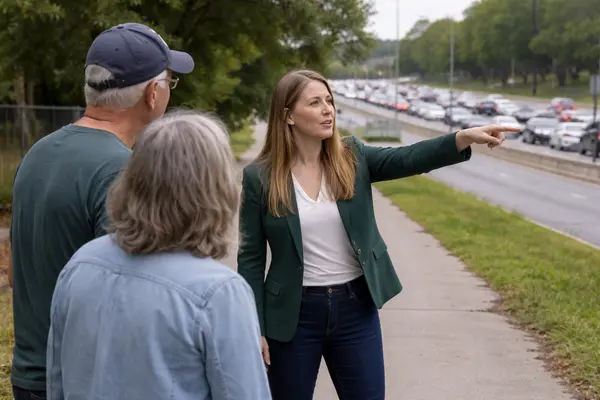
Austin City Council member Paige Ellis, whose District 8 includes much of the corridor, said residents face daily congestion pinch points while also living atop the aquifer’s recharge and contributing zones. "There’s clearly a need for some improvements" in the areas where "the most gridlock happens," said Paige Ellis, Austin City Council member for District 8. At the same time, Ellis has cautioned against overbuilding capacity in the corridor, saying she is weighing both mobility and neighborhood impacts. "I think two lanes is too much. It’s only going to increase crawl and traffic and make everyone’s commute even worse. So I think I’ve struck a fair balance of trying to get the commute solutions that we need and deserve in Southwest Austin, while being mindful of some of the things that my constituents are asking me for.", said Paige Ellis, Austin City Council Member. Residents who live near the corridor have also focused on air, noise and water-quality concerns associated with adding lanes over recharge features. "I recognize that there is a traffic and infrastructure issue. The issue that I have, though, is that there are other implications for this project, whether it’s noise pollution, air and water pollution, the fact that they’re going to be expanding the roadway over the Edwards Aquifer recharge zone.", said Travis Holler, Zilker neighborhood resident.
CTRMA has said the draft assessment and public-involvement process are designed to capture those concerns while advancing a plan meant to move more people through a corridor that has seen little structural change since it was built in phases from the 1970s through the early 2000s. "Public involvement has significantly shaped the MoPac South Environmental Study and Build Alternative to create a project intended to provide benefits for all types of users.", said James Bass, Executive Director of CTRMA. CTRMA has also described the express lanes as supporting regional growth while accommodating transit use, including toll-free access for buses and vanpools, and it has stated that the level of environmental review is coordinated with the Texas Department of Transportation under NEPA for improvements within an existing right-of-way.
Environmental advocates have pressed CTRMA to release more underlying information and to pursue a higher level of review for a toll-lane expansion over what they describe as vulnerable public resources tied to the aquifer and Barton Springs. "This is about accountability. The public has a right to know the basis for a massive, proposed toll road expansion located directly on top of multiple and highly vulnerable public trust resources. By state law and basic principles of good government, the CTRMA can’t pretend they want help from the public in evaluating the proposed project and potential alternatives but then keep secret almost all of the information they are relying on.", said Bill Bunch, Executive Director of Save Our Springs Alliance. The Austin City Council has previously adopted guidance urging city staff to coordinate with CTRMA while applying stricter environmental expectations to the project. "[The resolution] tells the city manager to work with the CTRMA on the MoPac South Project. When you see state money being spent on projects that affect the local community, we want to make sure we are holding the highest standard possible.", said Paige Ellis, Austin City Council Member.
The widening debate is unfolding amid broader pressure on Austin’s high-speed corridors, where serious crashes and closures have repeatedly disrupted traffic and strained public resources, as previously reported in a separate I-35 corridor coverage by this publication. In another recent transportation dispute involving state agencies and local oversight, the outlet also reported on TxDOT’s leverage tactics in Austin mitigation negotiations tied to other projects.
Public comments on the draft environmental assessment remain open through early May, with CTRMA and TxDOT expected to review submissions before determining whether the project moves forward under the current assessment or must begin the longer process of preparing a full environmental impact statement. "We know that the most effective way to reduce traffic-related injuries and fatalities in our community is by redesigning our transportation system using tried and true safe design principles," said a City of Austin representative. "Our long term goal is always going to be zero, and over these first 10 years, obviously, we haven't achieved that," said Joel Meyer, Austin's transportation safety officer. "Here in Austin, it's really been a story of gradually growing our operational and capital budgets, adding staff, building capacity internally," said Joel Meyer, Austin's transportation safety officer. "A lot of times, the traveling public doesn't really know or even care which agency owns the roadway. [They just know that] these fatalities are happening in our community," said Joel Meyer, Austin's transportation safety officer. "In 2024, 40% of motorcycle fatalities occurred in intersections or intersection-related areas," said a TxDOT Analyst. "Motorcyclists are inherently more vulnerable while on the road because they are less visible, and motorcycles offer no significant protection to their users in the event of a crash," said Steven McCraw, DPS Director. "Well, most people equate Texas with drought, but floods have caused an enormous amount of damage throughout the state. The legislature saw the loss of people and property in 2017 and tasked the small but mighty TWDB to address flood mitigation in our great state of Texas. The goals of the first statewide flood plan are simple, but absolutely critical to save lives and property.", said Brooke Paup, TWDB Chairwoman. "The more proactive we are in preparing, the more easily we can make it through the next emergency together," said Jim Redick, HSEM Director. "As you know, while the recent rainfalls help, they won’t end the drought. The ground is so dry, it acts like a sponge, absorbing rain and preventing crucial runoff into streams and lakes.", said a Texas Commission on Environmental Quality source. "As you know, while the recent rainfalls help, they won’t end the drought.", said NOAA/PSL. "We didn’t just look at existing ridership we looked at projected population growth, we looked at project employment growth and where those trends are actually emerging," said Keahey. "They’re still continuing not to look at Lamar as an alternative for high capacity transit, rail transit specifically," said Jace Deloney. "The best way that you can invest in public transit is to do it from the core out, and to really focus on real urban arterials that already have the traffic, already have the ridership, already have the development," said Jace Deloney. "Transit Plan 2035 is truly a community-built plan as nearly 40% of it changed based on the thoughtful feedback from Central Texans during the second round of engagement alone," said Dottie Watkins, CapMetro President & CEO. "The number one thing we heard along the line was, 'Let's get moving on this.' We believe this phase one [of] Austin light-rail really achieves that. It allows us to get moving on building a system that Austinites want," said Greg Canally, Executive Director of the Austin Transit Partnership. "On-street light-rail … is the best solution for Austin," said Greg Canally, Executive Director of the Austin Transit Partnership. "When you get that green light to come out of the station, the train gets all green lights until it gets to the next station," said Lindsay Wood, Austin Transit Partnership spokesperson. "My concerns around Southwest Austin have put me in a position where I feel like I’m being asked to vote away the service that we currently have," said Paige Ellis, an Austin City Council member. "The city can sign the AFA for the boardwalk or decline it," said Tucker Ferguson, TxDOT engineer. "It is over and above, similar to a lot of the things we did," said Heather Ashley-Nguyen, TxDOT engineer overseeing the Central Austin expansion. "Transparency in government becomes an incentive for people to behave ethically," said Diana Prechter, parks advocate.