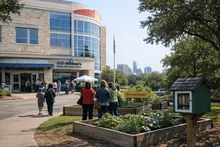
Austin’s Office of Climate Action and Resilience has awarded $136,000 in Bright Green Future Grants to fund 65 hands-on sustainability projects at 53 Austin-area schools, including several campuses that serve students from Mueller and nearby neighborhoods.
The city announced the awards on Dec. 11, 2025, saying the grants will support school-based projects such as outdoor classrooms, bicycle clubs, rain gardens, gardens for food and habitat, recycling and composting systems, and tree planting and care. The program received 140 applications from 55 schools, and grants are capped at $3,000 per project; city materials said every Austin City Council district has at least one awardee. In and around central and East Austin, award recipients include Blanton Elementary School, Kealing Middle School and Lamar Middle School, among others, with projects that range from bicycle clubs to outdoor learning spaces.
The grants are administered by Austin Climate Action and Resilience, which the city says is working toward a community-wide goal of net-zero greenhouse gas emissions by 2040. The grant program was founded in 2012—when the office was still known as the Office of Sustainability—and is funded through collaboration with multiple departments, including the office’s Urban Forestry Team, Austin Resource Recovery, Austin Transportation and Public Works, Austin Water and Austin Watershed Protection.
The funding is concentrated at campuses serving higher shares of low-income students: city materials said more than half of the recipient schools qualify for federal Title I support. In Austin ISD overall, about 50% of students are low-income, but the concentration is much higher at Title I campuses—79%—compared with 38% at non-Title I campuses, according to the district’s federal demographic report. The same report said English learners make up about 30% of Austin ISD students but about 6% of the district’s gifted-and-talented population, and low-income students account for about 50% of district enrollment but 28% of gifted-and-talented students—data that city and district leaders have cited in framing hands-on programs as a way to widen access to enrichment.

In a citywide district that enrolled 72,702 students in the 2024-25 school year across 113 district-owned facilities housing 128 school programs, even small campus grants can spread quickly through student clubs, science classes and outdoor lessons. Austin ISD projects its resident student population will decline about 5.3%—roughly 3,700 students—by 2029, with the steepest declines expected in 2025-26, district planning materials show, a backdrop that has raised questions across Austin about how schools sustain programs during shifts in enrollment.
City officials and educators said the grants are designed to put students in charge of practical work that connects to the city’s climate goals. “Our school is grateful to receive a Bright Green Future Grant, which will allow our students to learn about environmental care through regenerative agricultural practices,” said Calvin Clary, educator at Burnet Middle School. “When students have the chance to learn sustainability by doing, the impact lasts far beyond the classroom,” said Zach Baumer, director of Austin Climate Action and Resilience. “These small but powerful projects show what’s possible — and give us real optimism for the future,” Baumer said. “While we’re trying to eliminate the use of fossil fuels, we’re also trying to eliminate disparities that can be predicted by race,” said Zach Baumer, climate program manager.
Austin ISD has framed its own sustainability work as a districtwide effort organized into eight action areas across teaching and learning, infrastructure and operations, and community engagement, and the district’s 2024-25 Sustainability Annual Report cited reduced energy and water consumption and student-led initiatives as recent progress. In Mueller, where residents have repeatedly pressed for school-community continuity in district decisions, the new grant cycle adds another touchpoint between city policy and campus-level projects; as previously reported in Mueller-residents-press-AISD-to-keep-neighborhood-in-District-1-as-redistricting-tests-law-identity-and-school-ties, neighbors have argued that lines on a map and program decisions can shape which voices have influence over local schools. A separate hands-on education event at Branch Park, Muellers-Festival-of-Learning-brings-hands-on-education-to-Branch-Park-on-Feb-14, also reflected Mueller families’ interest in practical learning activities that move outside a traditional classroom.
Schools begin using the funds as they schedule projects with campus partners and participating city departments, with grants covering materials and supplies that can be deployed quickly—such as garden beds, compost systems, tree-care tools or bicycle-club equipment—under the program’s $3,000 cap. City officials said the grants are intended to support a range of campus projects, including outdoor classrooms at campuses such as Lamar Middle School and bicycle clubs at campuses including Blanton Elementary and Kealing Middle School, alongside rain garden and water conservation work, recycling and composting projects, and aquaponics and solar-powered bird feeder initiatives.