AUSTIN, TX — Austin city financial staff urged the City Council to pause committing additional city money to planned park decks over Interstate 35, warning that rising cost estimates and missing outside funding could squeeze park investments that Mueller residents rely on.
The warning came during a recent council work session as members weighed whether to advance the city’s “cap-and-stitch” concept—building structural decks over lowered portions of I-35 and eventually putting park space and other amenities on top—while the Texas Department of Transportation continues the I-35 Capital Express Central expansion through Austin. City staff told council the decision is time-sensitive: council must determine cap locations by May 2026, and TxDOT’s deadline to include those structural elements in a 2028 bid package is November 2026, according to earlier reporting from KUT and the Austin Monitor.
Financial stakes have escalated as the city confronts both the price of building the decks and the cost of what residents expect to see on top of them. City estimates cited in prior local reporting have put a full buildout at roughly $1.4 billion, plus ongoing maintenance that could approach about $50 million a year, while a cost jump at one location between 11th and 12th streets prompted officials to caution that the increase may not reflect other sites. City staff also told council that much of the visible park programming—features such as “grass and trees, splash pads, tennis courts, soccer fields or rock climbing walls”—remains largely unfunded, and that the city has not yet paid a separate $25 million needed to complete full design drawings that would firm up cost estimates.
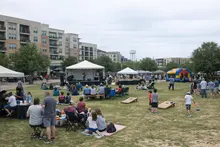
For Mueller and nearby neighborhoods such as Brentwood and Highland, the funding debate is landing as the I-35 corridor continues to shape daily mobility and access to public space. Neighborhood groups have warned that widening the freeway’s footprint could drive “at least 142 displacements,” including homes, businesses and community facilities in the Mueller/Rooftop area, while other neighborhood letters have argued that east-west crossings are already strained for reaching employment, education, health care and food. Those access pressures intersect with Mueller’s park-dependent design: the neighborhood’s network includes about 140 acres of parks, trails and open space, anchored by the 30-acre Mueller Lake Park (Girard Kinney Park) with a loop trail and amphitheater, and planning goals that place residents within 600 feet of greenspace, as Mueller Today has previously reported in coverage of the March 20 Movie in the Park program at Mueller Lake Park.
City leaders and transportation officials framed the decision as a tradeoff between risk and long-term promises, while residents and advocates emphasized trust and accountability. “At this point, we just can't recommend you move forward with such a decision, because that does create such a significant risk,” said Kim Olivares, director of financial services for the City of Austin. “That means there would be less money available for other bond properties,” said Kimberly Olivares, Austin deputy chief financial officer. “We do not want to conflate the escalation seen here with 11th to 12th as to something that would be seen across the board,” said Brianna Frey, Austin Transportation and Public Works. “Not a good representative of other locations,” said Bradley Wheelis, a TxDOT spokesperson.
The parks dimension has drawn added attention in Mueller after recent leadership changes at the City of Austin Parks and Recreation Department and continuing debates over how the city manages public space. In a previous Mueller Today profile of Parks and Recreation Director Jesús Aguirre’s early priorities, Aguirre emphasized the department’s role in serving neighborhoods citywide, including those shaped by major infrastructure. “Austin is at a pivotal moment of growth and change, and parks and recreation are essential to ensuring our communities remain healthy, vibrant and inclusive,” said Jesús Aguirre, director of the Austin Parks and Recreation Department. Council members also highlighted competing needs, with some arguing that a large cap investment could divert funding from basic services and neighborhood priorities outside the downtown core. “Working people in Austin are struggling. People don’t have enough food in parts of town. They don’t have affordable housing or reliable transportation. And I think as a council, we need to consider the whole city’s needs, not just downtown,” said Mike Siegel, an Austin City Council member. Others framed the decks as an attempt to reconnect communities historically divided by highway planning. “For me, this is about healing a scar that I’ve lived through, that ripped through our city almost 100 years ago by way of the 1928 Master Plan,” said José Velásquez, an Austin City Council member.
Beyond financing and design, I-35 construction has also carried environmental and safety implications along the corridor that serves many Mueller commuters. TxDOT bridge work has been linked to displacement of bat colonies, with previous reporting estimating 15,000 to 20,000 bats at one North Austin bridge site and 10,000 to 15,000 at another ahead of demolition, alongside mitigation efforts intended to support future roosting. “We’ve been worried a lot,” said Tracy White, a TxDOT environmental specialist. “The concern that I have had has just been making sure we do as little harm to these bat colonies as possible, and if possible, build back a larger structure for more habitat,” said Tracy White, a TxDOT environmental specialist. “They are generally concerned about the state mammals,” said Fran Hutchins, director of Bat Conservation International. The corridor has also remained a focal point for serious crashes and service-road closures near Central Austin, as previously reported by Mueller Today in its coverage of a fatal crash at the I-35 southbound service road and E. 38th 1/2 Street.
The council’s next steps are expected to focus on whether to narrow the cap concept to fewer acres and locations or delay further commitments until design work and funding plans are clearer, with staff continuing to press for decisions that align with TxDOT’s near-term bid deadlines. If the city misses key windows for including structural elements, the caps could become more expensive or harder to deliver later, while moving forward without firm cost and funding commitments could reduce the money available for Parks and Recreation Department projects in neighborhoods such as Mueller and for other city bond-funded priorities.