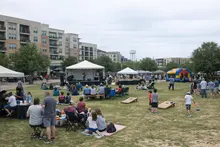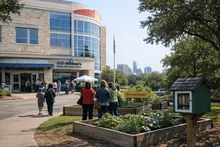
The morning at Mueller Lake Park started the way a lot of Austin mornings do: with shoes tapping pavement, a few dogs pulling at leashes, and lake water holding the gray of an overcast sky. But just before the Race to Cure Sarcoma began on March 21, the crowd’s attention tightened around a smaller group near the amphitheatre—survivors in bright yellow shirts, standing shoulder to shoulder as their names were recognized in the pre-race ceremony. Behind them, families held handmade signs and folded race bibs; friends adjusted strollers; strangers offered quiet nods that said, without needing to say, we know why you’re here.
More than 400 walkers and runners showed up for the second year Austin has hosted the Race to Cure Sarcoma, part of a national series held in 14 cities. The route was simple—three loops around the lake for the 5K, plus a one-mile option for people who wanted the day to fit their bodies and their circumstances. What stayed with people wasn’t the geometry of the course so much as the way the crowd moved between celebration and remembrance without awkwardness: cheers for survivors, applause for memorial teams, and long hugs that held on a beat longer than usual.
At the center of that gravity was the largest team in the Austin race: the Aubrie Peña Legacy Foundation Team, more than 150 strong. They came in clusters—siblings, cousins, friends from school and work—many wearing shirts printed with Aubrie Peña’s name. Aubrie was diagnosed with sarcoma in 2022 and died two years later, and her family has turned what they can’t change into a reason to gather. Her mother, Maria Peña, has said she hopes to grow the race in the years ahead and is welcoming volunteers—less as an administrative plea than as an invitation to widen the circle around a cancer that can feel isolating.

Sarcoma is one word that covers a sprawling set of diseases: cancers that form in bones or connective tissues like muscle, fat, nerves, and blood vessels, with more than 100 subtypes. That complexity is part of why it’s hard to treat. “These are really rare cancers that come from bone and soft tissue.” said Dr. Jake Stein, MD, MPH, UNC Lineberger Comprehensive Cancer Center. People often learn the word after weeks or months of appointments that don’t quite explain a swelling, a pain, a lingering symptom—until a scan finally gives it a name.
Rarity is also what makes research harder to fund and organize: fewer cases mean fewer clinical trials, fewer specialists, fewer chances for patterns to reveal themselves quickly. “The rarity of these tumors is what gets in the way of research.” said Dr. Jake Stein, MD, MPH, UNC Lineberger Comprehensive Cancer Center. That’s one reason the Sarcoma Foundation of America has tried to function as both a research engine and a support structure—funding studies, offering education and resources for patients and caregivers, and advocating to unify what can otherwise feel like a fragmented community. Founded in 2000 after a 3-year-old boy named Jeffrey Thornton was diagnosed with sarcoma, the organization has invested more than $26 million into sarcoma research and built its mission around research funding, education, advocacy, and awareness.
The Austin race feeds into that work directly. This year’s event raised money for the Sarcoma Foundation of America, and it also carried the kind of awareness that moves through ordinary conversation afterward—at brunch tables and pickup lines and Monday meetings—when someone says, “I didn’t even know what sarcoma was.” According to the foundation, more than 236,000 people in the U.S. are living with sarcoma. And while sarcomas represent about 1% of adult cancers, they account for about 15% of childhood cancer cases; roughly half of bone sarcomas and a fifth of soft-tissue sarcomas are diagnosed in people under 35. The numbers help explain why so many teams at Mueller included both parents and kids: sarcoma is rare, but it doesn’t stay neatly in one age group.

For Texans, access to specialized care matters because so many sarcoma subtypes require coordinated expertise—oncology, surgery, radiation, pathology, and the kind of genetic and genomic tumor analysis that helps tailor treatment. Texas Children’s Hospital, for example, operates one of the nation’s largest soft tissue sarcoma programs for children and adolescents, built around multidisciplinary, family-centered care. Even with that level of specialization, outcomes can change drastically depending on whether the cancer is localized or has spread: five-year survival for soft-tissue sarcomas is about 80.8% when it hasn’t metastasized, dropping to roughly 16.4% once it has. In that context, the race’s emphasis on awareness isn’t an abstract slogan—it’s tied to earlier detection, better referrals, and faster access to the right specialists.
That’s also why events like this have become a kind of community infrastructure in Mueller, where the park’s trails and lawns host everything from weekend markets to family gatherings. As previously reported in previous report, last year’s Race to Cure Sarcoma framed the same idea people repeated this weekend: showing up together can be its own kind of medicine. Austin has a deep bench of cause-driven runs—recently including a bakery-themed fundraiser that paired miles with pastry stops to support Austin ISD lunch-debt relief—and the format works here because it offers something concrete. You register, you walk or run, you stand beside someone else’s story long enough for it to become part of your own.
Near the finish line at Mueller Lake, that concreteness took the form of small, specific moments: the slap of a medal ribbon against a runner’s chest, a volunteer leaning over a table to untangle finisher medals, kids shouting a parent’s name as if the entire day hinged on that one crossing. And for those who came carrying a diagnosis in their family—past or present—the meaning was less about a time on a watch than about the fact that the finish was there at all, waiting.
A survivor story from elsewhere in Texas captures the simple, daily persistence that a race can’t show but can honor. “I simply kept moving forward.” said Shaine, sarcoma survivor from El Paso. At Mueller Lake Park, that idea translated into a morning where people could move forward together—survivors in yellow, families in memorial shirts, and a team built around Aubrie Peña’s name, already making plans for what this gathering might look like again next year.