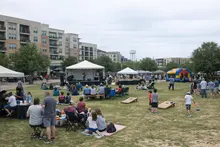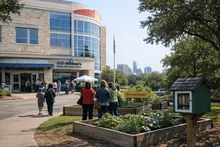
Barton Springs Nursery has expanded beyond its long-running garden-center footprint with a new Design Studio & Showroom at 910 N. Lamar in Austin, a 3,500-square-foot space that blends an appointment-based landscape hub with a walk-in retail store and an indoor plant gallery. The studio opened March 16, repositioning the nursery’s brand as much around interior experience and product curation as outdoor plant shopping. The effect is intentionally “library-like”—tables and seating nooks tucked among tall stacks of books for sale—while the plant displays lean into sculptural vignettes (including desert plants staged on an indoor sand mound) rather than the typical rows of inventory.
The new North Lamar site functions in three lanes. First, it is a front door for design consultations and project planning—customers can schedule meetings for landscape architecture or garden installation, with staff evaluating existing plant health, sun and shade patterns, soil limitations, and on-site constraints before offering planting concepts and material direction. Second, it is a retail showroom for furnishings, gifts, and garden accessories, with textiles and decorative pieces meant to make the business relevant even to visitors who aren’t ready to redesign a yard. Third, it works as a plant display space—less about grabbing a flat of annuals and more about helping people visualize how plants and hard goods can read together as a lived-in environment.
Owner Amy Hovis has long framed landscaping as an ecological and experiential practice rather than a decorative afterthought, and the new space is designed to translate that philosophy into a walk-through environment. "If you have a lot of lawn and it looks good, you’re doing something wrong,” said Amy Hovis, owner of Barton Springs Nursery. That stance—skeptical of pristine turf and high-input maintenance—shows up here in the emphasis on browsing, learning, and seeing plant combinations staged in ways that suggest lower-water landscapes can still feel layered and intentional.
The showroom also extends a merchandising approach Barton Springs Nursery has used outdoors for years: teaching by demonstration. “We have gardens planted throughout the entire nursery, and they’re done in ways that are really artful, so they’re inspiring to people,” said Amy Hovis, owner of Barton Springs Nursery. Indoors, that idea becomes a series of architectural plant moments—cacti, potted specimens, and styled groupings that double as inspiration boards for clients who want to understand what “naturalistic” can look like in a small patio, a tight side yard, or a larger property.
A big part of the business bet is the furniture and décor assortment, meant to bring in design-minded shoppers who might not otherwise stop at a nursery. Hovis has made Fermob—a French outdoor-furniture brand commonly seen in parks and cafés—one of the featured lines, and the showroom also carries Tiptoe, another French brand known for modular, customizable pieces; the company says the North Lamar shop is the only U.S. retailer carrying Tiptoe. Hovis ties that selection directly to her time living abroad. “Bringing these brands into our showroom has been a long-held dream, especially after living in Paris for a decade, where Fermob is found in parks, cafés, and public spaces,” said Amy Hovis, owner of Barton Springs Nursery.
In a city where weather whiplash can swing between drought anxiety and heavy-rain weeks, the opening also lands as a practical signal about what Austinites are buying: less about decorative lawns and more about resilient outdoor rooms that can handle stress. As this publication has reported in recent coverage of Central Texas rainfall and persistent drought risk, even “good rain” doesn’t erase the broader need to plan landscapes around volatility—an everyday reality for households trying to balance shade, water use, and plant survival. “Things pop up that you didn’t imagine,” said Amy Hovis, owner of Barton Springs Nursery. For customers, the showroom’s promise is that they can come in with a specific problem—heat, soil, or a struggling bed—and leave with a clearer sense of options, whether that’s a booked consultation or smaller purchases that support a gradual DIY shift.
Because it’s an interior build-out rather than a ground-up construction project, neighborhood impacts look different than a typical development story: no new residential density, no school-enrollment bump, and no large parking structure changing the streetscape. Still, the opening adds another destination retail stop on a busy corridor, which can mean more short vehicle trips, more delivery traffic for bulky goods, and more weekend foot traffic competing with nearby businesses. Supporters see that as a net positive—another locally rooted retailer pulling people into central Austin at a time when the city’s opening-and-closing churn can be relentless, as previously reported in our coverage of recent restaurant turnover. Critics, meanwhile, tend to read the design-forward shift as a marker of who the neighborhood is being built for, and they question whether curated furnishings and consultation services are accessible to renters and lower-income households even when walk-in shopping is welcomed.
The project did not require a public zoning fight typical of larger redevelopments, but it does sit within the day-to-day regulatory framework that shapes commercial interiors—certificate-of-occupancy inspections, life-safety compliance, and the kind of tenant improvements that quietly reshape how a corridor functions without a headline-grabbing land-use case. The showroom is open daily from 10 a.m. to 6 p.m., and the business is explicitly inviting casual visitors: people can browse books and gifts, shop furniture, and study plant displays without committing to a full landscape plan. That “come in even if you’re not renovating” approach is part of how Austin has been evolving toward design-as-retail, from pop-up marketplaces to specialty shows—an appetite reflected in earlier coverage of downtown shopping events like For Mueller Shoppers, a Downtown Sparkle: InterGem Returns to Austin Jan. 9–11.
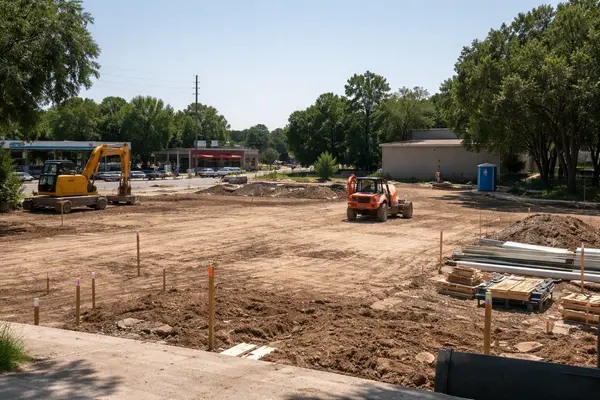
Image description: A midday, clear-day photograph shows a vacant commercial lot along North Lamar with the footprint of a future storefront marked by wooden stakes and orange survey flags. A compact excavator sits near a shallow trench, with a skid-steer loader parked beside piles of gravel and stacked pallets. In the background, two-story mixed-use buildings and a line of street trees frame the corridor, while passing cars and a nearby bus stop underline the site’s scale relative to the surrounding street activity.