The newest cache of Uvalde Consolidated Independent School District records—roughly 11,500 documents totaling an estimated 40,000 to 50,000 pages—arrives with the weight of a courtroom order and the gravity of a community still counting its dead. The papers, produced after more than three years of legal pressure and a judge’s ruling enforcing Texas open records law, largely cover the span immediately before and after May 24, 2022, when a gunman entered Robb Elementary and killed 19 children and two teachers.
The scale of the disclosure is staggering. So is the fact that it took this long. In Texas, the Public Information Act is designed to make government records presumptively public; in practice, the Uvalde case has become an emblem of how transparency in mass tragedy is not handed over—it is extracted, page by page, through litigation, appeals, and the slow leverage of a judge’s signature.
The district’s latest production is the result of that leverage. Media organizations sued under the state’s open-records framework after repeated attempts to obtain communications and safety documentation stalled. The district resisted, arguing over exemptions and the scope of what could be released, even as the shooting response drew national scrutiny and families demanded a fuller accounting of preventable failures. The judge’s order issued last year functioned as the decisive fulcrum: it made compliance unavoidable and transformed what had been a voluntary posture into a compelled one.
Texas open records law matters most in moments like this—when institutions face an incentive to narrow what the public sees. The statute’s core premise is simple: public agencies may not treat public information as proprietary. But the Uvalde release shows how the law’s most powerful feature is procedural rather than philosophical. It creates enforceable deadlines, rights to challenge withholding, and—when agencies refuse—grounds for courts to mandate production. In high-profile tragedies, that mechanism becomes a safeguard against the slow erosion of public memory into official narrative.
What these new records add is not a single smoking gun but a densely documented, cumulative portrait: internal warnings, reminders that became routine, threat reports handled unevenly, and post-attack messaging that prioritized information control as much as safety planning. The story they tell is one Texans have heard before in outline. The documents supply the missing texture—timestamps, subject lines, short directives that read differently when placed against what happened.

One early thread runs through a mundane but now haunting item: a post-drill reminder about locked doors. After a fire drill on Sept. 3, 2021, staff received an after-action email reiterating a basic rule: “You must make sure your door is locked at all times.” It is the kind of sentence that appears in school inboxes across America and is quickly buried under the next day’s logistics.
In Uvalde, that sentence has become evidence. The newly released email sits beside other accounts showing door-security guidance was not consistently followed and that mechanical and human factors collided: maintenance requests, prior concerns, and later testimony in legal proceedings pointing to how easily a safety maxim can become optional in day-to-day operations. The significance is not merely that a door should have been locked; it is that the system treated door-locking as a reminder rather than a verifiable condition, a culture rather than an enforced standard.
The records also trace a pattern of threats and the district’s investigative posture months before the attack—warnings that did not predict May 24 specifically but underscored the reality that violence was not an abstract concept in the district.
On Dec. 7, 2021, the district investigated a report of an alleged shooting threat during the school day. An alert states: “Uvalde CISD Police Chief Arredondo was made aware of an alleged school shooting to take place today during the 8th period. The Uvalde CISD Police Department immediately began an investigation into the threat.” The language is brisk and procedural, signaling response—yet its presence in the newly released materials invites the harder question: what did “immediately” mean operationally, and what lasting changes did such investigations produce?
Another threat report came on May 9, 2022, just over two weeks before Robb. The district passed that report to the Texas Rangers, and the caller was threatening to harm Uvalde High School. In the starkest sense, these documents show an environment aware of threats but struggling to transform awareness into consistent protection. The protocols existed; the documents suggest the implementation varied.
That inconsistency becomes sharper in the communications released from the hours and days after the shooting—messages that show administrators trying to stabilize campuses and staff while also managing exposure.
On the night of May 24, former Dalton Elementary Principal Mandy Pruitt emailed staff after 10 p.m., instructing them to meet in the cafeteria at 8 a.m. the next day. She told staff not to worry about end-of-year tasks, noted there would be increased security, and said school would not operate a full day. Moments later came a second directive: don’t speak with the media.
In isolation, those messages can be read as crisis management: protect staff, reduce chaos, prevent misinformation. In the broader context of Uvalde, they also land as the first contours of an institutional instinct to control the story—even as the public was pleading for facts.
In another email, sent days after the shooting, former Student Services Director Ken Mueller told principals not to share details of school safety plans with reporters. He wrote he had watched news reports and believed information being reported was inaccurate. Then he warned them what was coming: “Questions will start to come up about what we have on each campus for safety,” Mueller wrote. “Review your plans and be refreshed on what you have in place and what deficiencies you have at your campus and how they are being addressed.”
But Mueller also established, early, a line the district wanted to hold on accountability: “Main thing to remember is that this is one person’s fault and that is the shooter. No plan is perfect when an evil person decides to do something like this.”

The tension between those sentences is difficult to ignore. One acknowledges “deficiencies.” The other frames the event as fundamentally beyond institutional responsibility. Together, they reveal a bureaucratic dilemma: how to concede enough to prepare for scrutiny without conceding so much that the institution absorbs blame.
At the state level, that dilemma played out in public as officials corrected and contradicted one another in the initial days. Governor Greg Abbott—who initially praised aspects of the response before later reversing course—became one of the most visible voices expressing anger at what he said he had been told. “Obviously it’s disgusting to see what happened,” Abbott said, condemning the law enforcement response in remarks reported by the Houston Chronicle. And in a separate account, Abbott underscored the breakdown in the information chain: “The information I was given turned out, in part, to be inaccurate, and I am absolutely livid about that.” The Texas Tribune reported that statement as scrutiny intensified.
The newly released district records echo that broader confusion and defensiveness, but from the inside: staff told to keep quiet, leaders discussing safety upgrades, and officials anticipating that media questions would force the district to articulate what it had—and what it lacked.
Those records also track the way the shooting reverberated beyond Uvalde, triggering threat assessments about copycats and online glorification. Documents indicate that the Southwest Texas Fusion Center briefed area departments and warned that there could be copycat attempts. They wrote that “in recent days, racially and ethnically motivated violent extremists and involuntary celibates have praised RAMOS on various social media platforms.” The center encouraged reporting suspicious activity, while noting no credible information about similar attacks being planned.
Within the district, the new batch includes exchanges that illuminate the mechanics of security planning: staffing, training implications, and communications interoperability.
In one message discussing new security jobs for each campus, former assistant superintendent Beth Reavis wrote, “We need to post for the new security positions for each campus.” Under the “campus security guard” position, she added: “Little nervous about this because it implies advanced training.” The phrasing is telling—an administrator acknowledging that titles carry expectations, and that the district was moving into a security posture that required expertise it may not have had embedded.
Reavis also raised questions about whether campus radios could communicate directly with police radios—a detail that reads technical until you consider what failed on May 24: coordination, communication, and a shared operational picture. Interoperability is not a slogan; it is hardware, frequencies, training, and policy.
Another set of documents captures the district navigating political currents in the months after the shooting. After the Uvalde County Commissioners Court passed a resolution urging a special legislative session and calling for lawmakers to raise the minimum age to buy a semiautomatic weapon from 18 to 21, Superintendent Hal Harrell sought legal advice. According to the records, an attorney cautioned him: “If it would not cause a division on the board then you can do it. If it would cause any type of split vote I don’t think I would touch it.”
It’s a snapshot of how public institutions weigh advocacy against governance—especially in a town where grief has been politicized and where even symbolic gestures can fracture boards and families alike. The larger push to raise the purchase age ultimately failed at the Legislature, despite calls from advocates and some lawmakers.
Yet the records also show the district moving quickly—at least on paper—toward hardening facilities for the next school year.
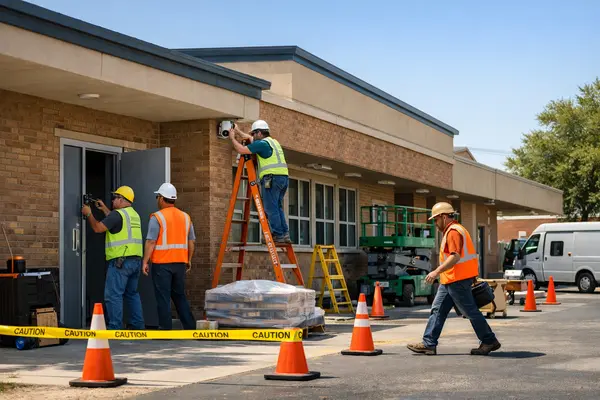
In an email dated Aug. 5, 2022, Harrell contacted Nim Kidd of the Texas Division of Emergency Management about security upgrades. “I will reach out to Suzannah Jones regarding support for locksmiths to help with some Door Audit findings,” Harrell wrote, referencing an effort to address weaknesses identified in a districtwide door review.
An attached project update described perimeter fencing planned at multiple elementary schools and the intent to assign 33 Texas DPS officers to the district for the upcoming year—at least four per campus. It noted a door audit had been completed and that officials were identifying doors needing repair or additional attention.
A day later, in an Aug. 6, 2022 follow-up, Harrell again asked Kidd for help finding companies to repair and replace door hardware and address weak doors already in place. In the language of emergency management, it was a request for surge capacity: expertise and labor to fix what local systems had not kept up with.
The question for Uvalde families, however, has never been whether a door audit can be performed after children are killed. It is whether the warnings that existed before May 24 were treated as urgent—and whether the institutions charged with protecting children behaved as if failure was unthinkable.
Those families have repeatedly articulated a view that the adults’ debates about tactics and jurisdiction miss the point. In the immediate aftermath, even children expressed clarity about policy and prevention. “Some people shouldn’t have guns.” said Alina Borrego, then 11, in remarks reported by KSAT. And in the same reporting, she tied reform to recovery: “If we want the (community) to heal we need some new rules. Cuz, if we don’t change nothing, it’s gonna be the same and it’s gonna happen again and again.” KSAT

Healing, in Uvalde, has also taken physical form: murals, memorials, and public ceremonies that refuse to let the town’s loss be reduced to a news cycle. “If there’s any art in the world that I wish didn’t exist would be these murals, because that means that children would be alive, the teachers would be alive, Uvalde would be the normal town it was before.” said Abel Ortiz, a Uvalde artist, in an interview aired by PBS NewsHour.
In Austin, the Legislature’s response to Uvalde has been framed as a corrective to the operational failures exposed at Robb—particularly the long delay before officers confronted the shooter. According to the Houston Chronicle, the state advanced HB 33, a sweeping package that requires active shooter training, joint exercises across agencies, door-breaching tools in schools, and designated crisis-communication officers to reduce the fog of contradictory public statements.
State Rep. Don McLaughlin placed the mandate in moral terms: “We owe it to the 19 students and two teachers from Robb Elementary -- and to every community across Texas -- to make sure this never happens again.” Houston Chronicle
The Chronicle also captured a blunt assessment of the communication failures that followed the shooting: “In four days, the story changed five times. Nobody knew what was going on and we didn’t get straight answers.” Houston Chronicle
The new UCISD records, heavy with internal emails warning staff away from reporters, sit uncomfortably beside that legislative rationale. If HB 33 is meant to ensure clearer communication in the next crisis, Uvalde’s document trail shows how deeply the impulse to manage information is baked into institutions under threat.
Uvalde’s local law enforcement has also tried to put language around cultural change. Chief Homer Delgado described the city’s Guardian Initiative as an accountability project as much as a training plan. “As officers, we are accountable to the people who depend on us, and we must demonstrate the highest levels of professionalism and responsiveness to carry out the core mission of every single officer – protecting the safety of the Uvalde community. The Guardian Initiative is key to the transformation of our department, and will require hard work, discipline, extensive training, and community engagement to enhance the department’s capabilities while ensuring integrity and transparency in our operations. We look forward to working hand-in-hand with the entire Uvalde community as UPD undergoes these critical changes to keep Uvalde Safe.” Delgado said, according to KSAT.
KSAT also reported that Uvalde opened Legacy Elementary in fall 2025, with safety central to its design—an architectural answer to a failure that began, in part, with doors.
The broader implications of the latest records release extend beyond Uvalde. Across the country, communities hit by school shootings have repeatedly faced battles over public records—body camera footage, dispatch logs, internal emails—because the same materials that can reveal failures can also expose agencies to political, legal, and reputational consequences. In that sense, Uvalde is not unique. But the sheer volume—tens of thousands of pages—illustrates how modern school systems generate a digital exhaust of accountability: chats, alerts, drafts, job descriptions, audit spreadsheets, requests for locksmiths.
That exhaust, now public, is a mirror. It reflects an institution that understood it had vulnerabilities, documented them, reminded staff of them, received threat reports, and after the massacre sprinted to harden campuses while trying to narrow the narrative.
Transparency does not, by itself, repair a shattered town. It does not reopen a classroom without fear or return children to families who will never again hear the slam of a backpack dropped at the front door. But transparency is the prerequisite for any reform that claims to be serious. It forces specificity—dates, names, wording—when institutions prefer abstraction.
In Uvalde, the new pages will be read through grief and anger, but also through a demanding logic: if the system can document a rule, it can enforce it; if it can investigate threats, it can standardize response; if it can control information, it can also communicate plainly. And if it took a judge’s order to release the records, the public is left with an unavoidable measure of trust: not what officials say they learned, but what they were willing to show.