The first thing you notice isn’t the scissors.
It’s the bubbles.
Inside Cultivate Behavioral Health & Education in northwest Austin, a vertical bubble machine stands like a tall aquarium lamp, sending up a steady stream of soft foam spheres. They rise in columns, catch rotating colors, and pop in their own time. The sound is a gentle burble—constant, predictable, low. For a little boy who has learned to brace his body the moment he hears the word “haircut,” the machine offers something rare: a sensory cue that doesn’t demand anything from him.
He watches the bubbles climb. His shoulders drop a fraction.
Henry “Tribes” Amoloja—barber, influencer, and the Dallas-based force behind Heartfelt Haircuts—doesn’t rush to fill the quiet with instructions. He positions himself where the child can still see the bubble machine. He lets the boy keep a toy in his hands. And when the child shifts, testing whether he is allowed to move, Amoloja nods as if the answer has already been decided.
“The most important thing is allowing children the flexibility to roam as they please,” Amoloja said.
For many families with autistic children or kids with sensory sensitivities, haircut day can feel less like a routine errand and more like an obstacle course—an environment loaded with triggers: the scratch of a cape, the tickle of loose hair, the hum of clippers, the bright salon lights, the social demands of a stranger standing close.
“They tend to not enjoy haircuts because the sound is right next to their ears,” said Laura Lorenzon Maxwell, stylist. https://abc7news.com/haircut-salon-special-needs-autism/11496556/?utm_source=openai
If you’ve never experienced sensory overload, it’s hard to understand the speed at which distress can arrive, and how total it can feel once it does. Bee Strike, a salon customer with autism and ADHD, described the sensation with blunt clarity: “It feels like everything is too much and I'm kind of being swallowed up,” said Bee Strike, salon customer. https://www.insideedition.com/how-this-hair-stylist-created-a-sensory-friendly-salon-for-autistic-people-82678?utm_source=openai
A haircut is, by design, intimate: a stranger near your face and ears, a sharp tool in view, touch that can’t always be predicted, and sounds that vibrate through your skull. For a child whose nervous system processes sensation at maximum volume, it can become unbearable.
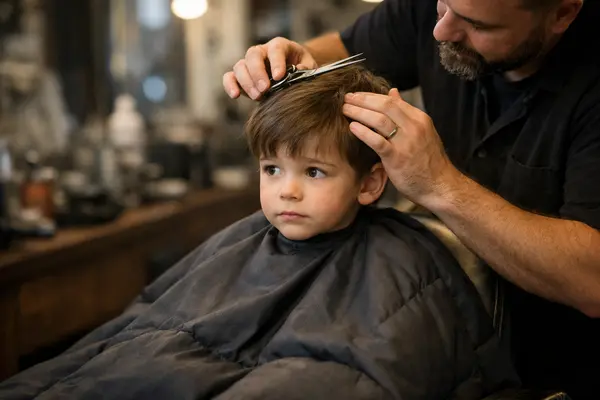
That’s why, earlier this month, eight children cycled through a different kind of haircut experience at Cultivate—complimentary sessions delivered not as charity in a hurry, but as craft: highly personalized, unhurried, and built around a child’s signals. It was a Heartfelt Haircuts event, but it felt more like a quiet collaboration between barbers, clinicians, parents, and kids.
Amoloja’s approach begins before the child even walks into the room.
“The first step is completing the intake questionnaire, then a phone consultation,” Amoloja said. “I learn their triggers, what might overstimulate them. A lot of the work is done before they walk in.”
For parents who are used to rehearsing—explaining, apologizing, promising a bribe just to get through a trim—those intake calls can feel like the first exhale in days. They can say what usually goes wrong. They can admit what they fear: the moment their child bolts, or cries, or freezes, or swings arms to block the clippers. They can describe the small details that matter, the details that other places have dismissed.
In a typical salon, those details get smoothed over in the name of efficiency. Here, they become the plan.
When this particular child found the bubble machine and locked in—eyes tracking the rising spheres—Amoloja took it as a kind of permission.
“If I get five- to 10-second windows of engagement, that works,” he explained. “If I can get enough of those, the haircut will get done.”
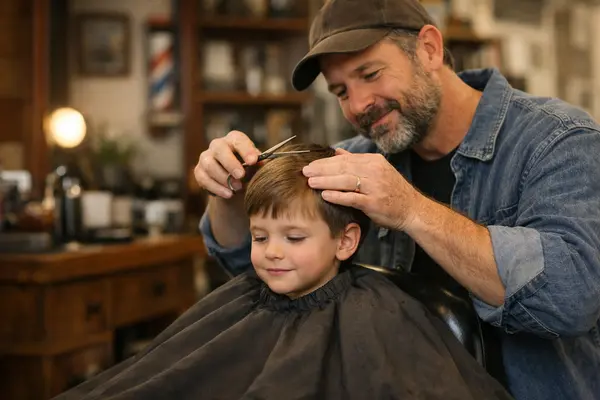
So the haircut is done in fragments. The scissors appear, not with a sudden snip near the ear, but introduced like a new character in the room. Amoloja holds them where the child can see, waits for the moment when the child’s body is most settled, then makes one quick, quiet cut.
And then he stops.
The boy reorients himself—bubbles, toy, breath—and Amoloja watches for the next window. He reads the child’s face, hands, the tightening around the shoulders that predicts a storm. He lowers his own body to reduce the looming sensation. If the child slips to the floor, he follows.

“If a child is most comfortable on the floor, Amoloja works down there,” he said.
It is a simple shift in posture, but it changes the entire power dynamic. The child is not trapped in a chair. He is not being held to a schedule. He is being met.
The cape that calms
There is another detail that parents often notice only once it’s already helping: the weight.
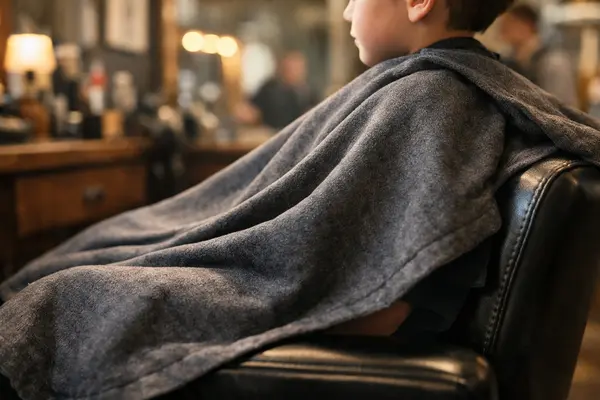
Amoloja developed what he calls the weighted cape—a modified barber cape designed to mimic the grounding sensation of a weighted blanket. The concept sounds deceptively straightforward, but its emotional impact can be immediate. Weighted blankets are widely used in sensory regulation because deep pressure stimulation can help some people feel calmer and more organized in their bodies. A traditional cape, by contrast, can flap, cling, and shift unpredictably—exactly the kind of light, irritating touch that makes some children feel like their skin is on fire.
A cape that offers gentle, steady pressure changes the sensory math.
The product, Amoloja said, came out of a larger commitment: not just to create something marketable, but to build trust with a community that has learned to be cautious.
“How are you going to sell something to a community you don’t understand?” he said. “If you’re going to make this work, you need to serve that community.”
Rather than rush to patent the idea, he spent time learning. He sought specialized training in sensory-safe techniques from Kate Owens, the founder of Sensory Safe Solutions, and learned from mentor Jelly Robinson. The deeper he went, the more he recognized how big the need was—and how few barbers were stepping into it.
“I looked myself in the mirror and decided ‘You will be the one to provide this service,’” Amoloja said.
The cape is part tool, part philosophy: a reminder that the body’s comfort is not a bonus feature but the central requirement.
That philosophy shows up in the way he negotiates every step. Clipper or scissors? A few seconds now, then a break? Would the child rather stand, sit, or lean against a parent? The “right” way becomes whatever helps the child stay regulated.
It’s also increasingly in step with how sensory-aware haircare is evolving nationally. Strategies highlighted by Inside Edition include quiet scissors, low-volume razors, letting customers explore hair products by smell or touch before using them, and switching tools based on sensitivity. That same report captured the human stakes behind the adaptations: “I'm autistic and I have ADHD (Attention-Deficit Hyperactivity Disorder). My average experience with hairdressers is generally places that come with a lot of sensory overload,” said Bee Strike. https://www.insideedition.com/how-this-hair-stylist-created-a-sensory-friendly-salon-for-autistic-people-82678?utm_source=openai
Industry conversations have started to treat these accommodations as a new standard of care. A Shining Through Podcast episode on sensory-friendly haircuts described weighted capes tailored to a child’s needs, sensory fidget buckets, and calming end-of-appointment rituals like “bubble parties.” In Austin, those ideas weren’t abstract—they were right there in the room, bubbling up beside the chair.
Why the need is growing
The demand for sensory-friendly services isn’t a niche trend; it’s tied to the scale of autism itself.
In 2022, 1 in 51 children aged 8 in South Central Texas were identified with autism spectrum disorder, according to the Texas ADDM Network. Nationally, the figure is even higher—1 in 31 children aged 8—based on CDC numbers referenced by the same Texas ADDM report.
Meanwhile, diagnoses have been rising among younger Texas children. Between 2018 and 2023, the rate of autism diagnosis among Texas children under age 8 increased from roughly 1 in 44 to 1 in 36, as reported by MySanAntonio. The broader national trend line has climbed, too: the Houston Chronicle reported in 2025 that autism prevalence continued to rise across communities, even as regional variations persisted.
In practice, those numbers translate into ordinary places—schools, pediatric offices, playgrounds—and, yes, barbershops. They translate into parents trying to solve everyday problems that the world still treats as optional accommodations.
The children who need sensory-aware haircuts don’t just need a calmer haircut. They need one that won’t set back the rest of the day. A haircut that doesn’t cost a parent a full recovery period and a child the feeling of safety in their own body.
For families who have been through the worst of traditional salon experiences, the relief when something goes right can sound almost like disbelief. One parent, reflecting on a sensory-friendly appointment, put it simply: “The staff's patience and understanding made all the difference. It was the first time my child left a haircut without tears,” said a parent. https://sensorystylist.com/blog/success-stories--transformative-experiences-with-sensory-friendly-haircuts?utm_source=openai
That kind of moment—no tears, no panic, no shame—can be the difference between a child who dreads grooming and a child who begins to tolerate it, even trust it.
“We just do our best to make them feel good”
Amoloja didn’t work alone in Austin. During the Cultivate event, he partnered with Yvonne Jeffrey of KAOS Salon, a stylist who has provided sensory-friendly haircuts in Austin for nearly 30 years. Her longevity matters in a field where so many families cycle through providers, searching for someone who doesn’t interpret sensory distress as “bad behavior.”
“The kids don’t know why they aren’t comfortable,” Jeffrey said. “We just do our best to make them feel good.”
It’s a statement that sounds obvious until you consider how often kids are expected to endure discomfort without explanation—how often “It’s fine” is used to talk over a child’s nervous system. Sensory-friendly haircutting flips that script. Discomfort is treated as information.
To do the work well takes time, and time is expensive. That’s one reason the Austin event served eight children—a number that might look small until you understand how individualized each session is. These haircuts aren’t built for volume. They are built for success.
And yet the ripple effect can extend far beyond one day.
When a community pays it forward
Heartfelt Haircuts’ Austin stop was a one-day event, but it wasn’t designed to be a one-and-done. Sponsorships, raffles, and grassroots donations helped build a fund for future sensory-friendly sessions, a practical answer to a persistent problem: even when families can find a sensory-aware barber, the cost and scheduling demands can put regular haircuts out of reach.
Because of that community backing, Amoloja said all of his 2026 sensory-safe haircuts are fully funded.
“We’ve gotten enough support so that all the haircuts this year are already covered,” Amoloja said. “If we keep going, we can do the same thing in 2027.”
In total, 100 to 120 sessions per month have been pre-paid by the community, extending the impact of fundraising well beyond the children who happened to be in the room that day.
Support came from a patchwork of local partnerships—organizations that, together, created something like a temporary village around each child. The Autism Society of Texas was present with resources and swag, part of a larger effort to make the day feel less clinical and more celebratory.
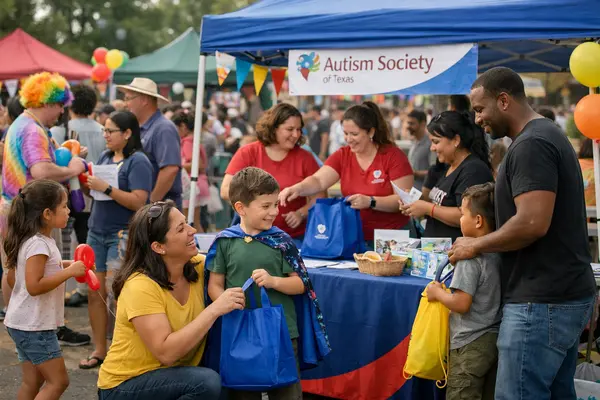
Inside Cultivate, the support expanded beyond hair.
More than a haircut
The clinic offered an ecosystem: music therapy, therapy dogs, neurofeedback demonstrations, and advocacy resources, all in the same space families had come to associate with appointments and paperwork.
“The goal is accessibility and connection,” said Cultivate Clinical Manager Lydia Irvin. “We want families to feel seen and supported.”
Cultivate provides applied behavior analysis therapy with a focus on early intervention and family collaboration—work that often intersects with the same regulation skills needed for something as ordinary as a haircut. But the event also acknowledged what families live with outside therapy rooms: the administrative strain, the insurance cycles, the constant need to reauthorize.
“It can be scary when you first hear your child may have autism,” said Shelby McPhaul, the community outreach coordinator. “Early intervention helps children build coping strategies and independence.”
McPhaul described the most rewarding parts of her role as the moments that don’t make headlines—when a parent finally connects with a resource, when a family feels less alone.
“Being a parent is already so hard,” she said. “I love helping families connect to resources that make life a bit easier.”
The therapy dog that day—Marvin, from Divine Canines—moved through the room like a gentle reset button. Children who didn’t want to be spoken to could still reach out and touch a calm, warm presence. Parents, too, softened when they saw their child soften.
Those layers of support matter because access to autism services is not evenly distributed. Research on autism prevalence reporting in Texas schools has found disparities tied to language: a Texas-based study published by PubMed found school district prevalence estimates for autism were significantly lower for White children from Spanish- or other non-English-speaking households compared with White children from English-speaking homes—an indicator that some families face steeper barriers to identification and, by extension, to services that follow diagnosis.
In that context, an event that bundles care—haircuts, therapy supports, resource navigation—functions as a form of outreach, even if it starts with something as deceptively small as a trim.
The next room: Trimmy’s
Amoloja’s work is headed toward a new kind of permanence.
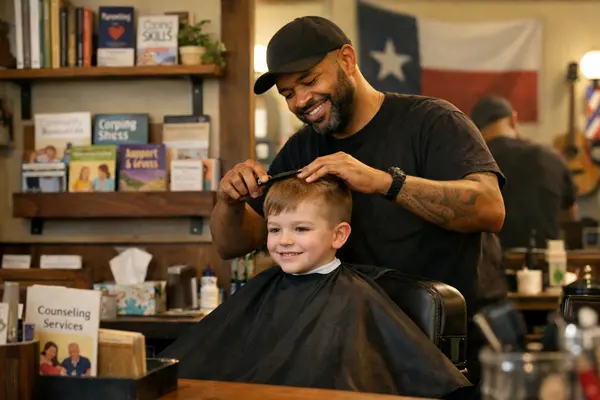
On March 7, he plans to open Trimmy’s in Richardson, north of Dallas: a fully sensory-friendly barbershop designed to feel less like a business and more like a playhouse, with themed sensory rooms for kids and a calming space where parents can relax.
The shop is an extension of what he has been building in pop-up events: an environment where sensory needs are assumed, not explained; where tools are adapted, not defended; where patience is treated as part of the service.
“I want people to feel as comfortable as they possibly can. Being able to find out what someone needs, it's not that hard to cater for it,” said Jade Vincent, stylist. https://www.insideedition.com/how-this-hair-stylist-created-a-sensory-friendly-salon-for-autistic-people-82678?utm_source=openai
That philosophy is spreading, but in Amoloja’s hands it has a particular tenderness—one shaped by preparation and by a willingness to be physically and emotionally flexible, to kneel on a floor if that’s where the haircut can happen.
“Parents are sometimes shocked that their kids are capable of doing this,” Amoloja said. “When you give them a comfortable environment, build trust with them, and they feel like they are safe around you, you will be surprised what they can make happen.”
Back in Austin, near the bubble machine, the little boy has made it through another short window: one snip, then another. Hair falls in soft, barely-there threads. The weighted cape steadies against his shoulders. He flinches once when a sound changes, then recovers as the bubbles continue their endless climb.
For a moment, it’s possible to see what families mean when they say a haircut can change the whole day. It isn’t vanity. It’s not even grooming.
It’s dignity.
And it’s the quiet, hard-won miracle of a child leaving the room still feeling like himself.