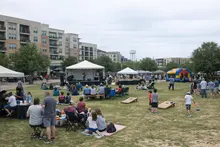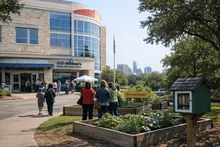
HONK!TX will return to Mueller Lake Park on March 28, bringing roving brass and street bands to a neighborhood better known for stroller traffic and weekend markets than spontaneous horn lines.
The nonprofit festival’s performances are free, and the event is designed to unfold in Austin’s public spaces rather than behind gates or on ticketed stages, according to the event page on Life at Mueller. For residents of Mueller — a dense, fast-growing community built around parks, trails and gathering spots — the festival’s format puts music into the same shared spaces where neighbors already cross paths.
A festival built for the park, not the arena
HONK!TX bills itself as a nonprofit that “unites street and brass bands from local, national, and international communities” for performances “in Austin’s public spaces,” according to the event page on Life at Mueller. The bands are mobile and unamplified, a practical detail that matters in a park setting, where sound carries differently and where audiences tend to form in motion — walkers pausing, kids drifting closer, cyclists slowing down.
That emphasis on public space is central to how the festival describes its purpose. "HONK!TX works to transform our neighborhoods, parks and public spaces through the power of music.", said Jason Fialkoff, co-founder of HONK!TX, according to The Daily Texan.
For Mueller, the idea of transformation is less about introducing crowds to an underused venue than about reimagining a familiar one. Mueller Lake Park functions as a neighborhood commons — a place for casual recreation and scheduled events. HONK!TX’s parade-like approach turns that everyday setting into a performance route and meeting ground.
What to expect on March 28
Rather than centering a single stage, HONK!TX is structured around street and brass bands moving through outdoor areas and drawing audiences where they stand. The festival’s musicianship also spans multiple traditions.
According to the event page on Life at Mueller, genres range from New Orleans brass and European Klezmer to Brazilian and West African rhythms. In a city that often categorizes music by venue or headliner, HONK!TX leans on the sound of ensembles and on proximity — a style of performance that can make genre boundaries feel secondary to the act of gathering.
The event’s unamplified format also changes how people listen. Instead of a distant stage mix, the listener hears breath, drum heads and the brassy edge of horns at close range, a kind of intimacy that can be hard to find in larger festival settings.
Community roots — and an intentional ceiling
Austin’s music calendar is crowded, and the city’s best-known festivals have long drawn tourists as well as locals. HONK!TX presents itself differently, placing a premium on community access and resisting the assumptions that success means constant expansion.
"We are not trying to grow," said Jason Fialkoff, co-founder of HONK!TX, according to The Daily Texan.
Fialkoff has also framed the festival’s identity with a comparison familiar to many Austinites weighing grassroots traditions against large-scale productions. "[HONK!TX] is more Eeyore’s Birthday than it is ACL.", said Jason Fialkoff, co-founder of HONK!TX, according to The Daily Texan.
As described by The Daily Texan, that stance reflects a broader effort to keep HONK!TX community-rooted and accessible, prioritizing public performance and local character over commercial scaling. The same reporting emphasizes the event’s audience-performer closeness — an atmosphere shaped not only by the music but by the way bands and crowds share the same ground.
In Mueller, where public space is central to neighborhood design, that approach dovetails with community life. A free event lowers barriers for families and residents who might not budget for ticketed festivals, and the park setting encourages casual attendance: people can join for a song or stay for an afternoon.
Music and meaning in the street-band tradition
The festival’s public setting is not just a logistical choice for bands; some musicians see it as part of the message.
"Playing on the street is an artistic and political action.", said Alexis Cornejo of Banda Rim Bam Bum, according to Austin Chronicle.
Cornejo has also described street performance as a collective craft aimed at listeners who may not have planned to attend a concert. "We put our energy into the sound…. We try to give well-played music to the people where the harmony builds in a collective way, as if each of us were a finger of a pianist.", said Alexis Cornejo of Banda Rim Bam Bum, according to Austin Chronicle.
That philosophy tracks with HONK!TX’s broader premise: musicians meeting audiences where they are, in spaces everyone shares. In a neighborhood built around walkability and parks, that exchange can feel less like a special occasion than an extension of daily public life — a reminder that culture is not confined to stages, and that community events can be defined as much by access and participation as by production value.
Read the press release on lifeatmueller.com.