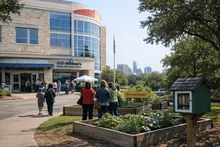
Our late-2025 coverage of the budget battles and frayed council dynamics — including “Phew: Austin City Council closes out rough year” as previously reported — captured the mood at City Hall as the year wound down. What’s easy to miss in the day-to-day churn, though, is how many of Austin’s hardest 2025 decisions were shaped less by ambition than by a tightening set of constraints: state laws that increasingly dictate what cities can and can’t do, waning one-time federal support, and state-imposed limits on how quickly property-tax revenue can grow.
The result was a year when Austin’s leaders still made meaningful policy choices — on housing codes, renter protections, and homelessness response capacity — but did so in a narrower lane than many residents assume City Hall controls. And when the city did ask voters for more room to maneuver, via a major tax proposal, residents said no.
Understanding 2025 starts with a basic reset of how municipal power works in Texas. Austin has the responsibility residents feel most directly — running core services and funding public priorities — but it does not have full authority over the rules or revenue tools that make those services possible. In a high-growth city, that mismatch becomes a daily stress test.
That growth is real and measurable. Austin’s metro population rose from 2.3 million in 2020 to 2.55 million by 2024, according to Axios. The same report notes the region’s GDP climbed 51% between 2019 and 2023, with median income up 33% and housing supply up 12%. Those topline gains are often cited as evidence that Austin can “afford” big plans.
But population and economic expansion cut both ways. More residents and higher incomes can expand a city’s tax base over time, yet they also intensify the immediate demands residents make on public safety, utilities, roads, parks, libraries, and the safety-net programs that become more visible as inequality and housing costs rise. Put another way: growth brings more receipts, but it also brings more receipts to write.
The three-part constraint: preemption, federal fadeout, and property-tax caps
Start with state preemption — the Legislature’s use of state law to override or limit local regulation. For civic-minded Austinites, it can help to think of preemption like a software update pushed from above: even if City Hall prefers one set of settings, the system’s administrator can force a new default statewide.

In 2025, the most concrete example affecting local housing policy was SB 840, which changed how much discretion large Texas cities have over what gets built in commercial and mixed-use areas. Under the law, cities meeting certain population thresholds must allow mixed-use residential or multifamily development “by-right” in commercial or mixed-use zoning districts — meaning the project doesn’t need a rezoning, a variance, or a special permit just to be considered lawful. The bill also limits how low a city can set certain standards: it bars cities from capping residential density below 36 units per acre or height below 45 feet, except in defined cases, according to a detailed summary from BVWNA.
To residents, “by-right” can sound like technical jargon, but the practical effect is easy to grasp. If a property sits in a commercial district where housing is now allowed by-right, the city’s leverage shifts: the debate moves away from whether housing is permitted at all, and toward how it is designed and what public benefits — if any — can be negotiated within tighter legal boundaries.
Austin felt that shift downtown. As local officials and stakeholders described in year-end reflections, SB 840 forced the city to revisit its Downtown Density Bonus approach — a policy tool that typically exchanges extra development capacity for community benefits, including affordable housing. When the state changes the underlying rules of the game, the city may have to rewrite its playbook quickly, and not everyone will agree that the rewrite is calibrated.
At the same time, Austin’s fiscal squeeze wasn’t only about the state telling cities what they can regulate. It was also about the state limiting how much revenue cities can raise through the tool they rely on most: property taxes. Texas’s property-tax caps don’t prohibit local government entirely from raising revenue, but they do place hard constraints on how fast the “no-new-revenue” rate and related formulas can grow without triggering political and legal hurdles. In a fast-growing city with expanding service demands, the cap functions like a governor on an engine: even if the car is going uphill faster, the system restricts how much power you can apply before the mechanism starts pushing back.
Those constraints became more visible as federal support ebbed. City leaders had leaned on one-time federal dollars — particularly pandemic-era funding — to launch programs and stabilize service delivery. As those funds aged out, the city confronted a reality many households recognize: it’s one thing to pay for ongoing expenses with a temporary windfall, and another to keep paying once that windfall disappears.
City Manager T.C. Broadnax put the issue bluntly while describing the city’s budget environment: “As federal funds provided through the American Rescue Plan Act (ARPA) expire and growth in sales tax collections slows, municipalities across the state are finally experiencing the harsh consequences of the property tax cap established by the Texas Legislature. Austin is no exception.” City of Austin

Taken together, those forces help explain why 2025 felt like a year of constraint even as cranes still dotted the skyline.
Growth, affordability, and who Austin is losing
The politics of budgets don’t unfold in a vacuum — they unfold in kitchens, rent offices, and commutes. As housing and everyday costs rose, Austin’s growth pattern also began to change.
A mid-2025 demographic analysis from the Austin Monitor described how the city’s expansion has increasingly relied on international migration while domestic migration slows and Hispanic and Black residents decline as a share in the region. The piece captures a pressure point that’s easy to see across the metro: rising costs can push longtime residents outward even when the broader economy remains strong.
“Right now, our affordability is not what it has been in the past… (It) is causing a pressure outward.” Austin Monitor
The same analysis underscored that Austin’s population trajectory is not guaranteed — it depends on jobs, the cost of living, and federal immigration policy, among other forces. “If we’re not seeing much change in our job growth, we may continue to see lower levels of domestic migration. If (we) are now facing additional countries on travel bans, more restrictive immigration policies that really curb humanitarian and undocumented migration…. it could mean population decline, which is something that we have not experienced in our area’s history.” Austin Monitor
Those demographic currents matter at City Hall because they shape the stakes of local policy. When people feel squeezed, they tend to demand clearer evidence that government spending is both effective and fair — and they’re more skeptical of big asks that sound like more of the same.
Prop Q and the voter “no”: what happened, and what it changed
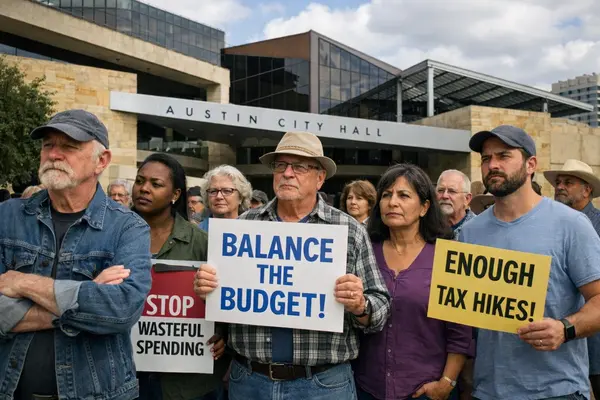
That skepticism formed the backdrop for the year’s defining fiscal confrontation: the city’s decision to put a major tax increase — Proposition Q — on the ballot.
By the end of 2025, even officials who disagreed on the measure’s merits converged on one point: the vote materially tightened Austin’s fiscal margin. District 4 Council Member José “Chito” Vela warned in year-end comments that “the budget conversations are only going to get tougher in the years to come,” a recognition that the city’s options were narrowing even before the next big priorities arrived.
District 10 Council Member Marc Duchen, who said he opposed the early version of the budget and the tax proposal, described the defeat as a needed accountability reset. “The money City Hall spends belongs to taxpayers, not us,” he said in the year-end review, arguing for a deeper look at spending, a review of vacant positions, and even a potential “forensic audit.”
Council members who supported seeking more revenue framed their position as an attempt to protect core services. Mayor Pro Tem Vanessa Fuentes, reflecting on the year’s tradeoffs, said that with “limited resources, we had to make hard calls,” even as the council tried to shield essential services from the sharpest cuts.
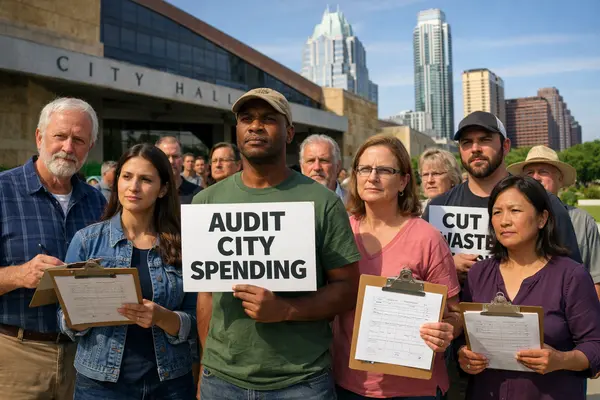
The most direct takeaway from Prop Q wasn’t just that voters disliked a tax increase. It was why they pushed back. The public conversation around the ballot measure repeatedly returned to themes of transparency and oversight — a sense that before City Hall asked for more, it needed to show more clearly how existing funds were being used and what efficiencies had been pursued. That’s the political space where calls for audits gained traction.
Citizen-driven efforts reflected that mood. Save Austin Now PAC announced a petition drive after Prop Q’s defeat aimed at requiring an audit of city spending. Meanwhile, the Austin United PAC escalated a separate fight by filing a lawsuit tied to its petition seeking a public vote on whether to pause plans for a new convention center — a project described by local critics as carrying multibillion-dollar long-term costs. Both efforts underscored the same theme: residents were looking for new mechanisms to slow down, verify, and scrutinize big-ticket decisions.
In practical terms, the Prop Q loss meant Austin’s budget had less cushion for the unexpected — whether that’s an economic slowdown, a major weather event, or escalating costs in core contracts. When a city runs with a thin margin, small shocks become big debates.
What Austin still managed to do: targeted reforms in a narrow window
Even in a constrained year, City Hall did not stand still. If anything, 2025 clarified which types of changes were most achievable: narrow, targeted reforms that fit within state law and could be implemented without blowing open the budget.
One of the most celebrated examples was a building-code change allowing more single-stair residential buildings. Supporters argued it expands the kinds of “missing middle” housing that can be built — smaller apartment buildings with layouts many families prefer — and can reduce costs. Vela called it “a real win” that modernized the code and “helps lower housing costs,” while Parker Welch, a board secretary for AURA, described Austin as “the first city in the country to pass single-stair reform on our own,” legalizing “higher-quality, family-friendly units in smaller apartment buildings.”
Meanwhile, renter protections moved in a public-health direction with a new requirement related to air conditioning. “As the summers get hotter, AC is no longer a luxury,” Fuentes said in the year-end review. “It’s a matter of public health, safety, and dignity.” The policy’s appeal is straightforward: it doesn’t solve affordability, but it sets a basic standard for habitability in a city where extreme heat is no longer occasional.
Downtown initiatives also advanced — from cultural investments to coordination efforts that try to align multiple agencies around intersecting challenges like mental health, homelessness, transportation, and public safety. These are the kinds of moves that can make daily life feel more functional without requiring the kind of sweeping authority or new revenue that the city struggled to secure.
Still, targeted wins didn’t erase the frustrations caused by preemption. In the housing arena, SB 840 constrained local choices while simultaneously forcing quick recalibration. That’s a recipe for conflict: if stakeholders feel the city’s response is rushed, and the city feels boxed in by state law, public debate can devolve into mutual suspicion rather than problem-solving.
The hardest service math: homelessness progress, and the 2026 gap
No 2025 explainer is complete without homelessness — both because it’s a humanitarian crisis and because it exposes how intergovernmental funding structures shape what a city can do.
Austin’s homelessness response shows measurable progress in capacity, according to the city’s 2025 ECHO report. The City of Austin said emergency shelter beds increased by 70% since 2022 and permanent housing beds grew by 35%, with more than 3,000 people housed last year. Those numbers reflect a system that, at least in capacity terms, has grown.
But the same update points to the fiscal cliff ahead: the city estimated a $101 million funding gap for fiscal 2026 to sustain the response capacity it considers necessary. When federal dollars fade and local revenue is capped, maintaining what’s been built becomes as hard as building it in the first place.
The politics of that gap are complicated by how much of the current system relies on temporary funding. “About a third of these considerations are current one-time funding that we believe council should consider for ongoing investment,” a funding perspective noted in a report carried by Yahoo News. The implication is the same one many nonprofits and governments face: if you treat one-time money like recurring income, you eventually have to make painful cuts or find a durable replacement.
This is also where the “local accountability” argument becomes more complicated. Residents may rightly ask City Hall to do more — and they may also reject higher taxes. In 2025, both impulses were present. The city’s challenge is not choosing one or the other; it is finding a governance model that can explain tradeoffs honestly enough that people believe the choices are being made in good faith.
Why the 2026 bond election is the next inflection point
If Prop Q was the year’s referendum on operating revenue and trust, the 2026 bond election is shaping up as the next major test — and a different kind of question. Bonds are typically about long-lived infrastructure: the things a city builds or repairs over decades, financed over time.

The case for a bond begins with needs that don’t go away just because budgets get tighter. “The City of Austin continues to face significant infrastructure challenges, including aging facilities, growing service demands, and affordability pressures.” Austin Post
City staff have recommended a roughly $700 million general obligation bond for 2026, according to the Austin Post. The proposed allocations illustrate how broad the backlog is: $250 million for transportation, $160 million for watershed, $140 million for parks, $58 million for community facilities, and $91 million for public safety.
Even the process design hints at how 2025 reshaped City Hall’s approach. The Austin Post report describes a proposed public decision tool meant to help the council weigh urgency, financial capacity, voter fatigue, and unspent bond funds — a kind of structured way to ask: if you can’t do everything, how do you decide what comes first?
That question will land differently after Prop Q. Many residents will approach the bond conversation with the same skepticism they brought to the tax election: show the work, explain the priorities, prove the follow-through. And because bonds feel less like “more government spending” and more like “fix the basics,” the city will have to demonstrate that it can deliver projects predictably — on time and within scope — while also being candid about what a bond can’t cover, such as recurring program costs.
What 2025 revealed about governing Austin now
By the time 2025 ended, Austin’s political story had become less about sweeping visions and more about the mechanics of governing a high-growth city inside a tight box. State preemption narrowed local authority; federal dollars that helped bridge gaps began to disappear; property-tax limits constrained the city’s primary revenue lever; and a major voter rejection signaled that public patience for big fiscal asks had worn thin.
Yet 2025 also showed that local governance still matters — not in the abstract, but in the details that touch daily life. Building-code changes can determine what kinds of homes are feasible to build. Rental standards can define whether a family rides out summer heat safely. Budget oversight and transparency debates can reshape trust — or deepen cynicism — depending on how leaders respond.
As Austin moves into 2026, the central challenge is not simply choosing between austerity and investment. It is rebuilding a shared civic understanding of what City Hall can control, what it can’t, and what tradeoffs follow from those realities. If the city can do that — pairing clearer public finance with measurable delivery — the frustrations of 2025 may read less like dysfunction and more like a painful but necessary adjustment to a new era of constrained local autonomy. If it can’t, every future debate, from homelessness funding to the bond ballot, risks becoming another proxy fight over trust itself.