
The Austin Parks and Recreation Board voted Monday not to recommend a proposed $2 million, three-year surveillance contract with LiveView Technologies, setting up a high-stakes week at City Hall as the Austin City Council prepares to take up the agreement in a work session Tuesday ahead of a Thursday vote. The proposed deal would place mobile security trailers—with camera systems and associated monitoring services—in city parks, a public-safety pitch that has collided with renewed concerns about privacy, enforcement limits and who ultimately controls the data.
The board’s decision is advisory, but it lands as council members weigh not only the LiveView contract, but also a separate policy proposal meant to reshape how Austin authorizes surveillance. Alongside the contract, the City Council is considering an ordinance known as the Trust Act, which would require city departments to obtain council approval before acquiring new surveillance technology or sharing data with third-party companies.
The surveillance proposal has drawn opposition from civil liberties advocates who argue that contractual promises about restraint are difficult to police once cameras are collecting footage in public spaces. Kevin Welch of EFF-Austin, warning that safeguards can erode over time or be sidestepped in practice, said, "I see data abused and misused by well-intentioned people every day. The reality is, the only data that is safe is the data that is not collected" as reported by the Austin Chronicle. Advocates have also raised concerns about how surveillance systems can be repurposed beyond their initial intent and the challenge of ensuring compliance without clear, durable oversight mechanisms.

Those enforcement and accountability concerns have also been tied to broader questions of transparency—especially over what, exactly, the LiveView agreement would authorize. Council Member Mike Siegel flagged uncertainty in how the contract language could be understood by both policymakers and residents. "If I’m confused, I’m sure the public is, too," Siegel said, according to the Houston Chronicle. Siegel’s remarks underscored a recurring critique of surveillance procurement debates: that even when restrictions are described in presentations, unclear or technical contract terms can muddy the limits, leaving residents unsure what is being deployed and what rules truly apply.
Meanwhile, supporters of tighter surveillance oversight have framed the Trust Act as a response to that recurring dynamic—an attempt to put council review, rather than departmental discretion, at the center of decisions about new monitoring tools and data-sharing arrangements. Council Member Chito Vela has argued that the biggest risk is not merely cameras in parks but how data might be handled, shared, or reused once captured. "I don't want to be sharing that data with third parties or using it for AI training or whatever the case may be," Vela said, in comments reported by FOX 7 Austin. Vela has also emphasized that the city’s contracts should explicitly cabin what vendors and the city itself can do with footage and metadata: "We want the contract to be tight with sufficient privacy protections and safeguards for the public," he said. FOX 7 Austin
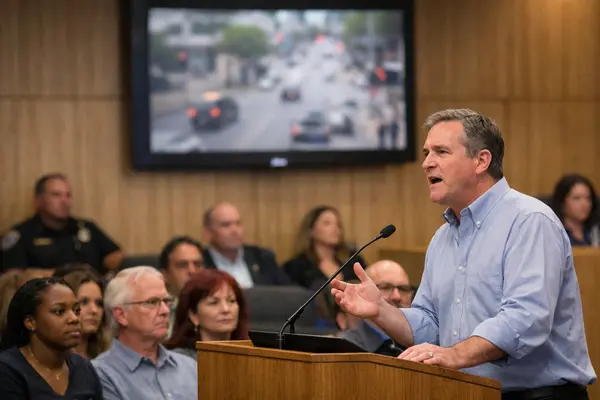
Public commenters have pushed in a similar direction—arguing that oversight requires not just policy statements but clear control of any material collected. During a council work session, Austin resident Austin Wright called for a structure that would keep surveillance footage under municipal custody rather than leaving it primarily in vendor-controlled systems. "The data get moved to the custody of the city of Austin in some kind of service that we can maintain...so we can have oversight as a citizenry," Wright said, according to Citizen Portal.
City officials have said the proposal includes technical guardrails intended to limit risk, including constraints on advanced features and restrictions on who can access video. Interim Chief Information Security Officer Dr. Brian Gardner described safeguards that would be used to narrow the system’s capabilities and lock down the collected data. "Those features will not be enabled... it will be purely bringing the data into the servers, encrypting the data, [with] controlled access," Gardner said, as reported by Citizen Portal.
Even with those assurances, the policy debate has centered on whether technical protections and contract language can substitute for stronger, public-facing governance—especially when surveillance tools are deployed in open, communal settings like parks, where the people recorded may not be suspected of any wrongdoing. Critics argue that cameras can change how public spaces feel and who uses them, while supporters say targeted deployments can deter crime, protect amenities, and reduce the burden on park staff.
That clash is now headed for a compressed timeline: the City Council is scheduled to examine the LiveView proposal in Tuesday’s work session before taking up the contract—alongside the Trust Act framework—at Thursday’s voting meeting. The outcome will determine whether Austin moves ahead with the three-year, $2 million park surveillance rollout this year and, more broadly, whether council members lock in a new requirement that future surveillance acquisitions and data-sharing arrangements come back to the dais for explicit approval.