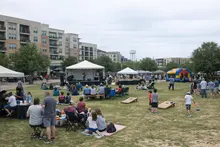
Ongoing student walkouts protesting U.S. Immigration and Customs Enforcement at Austin Independent School District (AISD) schools have prompted increasingly urgent responses from district officials and state leaders as of February 2026, drawing investigations from Texas Gov. Greg Abbott and Attorney General Ken Paxton while continuing to affect school operations in Austin, Texas.
The most recent disruptions have unfolded on multiple campuses, with district leaders pointing to repeated mid-day departures that pull students from instruction for extended stretches. At Crockett High School in South Austin, students left class between 10:40 and 11:40 a.m. and gathered outside the campus, according to reporting by CBS Austin. The district has described the walkouts as recurring, not isolated, and has warned that the frequency is increasingly difficult for schools to absorb while maintaining regular instruction, supervision, and campus security routines.
That pattern has pushed AISD to deliver a more pointed public message—one that acknowledges the motivation behind the demonstrations while urging students to keep their advocacy anchored in the classroom. In a video posted to the district’s Instagram account and reported by CBS Austin, AISD said it had watched students “find your own voices” and told them, “Seeing our students engage with the world makes us incredibly proud.” The district then pivoted to the operational impact, saying, “The number and frequency of these demonstrations is starting to cause a real disruption to our school day,” and stressing that “Passion may get your voice heard, but education is what gives your voice its power and influence,” according to CBS Austin’s summary of the message.
District leaders have framed the situation as both a learning issue and a safety obligation—an effort to keep schools open to civic discussion without normalizing repeated departures from class time. Superintendent Matias Segura has emphasized that the district’s duty does not end at the campus perimeter once the bell has rung. “During the school day, our students are our responsibility and we’re committed to the safety of our schools in our community, regardless if they are on our campus,” Segura said, according to Austin Current.

AISD has also tried to draw a bright line between valuing student expression and formally endorsing walkouts as a method of engagement. In communications described by CBS Austin, district officials have urged students to begin the “work” of advocacy “inside our classrooms,” arguing that missed instruction erodes the very tools students need to influence policy and public opinion. The message has been reinforced by district legal guidance that, while students may choose to leave, the district is not treating the walkouts as school-sanctioned activities.
In a letter defending AISD’s handling of the protests, General Counsel Kenneth M. Walker II said the walkouts were not sanctioned and that students who leave class will not receive excused absences, according to CBS Austin’s account of the correspondence. Walker also addressed the limits of enforcement under Texas law, arguing that schools cannot physically prevent students from leaving campus—an issue that has become central to the debate as state leaders scrutinize what districts should do when students walk out en masse.
Civil-rights advocates, however, have cautioned state officials and districts against conflating disruption with viewpoint-based punishment. Adriana Piñon, legal director of the ACLU of Texas, said the constitutional baseline is clear even when administrators face genuine operational strain. “Government officials cannot punish students simply because they dislike their message. Students do not lose their free speech rights when they enter their schools, and while the law may permit discipline in some cases, it certainly does not require it,” Piñon said in an ACLU of Texas statement.
The ACLU has argued that student walkouts often fall within protected civic expression and that any discipline must be narrowly applied and not used as a proxy for suppressing a particular viewpoint, according to its public comments responding to the state’s reaction. At the same time, the organization has acknowledged that schools retain limited authority to address safety hazards and substantial disruption—areas where the district says repeated walkouts have now created day-to-day complications.
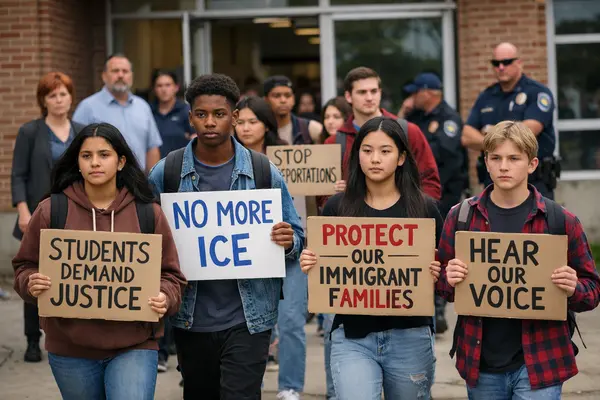
Pressure on AISD has intensified because the protests have not remained a purely local dispute. Abbott and Paxton have initiated state-level reviews into whether AISD’s handling of the walkouts meets legal and educational standards, injecting statewide politics into what district leaders describe as a practical struggle over attendance, accountability, and supervision. Abbott has repeatedly framed the walkouts as incompatible with the mission of public schools. “AISD gets taxpayer dollars to teach the subjects required by the state, not to help students skip school to protest,” Abbott said, as reported by The Dallas News. “Our schools are for educating our children, not political indoctrination,” he added, according to the same report.
Abbott’s rationale, as presented in The Dallas News, centers on the idea that school time and resources should be directed toward state-mandated instruction rather than actions that encourage students to leave class. That stance has dovetailed with broader state scrutiny of how public schools handle political content, even as AISD insists it is not organizing the walkouts and is warning students of academic consequences for unexcused absences.
The Texas Education Agency (TEA) has confirmed it is investigating AISD, according to CBS Austin, and cited state law requiring educators to support learning in ways that are “objective and free from political bias.” The agency’s involvement adds another layer to the controversy: administrators are being asked to prove they are not facilitating protests, while also demonstrating they are maintaining safety and order without violating students’ rights.
Students participating in the walkouts have said they see those tradeoffs differently, describing the protests as a moral response to immigration enforcement rather than an elective political exercise. Jayla, a 17-year-old junior at Eastside High School, told KUT, “They’re tearing innocent families apart.” For students like Jayla, the urgency of immigration enforcement and family separations is not abstract—and the decision to leave class, they say, reflects the limited options available to young people who cannot vote and do not shape policy directly.
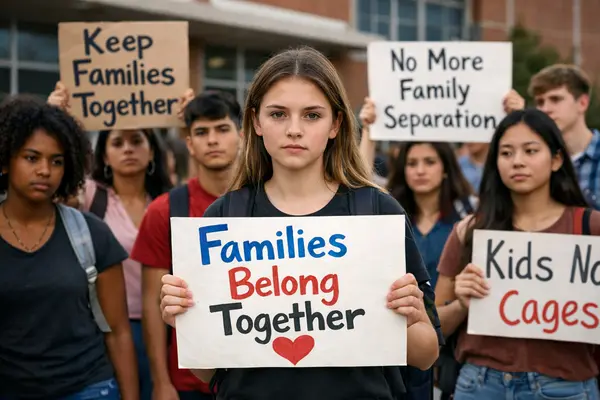
That sense of limited agency has been echoed by younger students as the walkouts spread beyond high schools. Emmet D., a student at Clint Small Middle School, described the protests as one of the few tools students feel they can wield. “We don’t really have that much power in most things that are going on in the world, and this is a way that we do have power,” Emmet said, according to the Austin Chronicle.
Some parents have supported that framing, rejecting state claims that the district is directing students toward a particular ideology. Brandi Ramirez, whose child participated, said she saw the activism as student-driven. “I don’t feel that my child was indoctrinated or anybody was pressured or encouraged by the school district to take part in the protest,” Ramirez said, according to Austin Current.
The competing narratives—disruption versus civic expression—have landed with particular force in Austin, a fast-growing city with a large student population and a long history of youth activism around war, policing, and civil-rights issues. In that environment, schools can become a focal point for broader political conflict, especially when state leaders adopt a more interventionist stance toward public education.
At the center of the current dispute is how Texas law and education policy define the boundaries of neutrality and the day-to-day authority of school administrators. State leaders have leaned on statutory language requiring instruction to be “objective and free from political bias,” a standard TEA has invoked in confirming its AISD investigation, according to CBS Austin. District officials, for their part, have cited the legal limits on using force or physical restraint to stop students from leaving campus—an argument Walker raised in defending the district’s response and explaining why schools cannot simply lock down exits during walkouts, according to CBS Austin.
The broader question—how schools should respond when protest activity becomes frequent enough to reshape the school day—has played out in other districts nationwide, from gun-violence walkouts to climate strikes, often prompting similar tensions between attendance rules and civic engagement. Advocates have argued such actions can be a form of experiential civics; administrators and some state officials have countered that repeated absences undermine learning and create supervision risks, particularly when students move off campus and into public spaces.
For AISD, the immediate challenge has been to keep campuses functioning while communicating that instruction remains the district’s primary responsibility. The district’s public messaging has aimed to preserve room for student voice while discouraging recurring disruptions, warning that absences will not be excused and emphasizing that the classroom is where students can build the skills and knowledge they will need beyond high school.
As February 2026 progresses, the next steps are now split between Austin and Austin’s overseers in state government. The TEA inquiry and the reviews launched by Abbott and Paxton remain pending, and district leaders have signaled they will continue to treat walkouts as unexcused absences while emphasizing that campuses cannot lawfully use physical force to compel students to stay. At the same time, students and supporting parents have indicated they intend to keep pressing their message, casting the walkouts as an urgent response to immigration enforcement and a rare avenue for youth influence even as AISD warns that repeated disruptions are testing the limits of a normal school day.