East Austin is a place where history can feel like it’s always in motion. New buildings rise, longtime businesses fight for breathing room, and familiar streets take on fresh names and new crowds. But beneath that churn is a deeper, steadier story—one that has powered Austin’s culture for generations and has too often been treated as background noise: the Black communities that built institutions, nurtured music and art, and carved out safety and dignity in a segregated Texas.
Preserving that story isn’t just about honoring the past. It’s about protecting the public record—so the city’s identity isn’t flattened into a single era or a single audience. It’s also about giving residents and visitors a clearer map of what matters: the schools that trained teachers and ministers, the churches that held communities together, the neighborhoods where Black homeownership and entrepreneurship flourished despite discriminatory policies, and the cultural spaces that made Austin sound like itself.
That’s the urgency behind the Texas Historical Commission’s newly updated travel guide, African Americans in Texas: A Lasting Legacy, released in February 2026. Published as a free, digital resource by the Texas Historical Commission, the guide is designed to spotlight Black historical, cultural, and civic sites across the state—schools and universities, monuments, churches, neighborhoods, and community spaces created and sustained by Black Texans through Reconstruction, Jim Crow segregation, and beyond. While the scope is statewide, East Austin is one of the guide’s most resonant concentrations of living landmarks, where history isn’t confined to a museum label; it’s woven into the sidewalks, sanctuaries, and stages.
The guide’s digital format matters, too. It’s not locked behind a paywall or packaged as a niche add-on. It’s built for everyday use—for a family planning a weekend walk, for a student researching local history, for a visitor who wants to understand the city beyond its most marketable myths. Anyone can access it through the Texas Historical Commission website as a free download.
East Austin’s Black history isn’t an artifact—it’s a present tense
The stakes of preservation are especially clear in East Austin because the neighborhood is so visibly in transition. Demographic change is part of the story, but it doesn’t erase what came before. Data from City-Data shows East Austin’s racial and ethnic composition today is approximately 41.7% White, 30.4% Hispanic or Latino, and 16.0% Black, along with smaller shares of other groups. That 16% is a reminder of continuity: Black Austinites remain a vital part of East Austin’s community life, even as rising costs and redevelopment reshape who can afford to stay.
To talk about Black heritage in East Austin, then, is to talk about both endurance and vulnerability—about institutions that survived segregation and about the very real risk that the neighborhood’s physical markers of Black life could be lost, renamed, or repurposed without acknowledgement. The travel guide functions as a counterweight to that drift, making it harder to pretend these stories weren’t here.
From the Green Book to today’s guide: why “where” has always mattered
Travel guides can sound like leisure—helpful, optional, even light. But for Black Americans navigating the segregated United States, guidebooks were about survival. The Negro Motorist Green Book—often shortened to the Green Book—was published in the mid-20th century to help Black travelers find lodging, meals, and services without being humiliated, threatened, or turned away.
Historian Candacy Taylor has described that distinction with blunt clarity. “...[it] didn’t tell you if a place had a good steak, or good seafood, or had a soft bed...it told you where you would be safe; it told you where you’d be welcome and not made to go around the kitchen and order something to go...The rest [of the guide books out there] are just fluff...To my mind, it’s still the only necessary travel guide that’s ever been printed,” Taylor said. National Park Service
The Texas Historical Commission’s updated guide isn’t a modern Green Book—travel in Texas looks different now, and the purpose is broader than survival logistics. But the underlying idea rhymes: place is political, and the ability to move through a landscape with context and dignity matters. By identifying sites established by Black communities during segregation—and by naming the neighborhoods, schools, and churches that anchored daily life—the guide pushes back against a long history of erasure.
It also restores a truth that can get lost in the shorthand version of Texas history: Black Texans did not merely endure segregation; they built networks of education, worship, commerce, and culture that shaped the state.
Learning, leadership, and the long arc of Black education in Austin
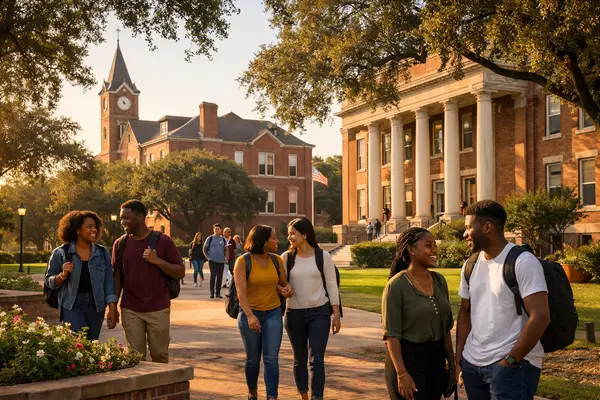
Among the guide’s best-known East Austin institutions is Huston-Tillotson University, a historically Black university formed in 1952 through the merger of two Reconstruction-era colleges founded in the 1870s to train Black teachers and ministers. That origin story places the campus in a statewide continuum of Black self-determination after emancipation—an era when education was both a personal aspiration and a collective strategy for survival.
Huston-Tillotson’s presence in East Austin also reflects why the neighborhood has long been more than a residential area. It has been a center of Black civic life—producing graduates who became educators, clergy, organizers, and professionals, and helping anchor the community during decades when Austin’s political and economic power was concentrated elsewhere.
The city’s educational history also includes earlier institutions tied to Black schooling and advancement. The Austin Convention & Visitors Bureau highlights the Tillotson Collegiate and Normal Institute as part of Austin’s African American landmark landscape, a reminder that training teachers—“normal” schools—was a critical engine of community building across Texas.
Meanwhile, East Austin’s cultural preservation work isn’t abstract; it’s housed in brick and mortar. The George Washington Carver Museum and Cultural Center, featured in the Texas Historical Commission guide, operates in a building that once served as a segregated library branch. Today, it preserves Austin’s Black cultural and artistic legacy through rotating exhibits—an evolution that captures the city’s contradictions: a space born from exclusion transformed into a place of celebration and public memory.
Neighborhoods that made room for Black homeownership—and Black futures
The guide also points readers toward historic neighborhoods that were once the backbone of Black homeownership, churches, schools, and businesses in segregated Austin, including Clarksville, Wheatville, and Gregorytown.
These communities matter not only as geographic footnotes but as evidence of what Black Texans created in the face of restrictive housing policies, intimidation, and the everyday barriers of Jim Crow. They were places where families built equity and stability when the broader city often tried to deny both. They were social ecosystems—where a church wasn’t just a church, and a school wasn’t just a school, but a hub for mutual aid, political organizing, and community care.
And they help explain why landmark preservation in East Austin is inseparable from conversations about displacement today. When a historic neighborhood disappears under new development, it isn’t only architecture that’s lost; it’s a map of how Black Austinites made a life here.
Sacred spaces: churches as anchors of survival and civic life
East Austin’s oldest Black churches appear in the travel guide for good reason. During segregation, Black churches often served as the most stable public institutions Black communities could control. They were places of worship, yes, but also spaces where civic life could unfold—where people could organize, educate, grieve, celebrate, and plan.
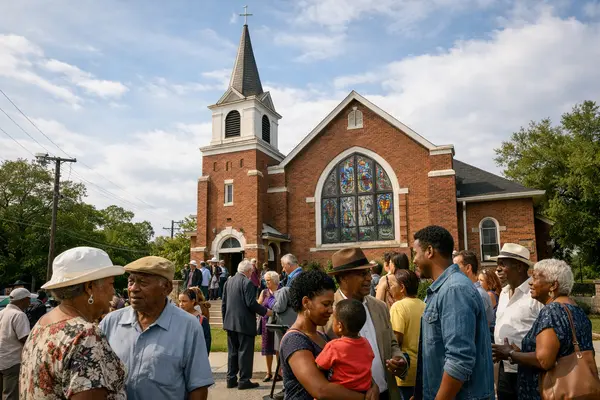
Among the guide’s highlighted congregations are Wesley United Methodist Church and Ebenezer Baptist Church, sites tied to generations of Black Austinites building community through faith and service. In a neighborhood where so much has been remade, these churches represent continuity—institutions that have seen the city change and have kept offering a sense of belonging.
The guide also nods to the texture of daily life in segregated Austin by identifying sites like the once-segregated Blackshear Elementary School, reminding readers that “separate” was enforced from childhood—and that Black Austinites still built excellence and community in those constrained conditions.
A mural, a grill, and the sound of East Austin
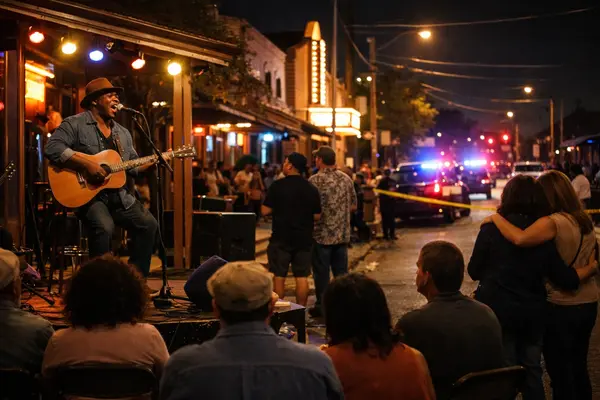
It’s impossible to tell East Austin’s Black history without telling its music history. Along East 11th and 12th streets, the guide and local landmark lists trace a corridor that once pulsed with jazz and blues.
Public art captures that legacy in a way that stops people mid-stride. Rhapsody, a 50-foot ceramic mural at 1021 East 11th Street by artist and educator John Yancey—who taught at both the University of Texas at Austin and Huston-Tillotson University—honors East Austin’s Black musical heritage. The work commemorates a historic scene that helped define Austin long before the city’s modern branding as the “Live Music Capital of the World.” It’s also a visual reminder that the neighborhood’s culture has always been cultivated, taught, and passed down.
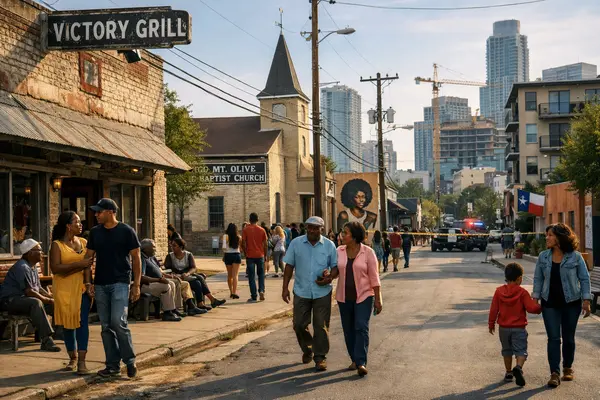
That musical lineage is inseparable from venues like the Victory Grill, which the travel guide context connects to East Austin’s role as a cultural center. The Austin Convention & Visitors Bureau lists the Victory Grill as a key African American landmark—and it’s easy to see why. It served as a stage where Black artists could perform and audiences could gather, helping establish East Austin as the heart of the city’s Black music scene.
This corridor’s history is often tied to what was known as the Chitlin’ Circuit—a network of performance venues, primarily in the South and Midwest, where Black musicians, comedians, and entertainers could work during segregation. The term refers to “chitlins,” a traditional Southern food, and it has come to symbolize the cultural spaces Black performers relied on when mainstream venues were closed to them. Naming that circuit isn’t nostalgia; it’s context for how art survived—and how Black communities built their own stages when they were shut out of others.
Statewide landmarks—and Austin’s place in Black Texan history
One of the guide’s strengths is how it places East Austin within a broader Black Texan story. Texas is organized into heritage regions through the Texas Heritage Trails Program, and Austin appears in the Hill Country Trail section—an important framing that pushes back against the idea that Black history in Texas is confined to a few major cities or a handful of well-known chapters.
Within Austin, the guide’s attention to state sites underscores that Black history is political history, too. The Texas Capitol includes tributes that honor Black lawmakers who served during the Reconstruction era before Jim Crow laws hardened racial exclusion. Austin is also home to the Texas African American History Memorial on the Capitol’s south lawn, a landmark highlighted by the Austin Convention & Visitors Bureau that places Black experiences—from enslavement to emancipation to civic leadership—into the state’s most symbolic public space.
Nearby, memory becomes even more literal at the Texas State Cemetery, where prominent Black civic leaders are buried—an acknowledgement that governance and public service are part of this heritage, not an exception to it.
And on the University of Texas campus, public commemoration takes another form. The Austin Convention & Visitors Bureau points visitors toward the Barbara Jordan Statue at UT Austin, honoring the trailblazing attorney, educator, and congresswoman whose voice and moral clarity shaped Texas and national politics.
“Living heritage” means the community gets to use its own history
Landmarks alone can’t carry memory. They need interpretation, storytelling, and stewardship—especially in places where the ground is valuable and the past is inconvenient.
That’s where community historians and archivists become essential partners in preservation, often doing the daily work of holding onto photos, flyers, oral histories, and artifacts that institutions didn’t prioritize. In East Austin, community archivist Alan Garcia has described that work as something meant to move through people’s hands—not to sit behind glass.
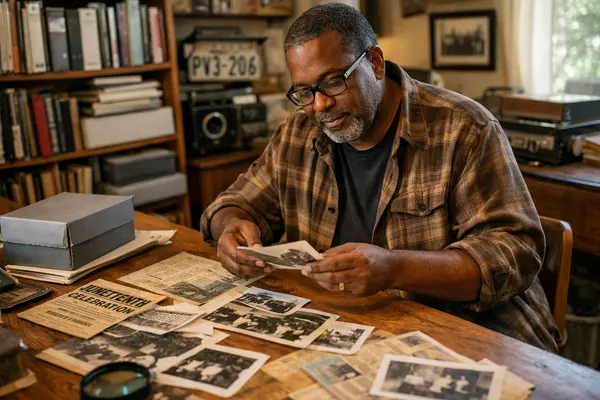
“I don’t want to collect just to keep things. I want people to use this. I want younger archivists and artists to take it on,” Garcia said. KUT Radio
In that sense, the Texas Historical Commission guide functions less like a static directory and more like an invitation. It gives people a shared reference point—a way to say, this mattered, this matters, and here is where you can see it.
Garcia has also described the emotional payoff of that kind of work in terms that echo what many families experience when they realize their personal memories are part of public history. “The best part is when I reconnect someone with a memory they’d forgotten, or give them a piece of their own story they didn’t know existed,” Garcia said. KUT Radio
The travel guide supports that reconnection at a different scale—linking individual sites into a coherent map, and linking that map to the longer story of Black Texans building lives, institutions, and culture under conditions designed to restrict them.
East Austin’s landmarks—Huston-Tillotson University, the Carver Museum, historic churches like Wesley UMC and Ebenezer Baptist, the neighborhoods of Clarksville, Wheatville, and Gregorytown, and cultural touchstones like the Victory Grill and Yancey’s Rhapsody—aren’t simply “stops.” They’re evidence. They show how Black Austinites shaped education, worship, music, business, and civic life—and how those contributions persist even as the neighborhood evolves.
A guide can’t preserve a building by itself. But it can preserve recognition, and recognition is a form of protection. It makes it harder to pave over a story when more people know to look for it—and when more people understand that East Austin’s Black history isn’t a sidebar to the city’s narrative. It’s a foundation, still holding.