The first notes of “Happy Birthday” didn’t drift across the Forty Acres so much as they rang—bright, deliberate, and unmistakably UT—spilling from the UT Tower high above the live oaks and limestone. Up at the carillon, a student musician from the Guild of Carillonneurs sent the melody outward in measured peals, and below, an attentive crowd paused in that particular campus hush that happens when everyone recognizes the same thing at once: this sound belongs to this place.
On the ground, the moment played like a scene that could have happened in any year—and that was the point. Students stood shoulder to shoulder with faculty and staff. Alumni lingered at the edges, some tilting their heads as if listening for the exact pitch they remembered. Phones lifted, then lowered again, as people realized the performance was better felt than filmed. For a few minutes, the Tower’s birthday was not an abstract number but a shared sensation: music overhead, limestone underfoot, and a landmark nearly ninety years old still capable of drawing the campus into one circle.
That date—Feb. 27—has been the Tower’s official birthday since it was dedicated on February 27, 1937, a moment that marked more than the opening of a building. It marked an era. The University of Texas at Austin’s Main Building and Tower rose as an announcement of confidence when the campus, and Austin itself, were still becoming what they would be. The project’s $3 million construction price tag was extraordinary for its day, a figure that read as ambition cast in concrete and stone.
Even then, the Tower’s identity was not entirely settled. In its early life, it wore a few names—the Library Building among them, and later the Administration-Library Building—labels that tried to capture what it contained rather than what it would come to mean. Over time, tradition did what official titles often cannot. Students and faculty began calling it the Main Building, and the phrase stuck not just because it was convenient, but because it was true in the way campus geography can be true: if you needed a north star for UT, you looked to the Tower.
The anniversary celebration on Feb. 27, 2026, leaned into that layered identity—part working building, part symbol, part soundtrack. The carillon performance, delivered from a height that makes even familiar songs feel ceremonial, served as both greeting and reminder. The Guild of Carillonneurs has long helped give UT its audible rituals, and the simple choice of “Happy Birthday” underscored how the campus continues to fold student tradition into institutional memory.

A few steps from where people gathered to listen, another tradition took shape at ground level: a time capsule, filled not with grand declarations but with the kinds of documents that tell the truth about daily life. Organizers and participants added items meant to anchor 2026’s celebration to 1937’s dedication—and to the decades of learning, governing, and living between.
Among the objects placed inside were UT course catalogs from the 1937–38 school year, a tangible snapshot of what Longhorns studied when the Tower was new. A printed and signed list of the Board of Regents went in as well—names in ink, a record of stewardship as concrete as any cornerstone. And there were newspapers from the day of the ceremony, the kind of ordinary artifact that becomes extraordinary once sealed away, waiting to be read by someone who will treat today as history.
Time capsules can be sentimental, but they are also practical. They remind a university that its most iconic structures are not monuments outside time—they are places that collect it. The Tower has watched students arrive for their first day and leave with their last. It has been lit in celebration and shadowed in grief. It has framed countless photos, yes, but it has also framed countless lives.
That continuity, however, depends on something less romantic than nostalgia: maintenance. UT Austin is in the midst of a significant restoration effort, a $70 million initiative aimed at ensuring the Main Building and Tower can carry their weight—literally and symbolically—into the next century. Preservation, especially for a structure that has become a citywide emblem, is never just touch-up paint; it is a long negotiation with weather, materials, and time.
Architecture professor Larry Speck has been blunt about what that kind of stewardship requires. “This is hugely overdue,” said Speck, a UT-Austin professor of architecture, in comments reported by the [Houston Chronicle](turn1news12). He also offered the kind of plainspoken truth that can feel almost impolite next to a beloved landmark: “Buildings aren’t meant to last like that, no matter how well they’re built,” Speck said. [Houston Chronicle](turn1news12)
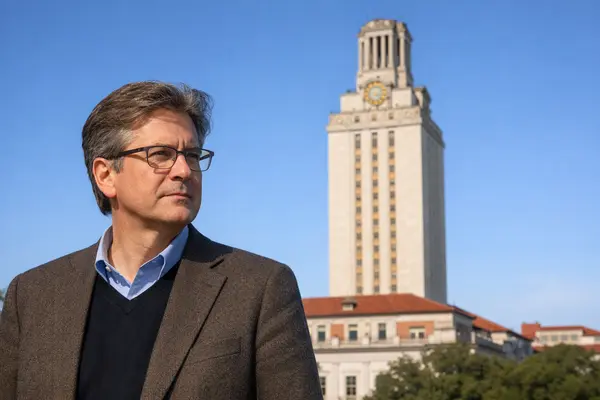
The point, Speck suggested, is not that the Tower is failing. The point is that endurance is not passive. Even the most carefully constructed buildings demand periodic reinvestment—especially those that function as public symbols. The Tower’s familiarity can make it easy to forget it is also a complex structure, exposed to Texas heat and storms year after year, asked to remain both beautiful and safe, iconic and usable.
University leaders have framed the restoration as a continuation of UT’s core identity—an investment not simply in bricks and stone, but in what the Tower represents when it rises above the campus skyline. “The most iconic symbol of The University of Texas, the Tower represents the long-standing tradition of excellence this great University is known for,” said UT System Board of Regents Chairman Kevin P. Eltife in [UT Press Materials](turn1search6).
UT President Jay Hartzell has tied the Tower’s upkeep to the university’s founding audacity. “Our Tower was built as a sign of audacity and a young university’s aspirations for excellence. Nearly a century later, we have those same characteristics. The Tower represents what is possible for a world-class university that is committed to creating knowledge and teaching tomorrow’s leaders to change the world,” said Hartzell in the same [UT Press Materials](turn1search6).
Those statements land differently when heard beneath the building itself—when the Tower is not a logo but a presence. On its 89th birthday, it stood as evidence of what earlier Longhorns chose to build, and what today’s Longhorns are choosing to preserve.
Outside the campus, Austin continues to change in ways that make the Tower’s steadiness feel even more pronounced. Population shifts, housing pressures, job-market turns—these forces reshape the city’s neighborhoods and commutes, its sense of who is arriving and who can afford to stay. City demographer Lila Valencia has described the mechanics of that change with a precision that cuts through the mythology of endless growth. “When we look at these components of change, what we’re seeing is pretty much stability in natural change, or births minus deaths, but we’re seeing big differences in migration,” Valencia said in reports and interviews cited by [City Demography Reports](turn1search0).
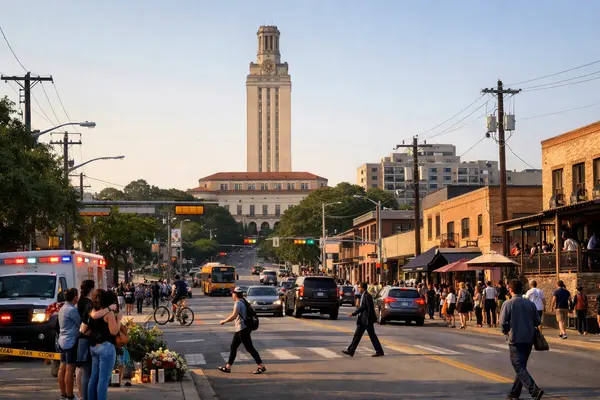
Valencia has also connected those migration patterns to the economy. “Domestic migration is often tied to economic issues, and we have seen that there has been slower job growth in the Austin area as well,” she said. [City Demography Reports](turn1search0)
In that context—a city recalibrating, a region negotiating what comes next—the UT Tower reads as more than campus architecture. It becomes a kind of civic punctuation mark, a structure that has watched Austin cycle through booms and reinventions and still returns, day after day, to the same essential task: marking a place where learning is supposed to happen.
That’s why an anniversary ceremony can feel both small and immense. A birthday song played from a carillon is, on paper, a modest gesture. So is a time capsule filled with catalogs and signatures and newspapers. Yet together, they reflect a quiet confidence: the belief that the details of university life are worth preserving, that the past is not just something to admire but something to carry forward intact.
As the last notes faded on the Forty Acres, the crowd did what crowds always do—they dispersed back into the motion of the day, into classes and meetings and work, into the ordinary hours that make up a university’s real life. The Tower remained, as it always does, holding the sky above the campus and the campus’s stories inside it.
The Main Building and Tower were born in 1937 out of an ambition large enough to justify a skyscraper’s silhouette on a Texas campus. At 89, they stand at the intersection of that original daring and today’s responsibility to protect what daring created. The restoration underway is a promise that the Tower will keep ringing—through celebrations, through commencements, through whatever Austin becomes next—so future Longhorns can look up, hear the bells, and recognize the sound of a place that has been waiting for them all along.